
Post-Brex Ramp vs Mercury
 Jan-Erik Asplund
TL;DR: While Ramp and Mercury are converging on product with treasury, bank accounts, corporate cards & expense management, they’re diverging on their approach to the infrastructure layer, with Mercury applying for a national bank charter and Ramp keeping its focus exclusively on SaaS & AI. For more, check out our full reports on Ramp (dataset) and Mercury (dataset).
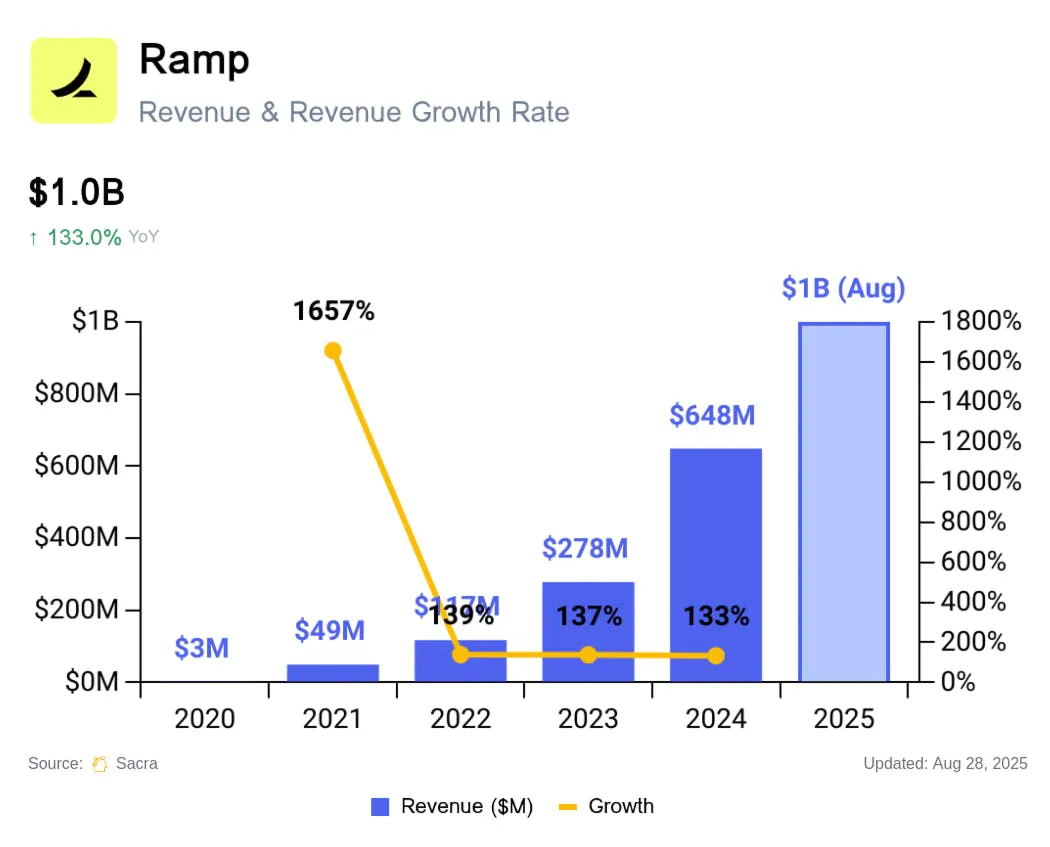
We’ve covered Ramp (June 2023, January 2024, August 2025) as a corporate card business through to its transition into a software & AI business, and we followed up with interviews of co-founder & CTO Karim Atiyeh about the Ramp way of thinking about infrastructure & product velocity and CPO Geoff Charles about AI & finance.
Key points from our March 2026 update via Sacra AI:
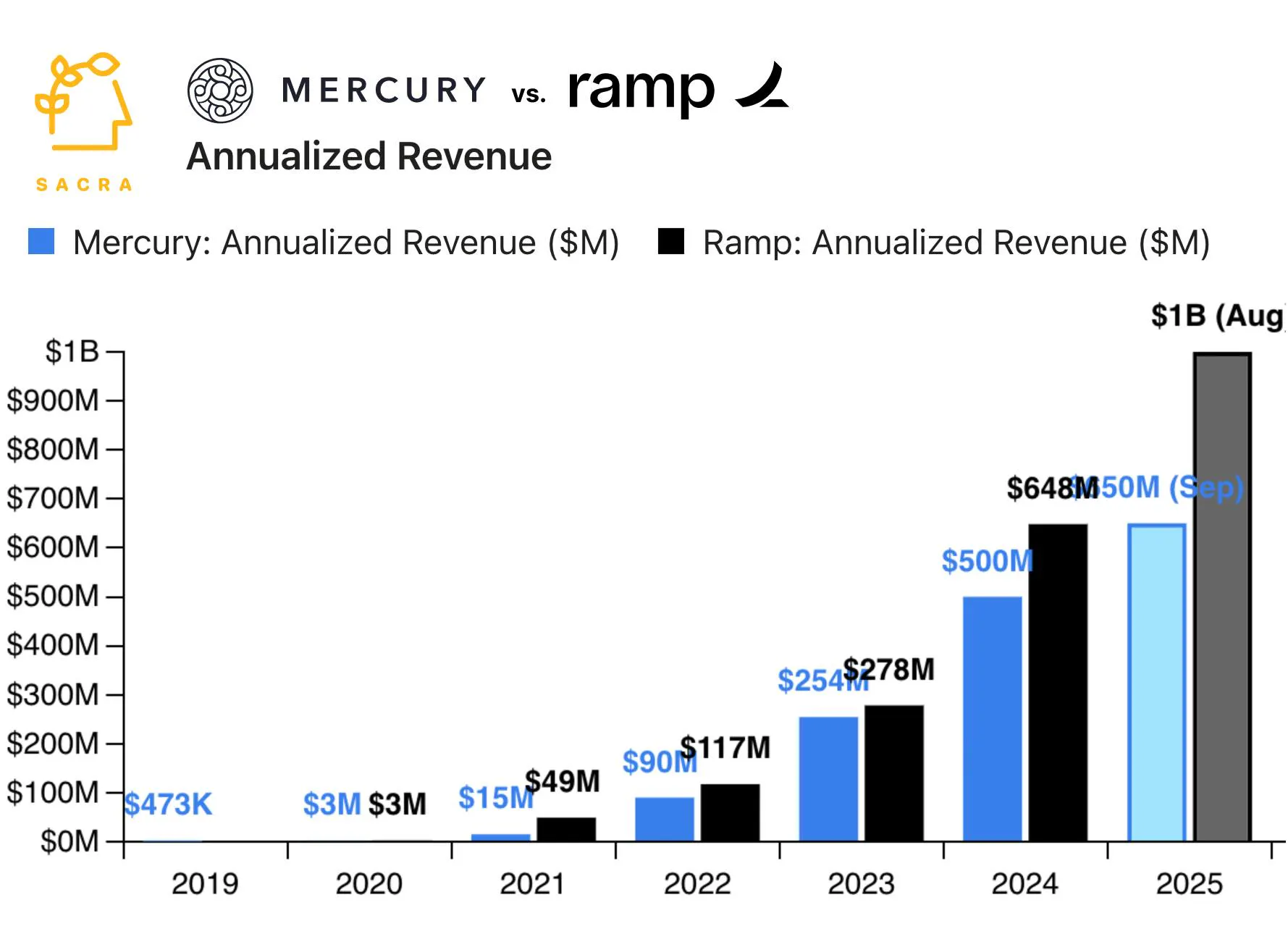
- With Brex's $5.15B exit to Capital One, the private B2B finance landscape is now defined by Ramp at $1B in annualized revenue (up 110% YoY) expanding from cards & expense management into treasury & deposits, versus Mercury at $650M in annualized revenue ($248B transaction volume, up 59% YoY) expanding from startup banking into the finance backoffice with corporate cards, bill pay & expense management. While HR & payroll leader Rippling ($570M ARR in February 2025, up 52% YoY) offers corporate cards and has pushed into the finance back office with travel, expense management & bill pay, its dogfight with Deel ($1.3B annualized revenue in 2025, up 63% YoY) over domestic & global payroll plus the operationally & people-intensive nature of the payroll business circumscribes its ability to stay aggressive & on the offensive to crossover the payroll / non-payroll expense boundary.
- Mercury has decided to transition from neobank to a bank via its December 2025 application for a national bank charter with the OCC and FDIC deposit insurance, vertically integrating to own its underlying banking infrastructure, particularly after the Synapse bankruptcy (April 2024) froze $200M in customer funds and Evolve Bank's cease-and-desist (June 2024) forced Mercury through a painful account migration to Column ($153M revenue in 2025, up 219% YoY) & Choice Financial Group. With the vast majority of its $650M in annualized revenue derived from interest income on ~$20B in customer deposits, Mercury is already valued like a bank at $3.5B for a 5.4x multiple, in line with chartered digital bank SoFi (NYSE: SOFI) at $22B for a 6x multiple on $3.6B in 2025 revenue and Nubank (NYSE: NU) at $68B for a 4x multiple on its $16.3B in 2025 revenue, meaning a charter improves margins by eliminating partner bank revenue share without compressing the multiple.
- Unlike Mercury & Brex (which built its own card infrastructure), Ramp has chosen to maximize customer-facing product velocity, focus exclusively on the application layer and partner with infrastructure providers like Marqeta & Stripe on card issuing and Increase for banking, betting that it can transform its majority interchange revenue into a software & AI-heavy revenue mix ($100M+ ARR on Ramp Plus & Enterprise by EOY 2025), maintain 100%+ YoY growth rate and meet & surpass its $32B valuation (32x revenue) as a high-growth AI company, not as a fintech or bank. As co-founder & CTO Karim Atiyeh told us in our interview with him in 2023, Ramp looks to partner by identifying “ambitious team[s] that [are] moving very fast, where the product roadmaps [are] aligned” and build long-term vendor relationships with asymmetric upside potential, such that a partnership can give both companies a durable competitive advantage by working together.
For more, check out this other research from our platform:
- Ramp (dataset)
- Brex (dataset)
- Rippling (dataset)
- Mercury (dataset)
- Karim Atiyeh, co-founder and CTO of Ramp, on the future of the card issuing market
- Geoff Charles, VP of Product at Ramp, on Ramp's AI flywheel
- Ramp passes Brex
- Ramp's LLM workflow
- Art Levy, Chief Business Officer at Brex, on the strategy of Brex Embedded
- Bo Jiang, co-founder and CEO of Lithic, on the key primitives in card issuing
- Dan Westgarth, COO of Deel, on the global payroll opportunity
- Immad Akhund, CEO of Mercury, on the business models of fintechs vs. banks
- Andrew Hoag, CEO of Teampay on building expense management for the enterprise
Read more from
Ramp at $1B/year


The hyperscaler employee experience