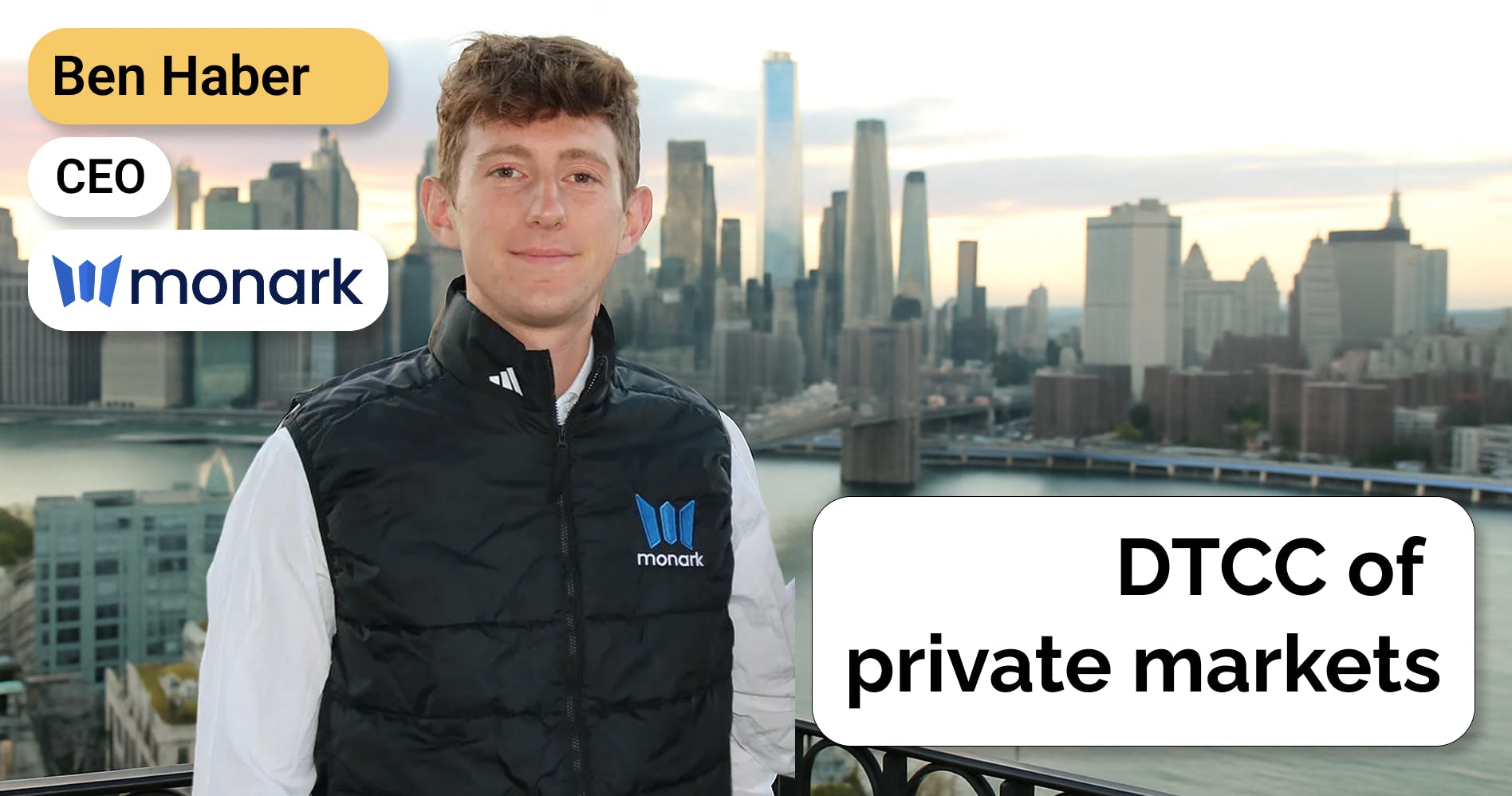
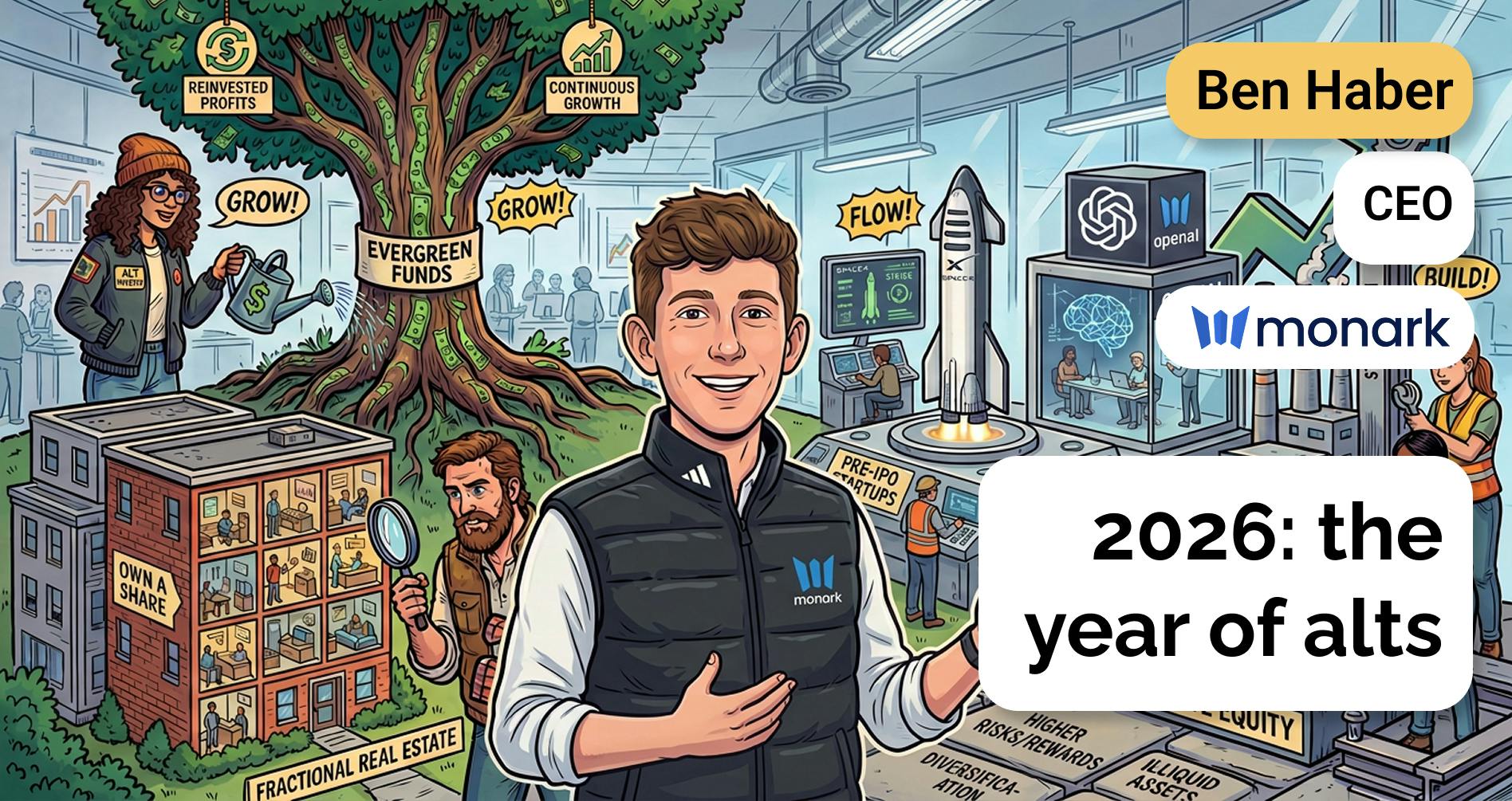
Ben Haber, CEO of Monark, on why 2026 is the year of alts
 Jan-Erik Asplund
Background
We first spoke with Monark CEO & co-founder Ben Haber in August 2025 about how brokerages were adding private assets as a new high-margin revenue line.
We followed up with Ben on the occasion of Monark's $8.1M seed round, led by F-Prime, to learn what's changed and where Monark is headed next.
Key points from our conversation via Sacra AI:
- Schwab's acquisition of Forge, Morgan Stanley's acquisition of EquityZen, and Goldman Sachs's acquisition of Industry Ventures have validated the thesis that incumbent wealth and brokerage platforms see private markets as a core growth vector, creating demand for B2B infrastructure companies like Monark (pre-IPO), Alpaca (crypto), and iCapital (private credit) that can standardize the backend for the long tail of brokerages and RIAs entering the space. "Our partnerships with Apex, BBAE, and Vested have started to prove that there is real demand from existing retail brokerage firms to access private markets. Going back to our core thesis: these firms already own the customer relationship, they have assets and eyeballs on their platforms, and they're great distribution channels for alts... Outside of our control, Schwab's acquisition of Forge, Morgan Stanley's acquisition of EquityZen, and what Robinhood is doing now are further proof points that incumbent distribution platforms are entering private markets."
- Robinhood Ventures is launching as a publicly traded closed-end fund holding private stocks, but such funds have historically struggled to scale—like Destiny (NYSE: DXYZ) Fund at under $500M AUM, ARK Innovation ETF (BATS: ARKK) venture fund at a few hundred million, and Private Shares Fund (NASDAQ: PIIVX) at roughly $1.2B—because retail investors overwhelmingly want single-asset exposure to specific companies like SpaceX or Anthropic, not diversified baskets that inevitably trade at a discount or premium to NAV. "The product structure, a publicly traded closed-end fund holding private stock, isn't new. It's essentially the same as the Destiny Fund, and it's inevitable that it will trade at either a discount or a premium to NAV. What we're seeing with Monark and our clients is that the real demand is for single-asset exposure. Investors are saying, 'I want to invest in SpaceX' or 'I want to invest in Anthropic'."
- Beyond single-stock pre-IPO SPVs, evergreen fund distribution is emerging as the next major driver of private market AUM, particularly in the RIA channel, where advisors are looking to build model portfolios with "alt sleeves" that include private equity, private credit, and venture exposure through funds that continuously raise capital and manage liquidity through redemptions. "We see the evergreen fund space as a big driver of AUM growth in private markets, particularly in the RIA channel. RIAs have demand for pre-IPO, but they're also looking for portfolio diversification beyond single-stock private companies... An easy button to get exposure to private equity or private credit, maybe an SMA that gives exposure to five different evergreen private equity funds or five different evergreen private credit funds."
Questions
- Tell us about this round and the vision behind bringing in strategic investors like F-Prime who deeply understand capital markets.
- What did you prove out with the last round of funding, and what are the milestones you're targeting with this one?
- Given the major acquisitions in the space, Schwab/Forge, Morgan Stanley/EquityZen, Goldman Sachs/Industry Ventures, some might argue that Monark's model depends on fragmentation persisting among brokerages and wealth management platforms. How do you think about that?
- How do you see Robinhood's private markets play, as a potential customer, competitor, or some mixture of both?
- Who is the prototypical person you're trying to attract to private markets investing, an older millennial with more assets and a financial advisor, or a younger investor more open to novel investment types but with less capital?
- With prediction markets becoming a massive trend, Kalshi running Super Bowl ads and Polymarket becoming huge, do you see them as a net positive for Monark by broadening people's appetite for investing outside of public markets?
- EquityZen and Augment have express deal structures where they pre-purchase the underlying supply to enable much faster buying and selling. Is that something Monark is exploring?
- Do you see the third-party manager and human advisor side of the platform eventually becoming more automated, or does it remain high-touch long-term?
- Do you see robo-advisors like Wealthfront and Betterment eventually entering private markets?
- Since we last spoke, the House has been debating bills to expand the definition of qualifying VC funds and the number of investors who can participate. How has the regulatory landscape evolved in 2026?
- As a first-time venture-backed founder navigating long enterprise B2B sales cycles with heavy compliance and legal overhead, how do you keep momentum going, operationally and psychologically?
Interview
Tell us about this round and the vision behind bringing in strategic investors like F-Prime who deeply understand capital markets.
We're super excited and really humbled by the investors who came into this round. Going into the fundraise, we were very focused on finding the right strategic investors. One thing I've noticed across the venture capital ecosystem is that there aren't many VCs that deeply understand capital markets the way F-Prime, Treasury, Commerce, and the other investors in this round do. As a first-time venture-backed founder, working with investors who truly understand our space and can add real strategic value was a priority.
David Jegen at F-Prime is someone I've looked up to in this space since we started Monark three years ago. I've known him for about two years, and he was one of the top investors on our list to lead the round. We're super excited they decided to participate. I can't speak to the potential strategic alignment with Fidelity at this point, but we certainly see them as a potential partner we'd be thrilled to work with.
Treasury is also worth touching on. Eli Broverman was co-founder of Betterment, and I've known the Treasury team for a very long time. We're thrilled they got conviction on the round. They're also very deeply connected with a lot of our potential and existing clients in the space, so we see a lot of value there.
The last thing worth noting is BBAE. They're actually one of our live customers, a retail brokerage firm we've already done a few pre-IPO offerings with, and we're seeing real traction. Higher net-worth investors are joining their platform to access pre-IPO investments, average account sizes are going up, AUM is coming onto the platform, and existing clients are bringing more of their wallet share into the BBAE ecosystem. They were super excited to participate as a strategic investor, and we're thrilled to be working with them.
What did you prove out with the last round of funding, and what are the milestones you're targeting with this one?
With the last round, we were very early, and the real proof point we were going after was demonstrating there was demand from retail brokerage firms and wealth management platforms to enter private markets. A year and a half ago, that was far from clear. Our partnerships with Apex, Viewtrade, BBAE, and Vested have started to prove that there is real demand from existing retail brokerage firms. Going back to our core thesis: these firms already own the customer relationship, they have assets and eyeballs on their platforms, and they're great distribution channels for alts. That was the biggest proof point from the last round.
Outside of our control, Schwab's acquisition of Forge, Morgan Stanley's acquisition of EquityZen, and what Robinhood is doing now are further proof points that incumbent distribution platforms are entering private markets. We proved some of it, and the market proved some of it simultaneously.
This next phase of growth is really about a few things. First, continuing to expand distribution. There's a lot more ground to cover, and many brokerage and wealth management platforms still aren't plugged into private markets. Second, going deeper on supply. Pre-IPO is the first business line we launched, but we're launching an evergreen fund platform in a couple of weeks with our first partner there. We see the evergreen fund space as a big driver of AUM growth in private markets, particularly in the RIA channel. RIAs have demand for Pre-IPO, but they're also looking to create portfolio diversification beyond single-stock private companies. Third, going deeper with our partners around content creation, education, and marketing, really leaning into how we tell the story of private markets.
We have a unique distribution strategy in that we don't face end consumers or advisors directly, but that actually gives us more scale. The content and educational materials we create can be distributed broadly through our partners, reaching a lot more people and helping to tell the narrative of why you should be invested in private markets, what areas might be interesting for your portfolio, and where the optimism is. There's a lot more optimism in private markets than in public markets right now.
Given the major acquisitions in the space, Schwab/Forge, Morgan Stanley/EquityZen, Goldman Sachs/Industry Ventures, some might argue that Monark's model depends on fragmentation persisting among brokerages and wealth management platforms. How do you think about that?
The platforms evolve. You've seen this in public markets over the last 15 years. A platform like Robinhood pops up serving a specific client base, Betterment serves a slightly different one, and then you have legacy platforms like Morgan Stanley that are deeply ingrained in how an older generation manages wealth. In terms of distribution platforms, there will always be multiple points of distribution. There will be periods of consolidation and periods where more platforms emerge. We might also see AI-native versions of self-directed brokerages with better user experiences come to life over the next few years.
From our perspective, our model is similar to what businesses like Apex or the large clearing houses, Pershing, Fidelity, Schwab, do in public markets: consolidate as many RIAs and retail brokerage firms as possible and standardize the backend systems they use to access public markets. That is very much the model we see Monark serving for access to private markets with those same distribution platforms. It's a necessary function, it creates a healthier market, standardizes processes, and helps drive down costs. The central standardizing function for brokerage firms and RIAs accessing private markets hasn't historically existed, and that's the huge opportunity we see Monark filling.
How do you see Robinhood's private markets play, as a potential customer, competitor, or some mixture of both?
A couple of things. First, it's very positive that Robinhood is out there telling the story of private market access. That's good for retail investors regardless of the structure Robinhood uses or who they partner with. Everyone benefits, including us.
That said, Robinhood’s journey into private markets has been a winding path. They tried tokenization in Europe, which hasn't taken off. There are a lot of questions from regulators around whether that derivative product structure is healthy for the market. Republic in the US has tried a similar version with mixed success. Neither product has seen real scale.
Now Robinhood is launching Robinhood Ventures, I believe next week. I'm super excited about it because it'll be a strong indicator of retail demand for private markets in general. The product structure, a publicly traded closed-end fund holding private stock, isn't new. It's essentially the same as the Destiny Fund, and it's inevitable that it will trade at either a discount or a premium to NAV. What we're seeing with Monark and our clients is that the real demand is for single-asset exposure. Investors are saying, "I want to invest in SpaceX" or "I want to invest in Anthropic." There's less demand for a basket of private companies. You see that reflected in AUM numbers: the Destiny Fund, a publicly traded closed-end fund, I don't think has topped $500 million in AUM. ARK Invest's publicly traded venture fund is maybe a couple hundred million. Private Shares Fund, a diversified basket of 100 companies, is the largest in the space at about $1.2 billion. Those numbers aren't huge in relative terms.
Robinhood will generate a ton of demand for their product. They're very good at that, and it'll probably trade at a premium for some period of time. But is it the best structure for investors to access private markets? I don't think so. We'll see whether Robinhood continues launching closed-end funds or eventually looks to enter the single-asset SPV space. We'd love to support them in doing that. Overall, it's a positive signal for the market that they're spending so much time focused on private markets.
Who is the prototypical person you're trying to attract to private markets investing, an older millennial with more assets and a financial advisor, or a younger investor more open to novel investment types but with less capital?
It's both. Everyone should have some exposure to private markets. How much varies based on wealth, risk tolerance, and investment horizon, but everyone should have some allocation to alts. What you choose to invest in within alts, which is a massive world of many different asset classes, may differ based on age, preferences, and risk tolerance.
Some studies have shown that younger generations have more of a proclivity to invest in private markets and alternatives generally. We've seen much more crypto adoption from younger generations, and I think we'll see similar trends as private markets become more accessible. Maybe older investors are more interested in stable, long-duration products like infrastructure or private credit funds, while younger investors are more interested in single-stock exposure to a SpaceX or an OpenAI. But that doesn't mean older investors won't also invest in SpaceX.
The deeper question is: why private markets at all? My thesis is that public markets have become trading markets. I know people who will buy a stock without even knowing the company's valuation. They're just analyzing whether the stock price might go up or down, with no consideration of what the company is actually worth. Public markets are, for a lot of people, about where you can get out. It's a trading mentality. Private markets, by contrast, are about investing. They're about owning something that you believe in, taking a long-term bet on the future, not just because there's less liquidity, but because these businesses don't have to beat the next quarterly earnings. They can take long-duration bets: building data centers in space, creating AI labs that will change the entire world. Private markets are more about betting on the future than public markets are today.
With prediction markets becoming a massive trend, Kalshi running Super Bowl ads and Polymarket becoming huge, do you see them as a net positive for Monark by broadening people's appetite for investing outside of public markets?
Personally I think prediction markets are really cool. I don't personally trade them much, but I find them interesting. The most interesting thing is that they're introducing a broader set of people to what is effectively a version of betting. The market dynamics are different. You can trade in and out, you're not necessarily betting against the house. So there are clear differences from a traditional sportsbook.
Howard Lindzon, founder of StockTwits, talks about being on Robinhood during the Super Bowl, betting on their prediction market. He said he's never bet on sports before in his life. He represents an older generation being brought into a new market. Kalshi and Polymarket have done an amazing job of bringing more people into prediction markets who traditionally wouldn't have bet on a sports game.
That said, I see making a prediction market trade as a fairly pessimistic action. It's not really a bet on the future the way investing in private markets is. Investing in SpaceX, saying "I believe this company is going to change the world," is a very different use of capital than betting on whether someone shows up at the State of the Union. A prediction market trade is an all-or-nothing short-term bet on a specific outcome. It's much less likely that a company like SpaceX at this point goes bankrupt and you lose everything. So I don't necessarily see prediction markets as a step into private markets or as something driving people toward alternatives. They reflect a very different vision of society, one very short-term in nature, asking "how do I make money fast and get a quick hit of dopamine?" versus investing in the future, putting money behind something you believe in, which creates much more long-term optimism and participation in whatever the future holds.
EquityZen and Augment have express deal structures where they pre-purchase the underlying supply to enable much faster buying and selling. Is that something Monark is exploring?
Monark's model is a bit different from traditional pre-IPO trading platforms. We don't do any high-touch trading or matching of buyers and sellers in the open market. We will launch our ATS this year to facilitate trading of SPV interests issued through our platform, giving investors access to secondary market liquidity. But that will be reserved exclusively for SPVs within our ecosystem, where we can match and settle trades at T+1 rather than the long settlement cycles you see on a platform like Hiive or Forge.
For all of our deals, when we do SPV offerings through our partner brokerage platforms, we are securing the underlying supply and in some cases pre-funding or warehousing that supply. That's something we've already been doing, using balance sheet capital or partner balance sheet capital to ensure the underlying deal is secure even if the SPV takes a little longer to fundraise. We're leaning into that more this year. We're having interesting conversations now with hedge fund-type trading firms that see an opportunity in providing capital to pre-fund these transactions, putting up capital for a week or two to ensure the SPV owns the underlying stock before going out to investors, in exchange for a small return.
That's the right model. We've seen Augment do it well for a long time using balance sheet capital, and it's absolutely the best user experience for the end investor. Nobody wants to invest in an SPV only to find out it doesn't own the underlying stock or couldn't raise enough capital to close. Warehousing and balance sheet pre-funding capacity is an important part of creating a standardized investing experience in the pre-IPO space.
Do you see the third-party manager and human advisor side of the platform eventually becoming more automated, or does it remain high-touch long-term?
There will certainly continue to be some version of high-touch trading in the pre-IPO space for the next few years. It just won't happen within the Monark ecosystem. Everything we do is tech-enabled. Every SPV created has to go through our systems. We're also expanding our fund administration relationships to support SPVs beyond our first fund admin partner, and we want to enable managers creating SPVs on other fund admins to also distribute through Monark.
Keeping the SPV model is really important because if you're not transacting through an SPV, especially if you're going direct to cap table, you have to deal with the companies directly, and they can block or defer transactions. That's not a great user experience.
What this model has allowed us to do is keep our costs super low, which means we can pour more resources into building out this market: making our clients' marketplaces the best experience possible for their users, creating educational content, deepening supply-side relationships, and allowing third-party SPV managers to distribute through our platform. We don't have a team of high-touch brokers manually facilitating transactions, which is an arduous process that often doesn't even result in a completed transaction. That model just isn't the most efficient one for the space, but it'll take a while for those types of players to phase out.
Do you see robo-advisors like Wealthfront and Betterment eventually entering private markets?
Definitely, though how fast I'm not sure. In the RIA channel, we're also working on the concept of model portfolios that include alts: an easy button to get exposure to private equity or private credit, maybe an SMA that gives exposure to five different evergreen private equity funds or five different evergreen private credit funds. Those are the kinds of product innovations you can make in the evergreen fund space because these funds are consistently raising capital and can manage liquidity through redemptions. You can create alt sleeves and include different alt products within traditional model portfolios. The same applies to robo-advisors. Including an evergreen fund or even pre-IPO exposure achieves the same thing.
There's a broad recognition across the advisor space, including robo-advisors, that providing exposure to alts is necessary and an important part of their growth and their customers' portfolio growth. 2026 is the year of alts. You're already seeing a lot of activity, and we'll continue to see more platforms enter private markets, hopefully by partnering with Monark.
Since we last spoke, the House has been debating bills to expand the definition of qualifying VC funds and the number of investors who can participate. How has the regulatory landscape evolved in 2026?
The two or three different bills in the House were consolidated into one and passed at the end of last year, the INVEST Act. It included changes to SPV rules to expand the number of investors, I believe to 500. It changed the definition of a qualifying venture capital fund to be more inclusive of secondaries and fund of fund investments, which is really impactful for the SPV space. And it directed the SEC to create a test to become an accredited investor, more of a merit-based system than the current wealth-based system, which I think is positive for the vast majority of the country that isn't currently accredited.
The bill is now being debated in the Senate. It had great bipartisan support in the House, and I think it's likely to pass, hopefully before the midterms. The Trump administration has been very much on the side of broadening investor access to capital markets, so there's likely support in the White House as well. Hopefully we see some meaningful regulatory change later this year.
As a first-time venture-backed founder navigating long enterprise B2B sales cycles with heavy compliance and legal overhead, how do you keep momentum going, operationally and psychologically?
We have definitely had very long sales cycles. Some of our first partners took two-plus years to find the right timing to work with us. But that's changing. The market has shifted, there's a lot more demand and excitement around private markets today, and we're seeing those sales cycles come down significantly, now more in the range of months, and moving toward weeks.
Longer sales cycles in fintech has a positive side as well. The fact that there's a long due diligence process even after partners decide to work with us is positive and goes both ways. We need to make sure our partners are adhering to proper KYC and AML procedures, and they need to make sure we have the right compliance systems and data privacy protections in place. A slightly slower sales cycle in fintech is ultimately a good thing and protects investors.
Internally, we've been building strong momentum for two years, so maybe we've just gotten used to things taking a little longer in B2B sales. Now that things are moving faster than they were six to eight months ago, it genuinely feels fast and exciting. Maybe we've just recalibrated our sense of pace.
The other thing I've really come to appreciate is the relationships you build along the way. I've made real friends at our partner platforms, people I genuinely enjoy talking to, thinking through markets with, and working alongside. There's something positive about things taking a little longer: you get to really know the people you're working with, build deep trust, and have some fun along the way.
Disclaimers
This transcript is for information purposes only and does not constitute advice of any type or trade recommendation and should not form the basis of any investment decision. Sacra accepts no liability for the transcript or for any errors, omissions or inaccuracies in respect of it. The views of the experts expressed in the transcript are those of the experts and they are not endorsed by, nor do they represent the opinion of Sacra. Sacra reserves all copyright, intellectual property rights in the transcript. Any modification, copying, displaying, distributing, transmitting, publishing, licensing, creating derivative works from, or selling any transcript is strictly prohibited.