$100M/year Harvey for the rest of the world
 Jan-Erik Asplund
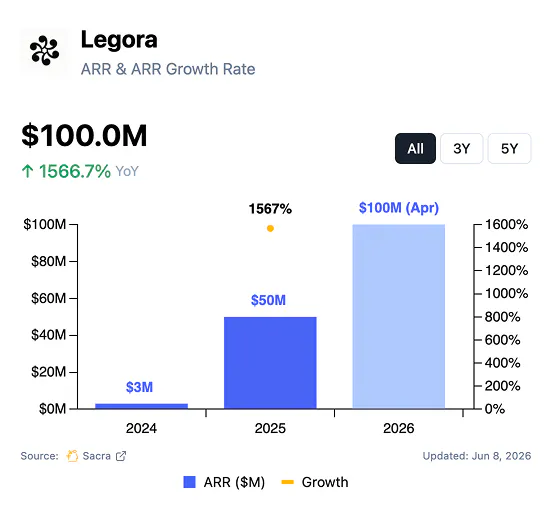
TL;DR: Where Harvey fine-tuned proprietary models, Stockholm-based Legora built on top of frontier models, selling in Europe before expanding into the US. As the legal AI market fragments across types & areas of practice, firms are now contracting with both Harvey & Legora and hot-swapping seats between lawyers across projects. Sacra estimates Legora hit $100M ARR in April 2026, valued at $5.6B as of their Series D for a 56x multiple. For more, check out our full report and dataset on Legora.
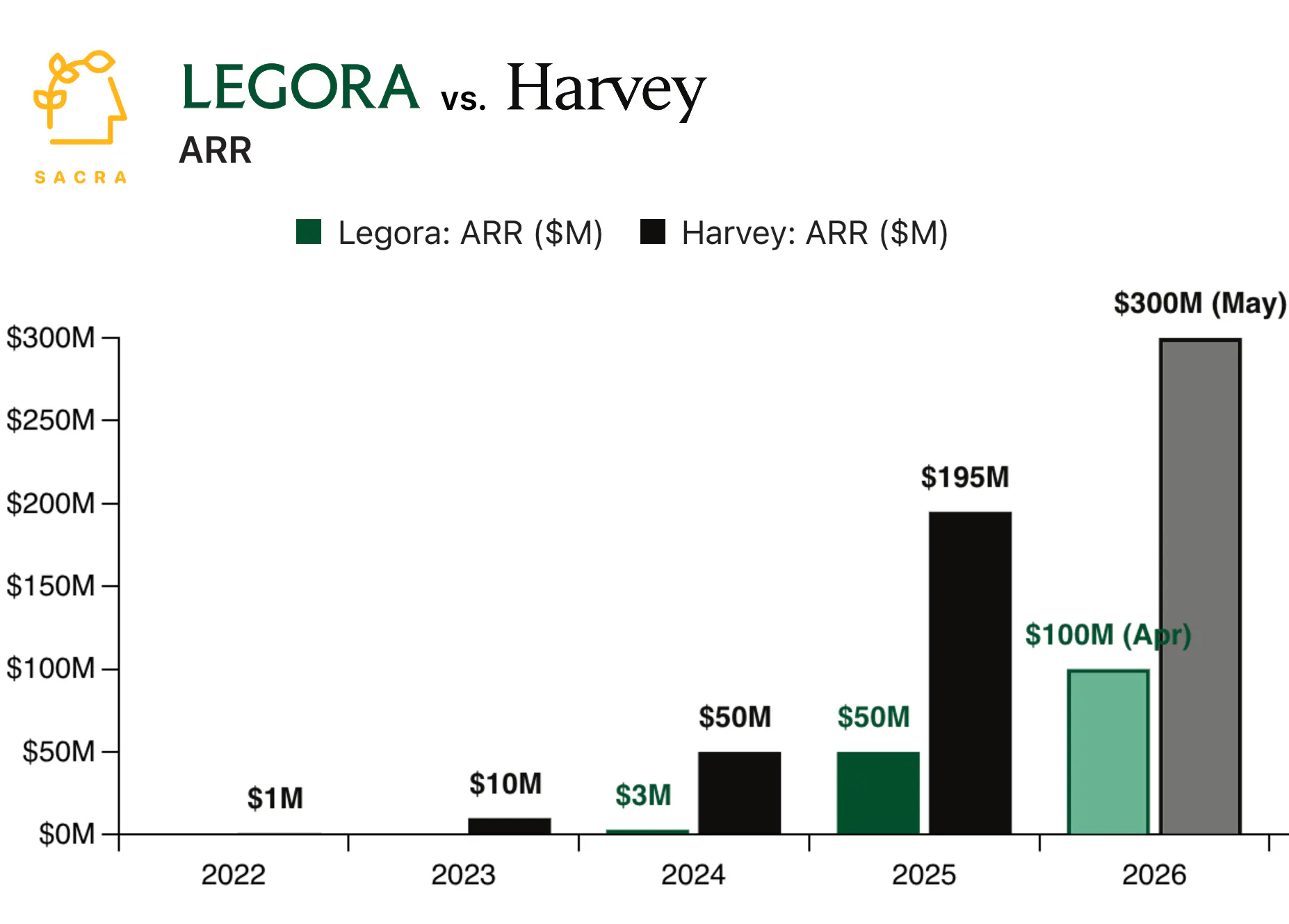
We've covered Harvey (January 2025, June 2025, December 2025, January 2026) as an upstart challenger to Westlaw and LexisNexis's legal tech duopoly at $50M ARR through to its now-$300M ARR.
To learn more about one of the key legal AI platforms challenging Harvey, we researched Legora ($866M raised, Redpoint).
Key points via Sacra AI:
- Where Harvey (2022) launched out of San Francisco fine-tuning its own proprietary legal models, Legora (2023) started inside the Stockholm office of Mannheimer Swartling building a workflow-first legal AI workspace on top of frontier models for tasks like faster M&A due diligence & contract drafting through a Word add-in. Legora initially positioned at ~$250/seat/month ($3K/year, 10-seat minimum) vs. Harvey's ~$1,200/seat/month—roughly one-fifth the price—but aggressive discounting from both sides (six-month terms, as few as 5 licenses) has compressed Legora's average ACV from ~$280K to ~$100K as both race to land into firms with contracts and expand from there.
- After winning European & international firms (Linklaters, White & Case) on EU data residency compliance and then expanding into the US with 5 offices in 12 months, Legora hit $100M ARR in April 2026, up from ~$50M at the end of 2025 (+1,567% YoY), valued at $5.55B as of their March Series D (Accel) for a ~55x multiple. Compare to Harvey at $300M ARR as of May 2026, up from $195M in 2025 (+290% YoY), valued at $11B as of their Series F for a ~44x multiple, Clio at $500M ARR as of April 2026, up from $433M at the end of 2025 (+84% YoY) valued at $5B valuation as of their $500M Series G in November for a 12.5x multiple, Filevine at $205M ARR in 2025, up 58% YoY from $130M in 2024, valued at $3B as of their September Series E for a ~16x multiple, and Thomson Reuters (NYSE: TRI) at $7.7B in revenue, up 5.4% YoY, valued at $37B for an ~4.8x multiple.
- As legal AI models have given way to workflows & agents, the legal AI market is fragmenting by transactional vs. litigation and specific practice areas across patent prosecution (&AI, PatentWatch), plaintiffs’ litigation (EvenUp, Eve Legal), M&A due diligence (Emma Legal, Marveri), contract drafting & review (Spellbook, Wordsmith) and more. Instead of choosing one vendor and deploying it firmwide, law firms are maintaining optionality by contracting with both Harvey and Legora with licenses that can be hot swapped between lawyers across projects & practice groups to ensure that the seat is active and benefiting from each tool’s relative strengths.
For more, check out this other research from our platform:
- Legora (dataset)
- Healthcare company associate GC on where legal AI products break down
- Legal tech VP of cloud operations on evaluating legal AI tools
- Director of Innovation at large law firm on why firms adopt Harvey over Legora
- Scott Stevenson, CEO of Spellbook, on building Cursor for contracts
- Shubham Datta, VP of Corporate Development at Clio, on Clio's $1B acquisition of vLex
- Harvey at $195M ARR
- Harvey at $150M ARR
- Glean for law
- Harvey at $75M ARR
- Harvey (dataset)
- Clio vs. Filevine
- Clio at $300M/year
- Clio (dataset)