

$20M/year Replit for GCs
 Jan-Erik Asplund
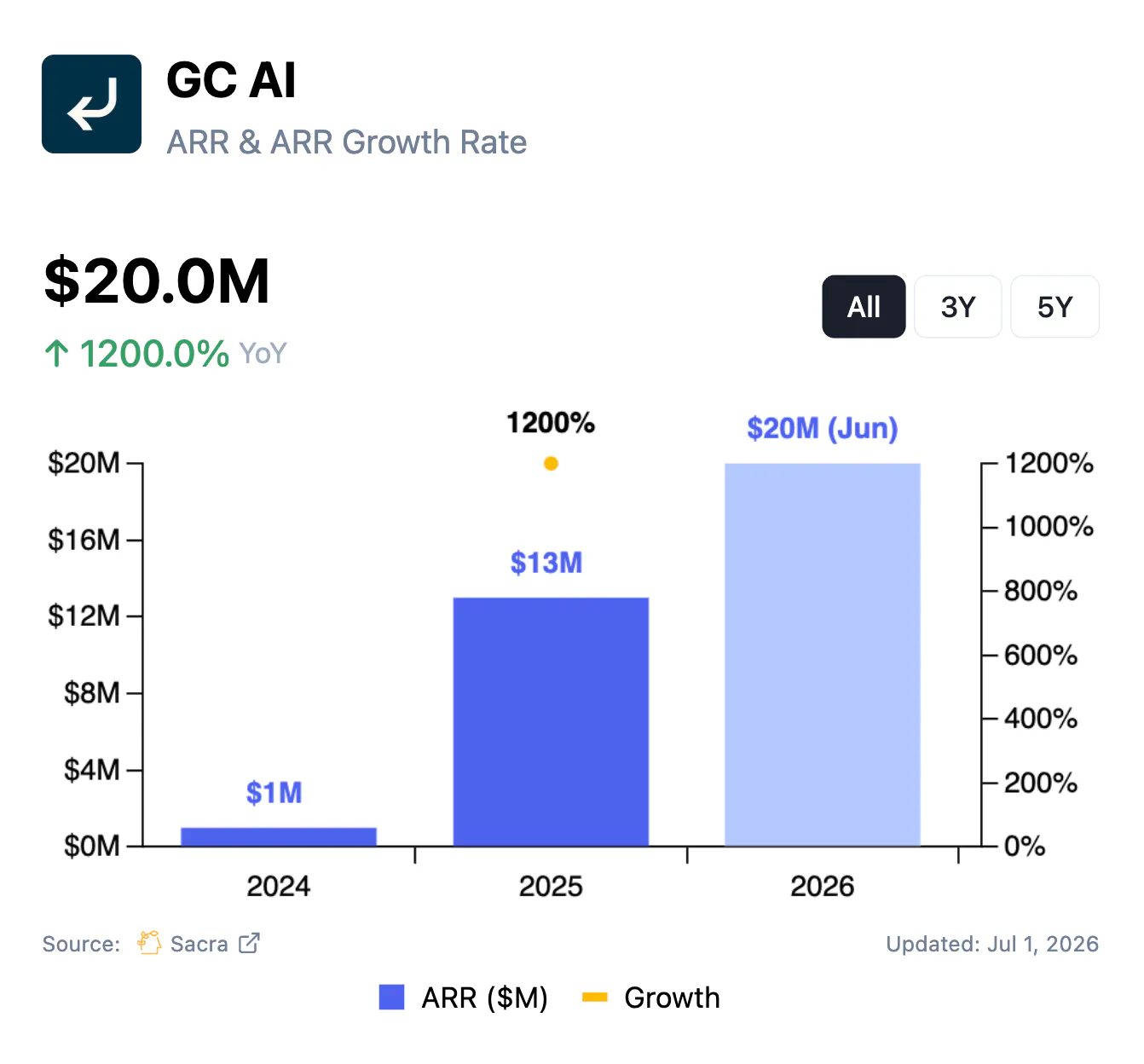
TL;DR: In-house legal AI, via AI workspaces like GC AI and Wordsmith and drafting tools like Spellbook, is emerging as its own major category of legal AI as tools purpose-built for the general counsel's workflow diverge from law-firm-focused platforms. Sacra estimates GC AI hit $20M ARR in June 2026, up from $13M at the end of 2025, valued at $555M as of its November 2025 Series B for a 55.5x multiple. For more, check out our full report and dataset on GC AI.
We've covered legal AI from Harvey (Jan 2026, Dec 2025, Jul 2025, Jan 2025) to Legora (Jun 2026) to Clio (May 2026, Jul 2025) and interviewed the VP of Corporate Development at Clio and the CEO of Spellbook.
To go deeper on the in-house side of legal AI, where Wordsmith, Spellbook, and GC AI are all converging on the general counsel's actual day-to-day workflow rather than the law firm's, we researched GC AI ($73M raised, Scale Venture Partners).
Key points via Sacra AI:
- After serving as founding lawyer on Amazon Alexa (2013) and general counsel at Replit, Cecilia Ziniti launched GC AI (2023) as a ChatGPT focused specifically on in-house counsels to help them draft contracts, create repeatable workflows, and learn how to write better AI prompts. At $500/month, GC AI is priced for the startup GC who can swipe a card and start using it self-serve like Spellbook ($92M raised, Inovia Capital), versus the enterprise-centric Wordsmith ($100M raised, Index Ventures) for your whole in-house team and the 500-attorney firm buying Harvey ($300M ARR, up from $195M in 2025) at $1,000/seat.
- Finding initial traction with solo and fractional GCs at high-growth startups (Liquid Death, Vercel, Snyk) through an education-first go-to-market with 6,000+ lawyers trained via free CLE classes, Sacra estimates that GC AI hit $20M in annual recurring revenue in June 2026, up from $13M at the end of 2025 (+1,200% YoY), valued at $555M as of their Series B for a 55.5x multiple. Compare to Clio at $500M ARR in April 2026, up from $433M at the end of 2025 (+84% YoY), valued at $5B for a ~11.5x multiple, Harvey at $300M ARR in May 2026, up from $195M at the end of 2025 (+290% YoY), valued at $11B for a ~44x multiple, and Legora at $100M ARR in April 2026, up from $50M in 2025 (+1,567% YoY), valued at $5.6B for a 56x multiple.
- In-house legal AI is fragmenting into AI workspaces for the GC's own drafting, research & Q&A (GC AI, Wordsmith, Ruli), contract tools for routine work (Spellbook, SimpleDocs, Ivo) that pull in business users like sales & procurement, and AI-native law firms (Crosby) that let in-house teams outsource that kind of routine work entirely. GC AI is part of a broader pattern of vertical ChatGPTs built around whatever makes a generic chatbot hard to adopt, with Langdock ($25M ARR in March 2026, up from $16M in 2025) wrapping frontier models in GDPR compliance for European enterprises, Adapta wrapping them in courses & consulting for Brazilian SMBs, and GC AI wrapping them in CLE-accredited education for in-house lawyers.
For more, check out this other research from our platform:
- GC AI (dataset)
- Scott Stevenson, CEO of Spellbook, on building Cursor for contracts
- Langdock (dataset)
- $25M/year Glean for the EU
- Glean for law
- Adapta
- Max Peters, CEO of Adapta, on building AI agents for Brazilian SMBs
- Filevine (dataset)
- $250M/year Notion of personal injury litigation
- Legora (dataset)
- $100M/year Harvey for the rest of the world
- Healthcare company associate GC on where legal AI products break down
- Legal tech VP of cloud operations on evaluating legal AI tools
- Director of Innovation at large law firm on why firms adopt Harvey over Legora
- Shubham Datta, VP of Corporate Development at Clio, on Clio's $1B acquisition of vLex


