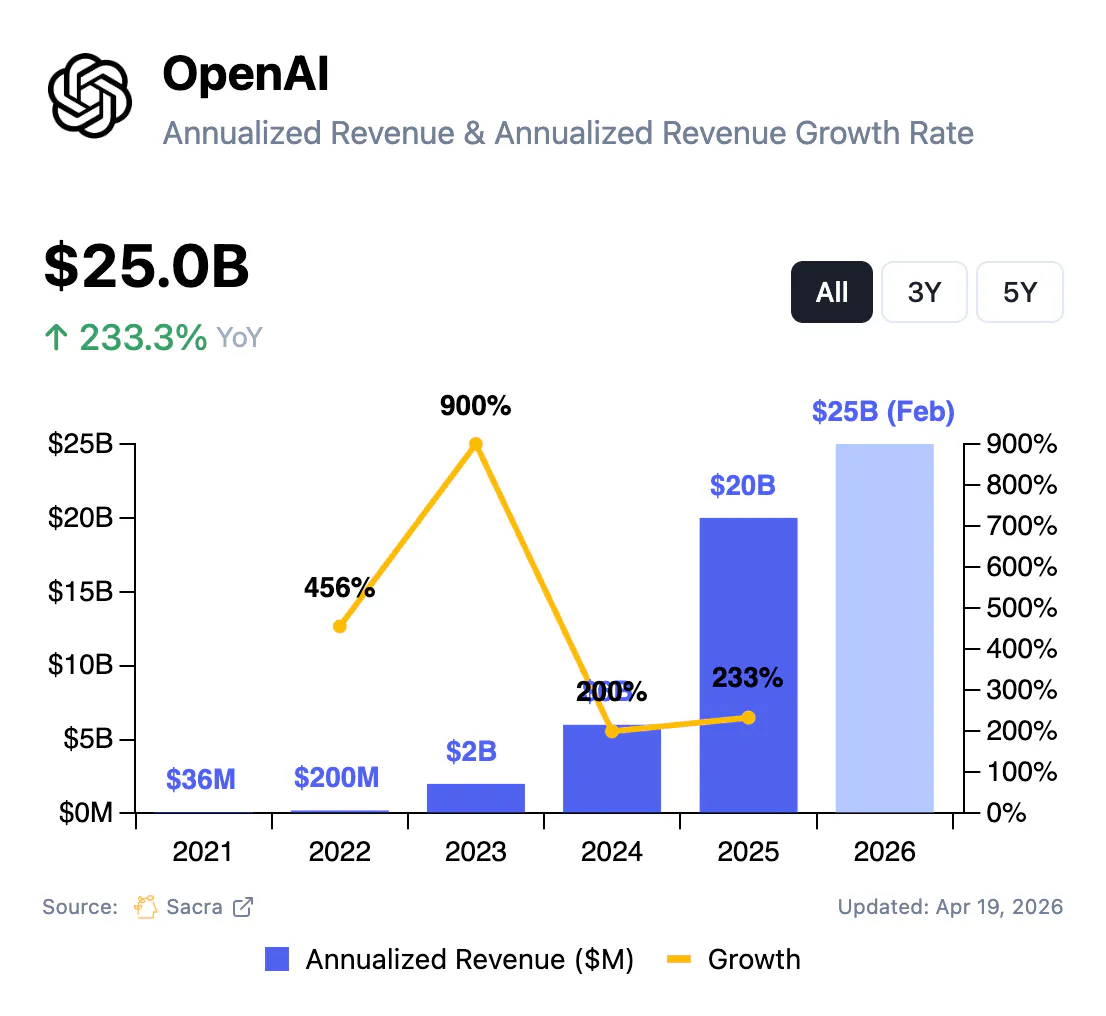
SOTA model nightclub hype cycle
 Jan-Erik Asplund
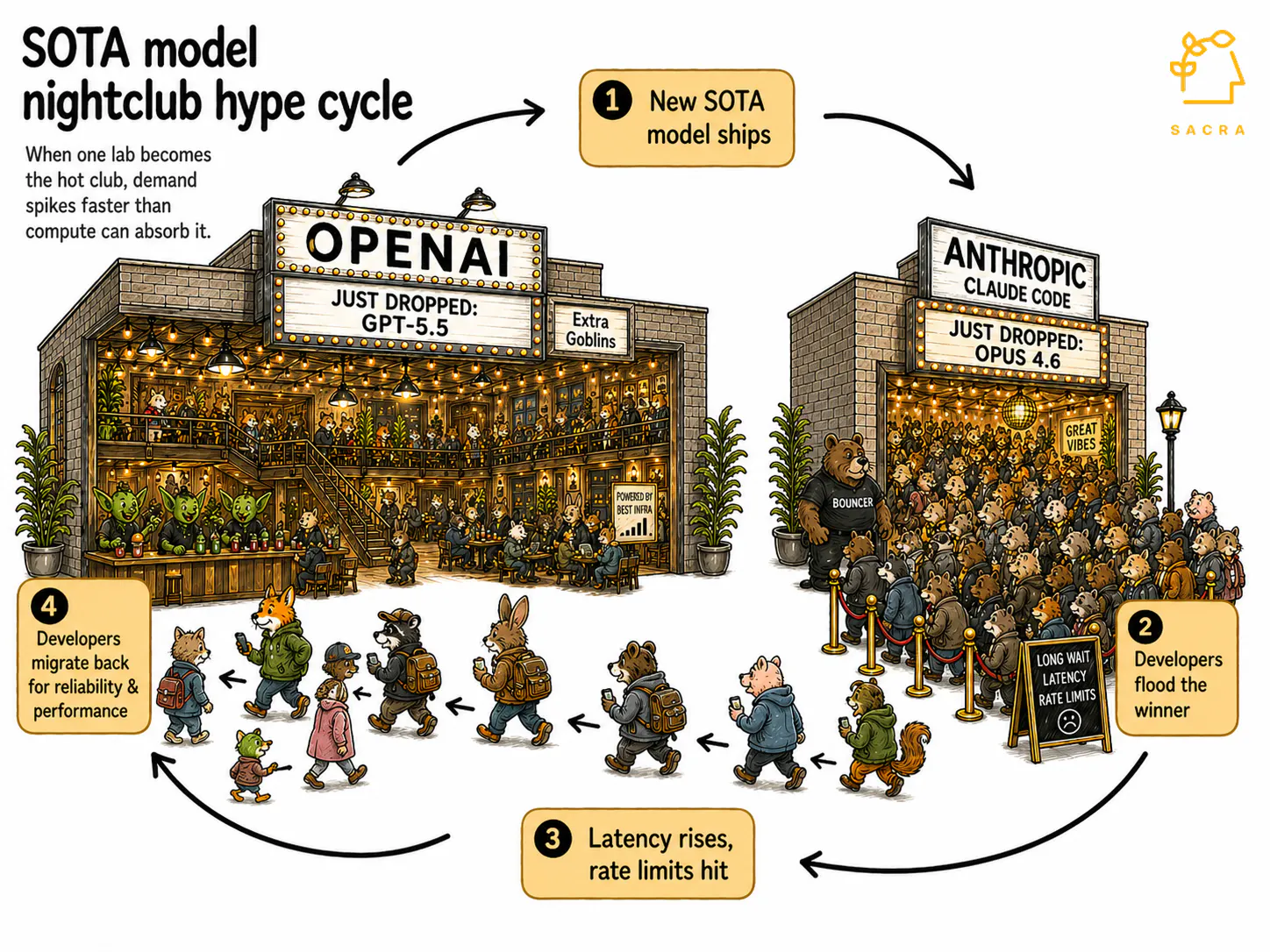
TL;DR: As overwhelming demand for Anthropic's Opus 4.6 led to degraded performance and tighter rate limits, developers are migrating back to OpenAI for GPT-5.5—and unlike past cycles, OpenAI is positioned to absorb the surge with new compute supply lined up & now, the ability to provide its models through AWS and Google Cloud. Sacra estimates OpenAI hit $25B in annualized revenue in February 2026, up from $20B at the end of 2025. For more, check out our full report and dataset on OpenAI.
We’ve covered OpenAI (October 2023, December 2023, October 2024, January 2025, April 2025, August 2025, April 2026) from its early days at $1B in revenue through the boardroom coup, early competition with xAI & Anthropic, its attempt to acquire Windsurf, and most recently, its decision to shut down Sora and reallocate GPUs toward coding and enterprise.
Key points from our April 2026 update via Sacra AI:
- In August 2025, we called Claude Code “Anthropic’s ChatGPT”, which redefined AI coding as agentic coding in the command line interface (CLI) and became the largest AI coding tool at $2.5B in annualized revenue as of February 2026 (50% of revenue from enterprise), up 2x from $1.25B at end of 2025, surpassing both Cursor at $2B in annualized revenue, up 2x from $1B in 2025, and OpenAI's Codex at $1B in January 2026, with Claude Code now responsible for an estimated ~7% of all public & private GitHub commits globally (~1M commits per day). After lagging OpenAI on product velocity through most of 2025, Anthropic surged on the back of using its own AI coding advantage to ship product faster, launching Claude for Excel (October 2025), Claude for PowerPoint (February 2026), and Claude Cowork (January 2026), an agentic, Claude Code-like interface for general knowledge workers with plugins now for finance & investment banking (vs. Hebbia), legal & contract review (vs. Spellbook), and code review (vs. Endor Labs).
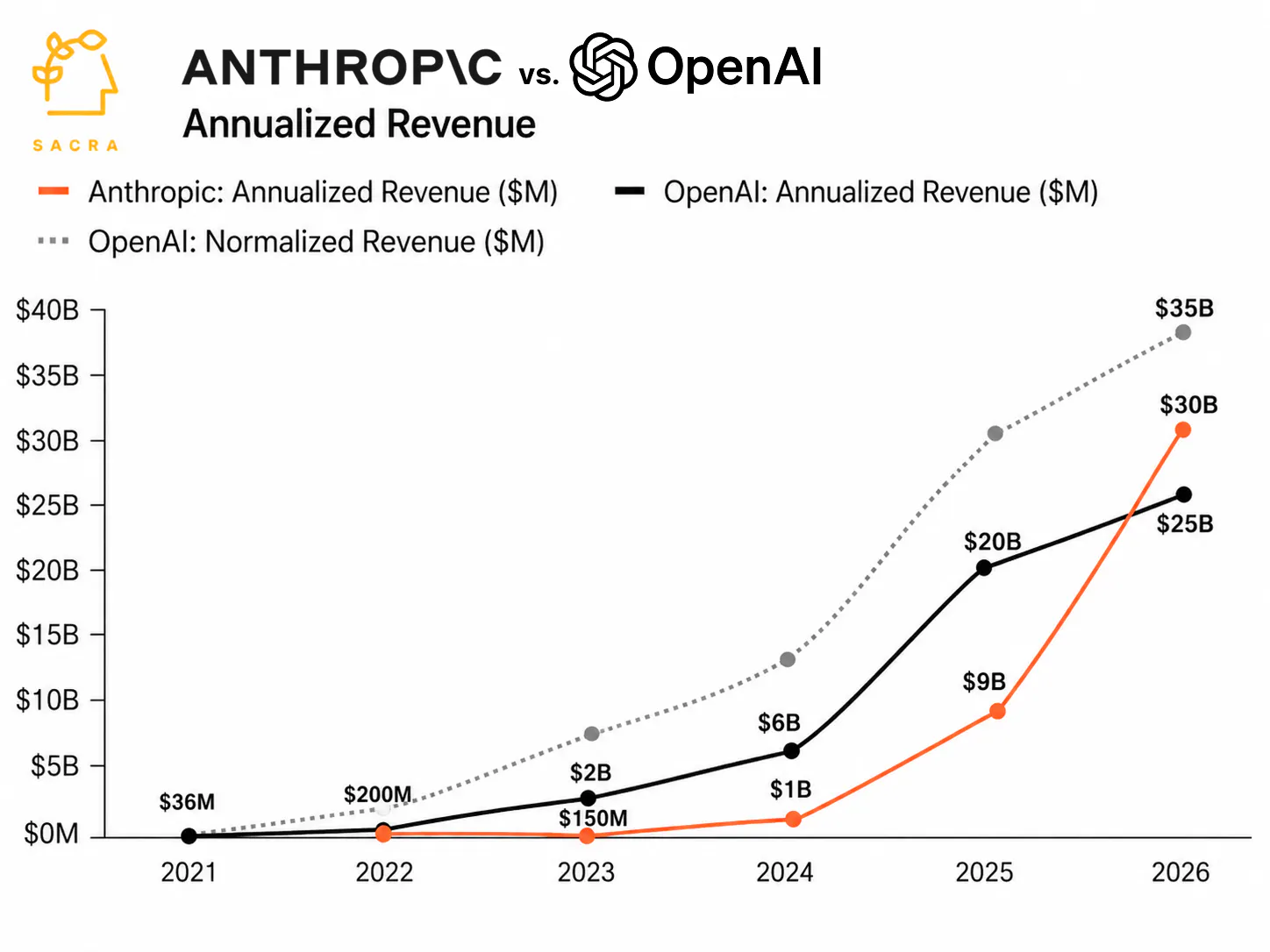
- OpenAI's lead at $20B in annualized revenue (Sacra estimate) over Anthropic at $9B narrowed rapidly in 2026 as OpenAI grew 25% through February to $25B (or ~$35B after grossing up Azure-resold API usage that is reported net of Microsoft’s economics, an estimated 10% of revenue) versus Anthropic which grew 233% through March 2026 alone to ~$30B given agentic coding’s high token intensity and massive revenue expansion dynamics. ChatGPT’s fixed subscription consumer business model lacks expansion and hasn’t meaningfully reflected the revenue opportunity with ads—with OpenAI slower to go after coding but flipping the competitive dynamic and fast following Anthropic with Codex, growing users from 5% of Claude Code's (September 2025) to 40% (January 2026) as Sam Altman called AI coding tools "probably the most likely path to AGI".
- The SOTA model nightclub hype cycle has Anthropic / OpenAI taking the lead at a moment in time with the launch of a top model (most recently, Anthropic’s Opus 4.6) which drives massive demand, creates a line around the block (degraded performance & tighter rate limits given compute scarcity) and causes developer backlash & migration back to the alternative for performance & reliability—a recurring pattern that explains why neither company has been able to separate & have an unmitigated takeoff, dominating like Uber over Lyft. At their last primary marks in March and February respectively, OpenAI at $852B (~24x normalized revenue) traded at a premium to Anthropic at $380B (~12.7x), but that has flipped in the secondary market where Anthropic now trades at $1T+ (~33.3x) vs. OpenAI at ~$880B (~25x), as demand for Anthropic stock peaked in the nightclub hype cycle.
- With compute as the constraint, OpenAI has positioned itself to absorb those demand spikes after lining up new supply from Amazon ($138B contract), Oracle ($300B contract), Nvidia ($100B contract), and Google, while sourcing new chips from Cerebras ($20B inference capacity) and Broadcom & re-negotiating its deal with Microsoft such that it can now serve its models through both AWS & Google Cloudit can now serve its models through both AWS & Google Cloud. OpenAI is greedily expanding compute capacity while simultaneously shutting down expensive side projects like its video generation API & app Sora (burning $15M/day), marking a shift from do-everything AI lab to a coding & enterprise-focused company that is burning the boats & allocating all available GPUs to win as the best model & best AI agent for coding.
- With GPT-5.5 retaking top coding-model benchmarks & developer momentum from Claude Opus 4.6 and Codex growing from 1M weekly users circa March to 4M in April, OpenAI has reclaimed the lead in developer workflows where Anthropic has been dominant since the summer 2024 launch of Sonnet 3.5. Codex’s major April update—adding Computer Use, image generation, desktop control, and web previews—turns it from a coding assistant into a white-collar knowledge work agent interface akin to Claude Code/Cowork, but with the GTM advantage of being bundled into ChatGPT and distributed through GSIs (Accenture, Capgemini, Infosys, PwC, TCS), AWS Bedrock, and OpenAI's enterprise accounts.