OpenAI's side chip
 Jan-Erik Asplund
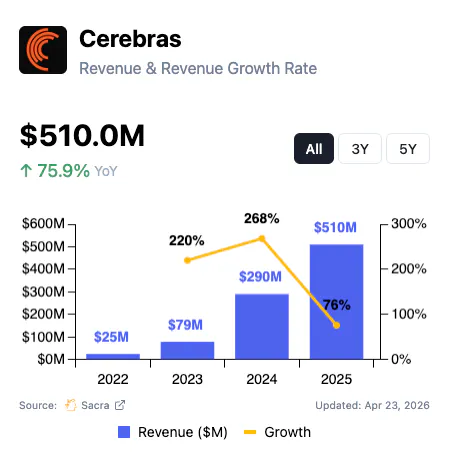
TL;DR: With a new partnership with OpenAI as the company seeks out lower-latency inference than what Nvidia can offer, Cerebras is capturing the latency-sensitive workloads where Nvidia's GPU architecture hits its limits. Sacra estimates Cerebras hit $510M in 2025 revenue, up 76% YoY from $290M in 2024, now targeting a $35B IPO for a ~69x multiple. For more, check out our full report and dataset on Cerebras.
We first covered Cerebras in September 2024 as the chip company was just expanding outside its initial customer base of national labs, pharmaceuticals (GlaxoSmithKline) and energy companies (Total Energies). We followed up in December 2025 as it was selling into AI coding IDEs & agents like Windsurf & Cognition and looking to challenge Nvidia directly as core infrastructure for AI.
After pulling its first IPO attempt in October 2025 amid regulatory scrutiny and G42 revenue concentration concerns, Cerebras refiled in April 2026 with a cleaner story for investors.
Key points from our April 2026 update via Sacra AI:
- Revenue from Cerebras Cloud doubled year-over-year to $152M in 2025, further shifting the company’s revenue mix towards 30% inference, up from 0% in 2023 when the company was purely selling hardware, with its recent growth driven by the rise of coding agents like Claude Code and OpenAI's Codex, which now offers the Cerebras-powered GPT-5.3-Codex-Spark as a near-instant coding assistant (1,000+ tokens per second, 13x faster than GPT-5.5) developers can use to run rapidfire iterations or spin up subagents for codebase exploration or cleanup.
- With Groq's team acquired & technology licensed to Nvidia, Cerebras has become the #1 independent pure-play challenger in AI chips, but unlike Nvidia—which primarily distributes its chips through GPU clouds like CoreWeave ($1.9B revenue in 2024, up 737% YoY) and Crusoe (~$500M ARR)—the vertically integrated Cerebras is solely focused on the latency-sensitive slice of compute demand it expects to grow rapidly as 1) inference overtakes training, and 2) reasoning-heavy, multi-agent workflows proliferate.
- Sacra estimates Cerebras hit $510M in 2025 revenue, up 76% YoY from $290M in 2024, valued at $23B after its February $1B Series H (Tiger Global) for a ~45x revenue multiple, reportedly targeting a $35B IPO (~69x multiple) having offset its 90% G42 revenue concentration issue by signing deals with MBZUAI (78% of revenue in 2025) and now OpenAI and AWS—compared to Groq, which Nvidia effectively acquired for $20B in December 2025 at ~$500M in projected 2025 revenue for a 40x multiple.
For more, check out this other research from our platform:
- Cerebras
- Groq
- Will Bryk, CEO of Exa, on building search for AI agents
- Kyle Corbitt, CEO of OpenPipe, on the future of fine-tuning LLMs
- Together AI: the $44M/year Vercel of generative AI
- Anthropic (dataset)
- OpenAI (dataset)
- Scale (dataset)
- Databricks (dataset)
- Hugging Face (dataset)
- OpenAI vs. Anthropic vs. Cohere