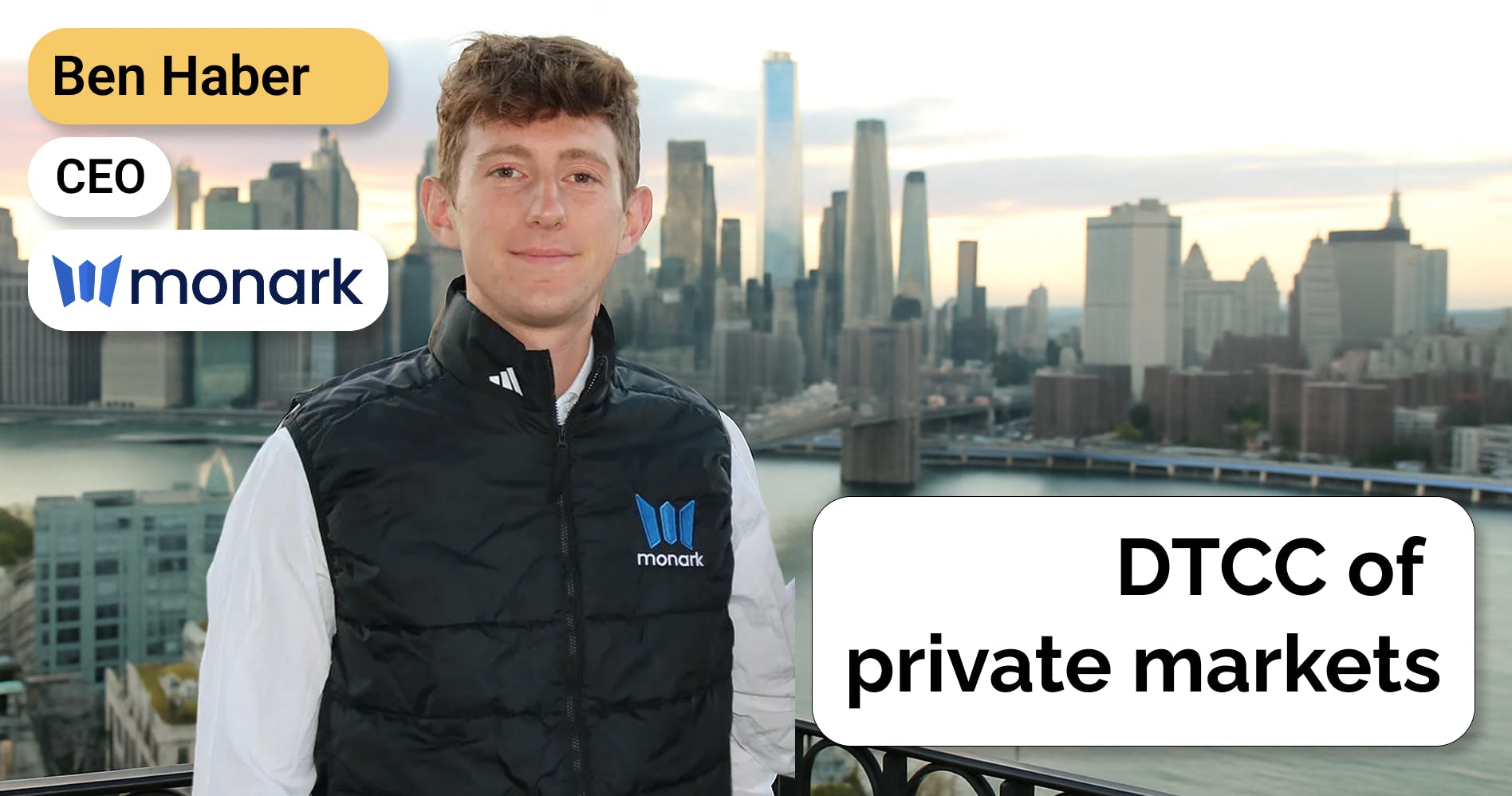
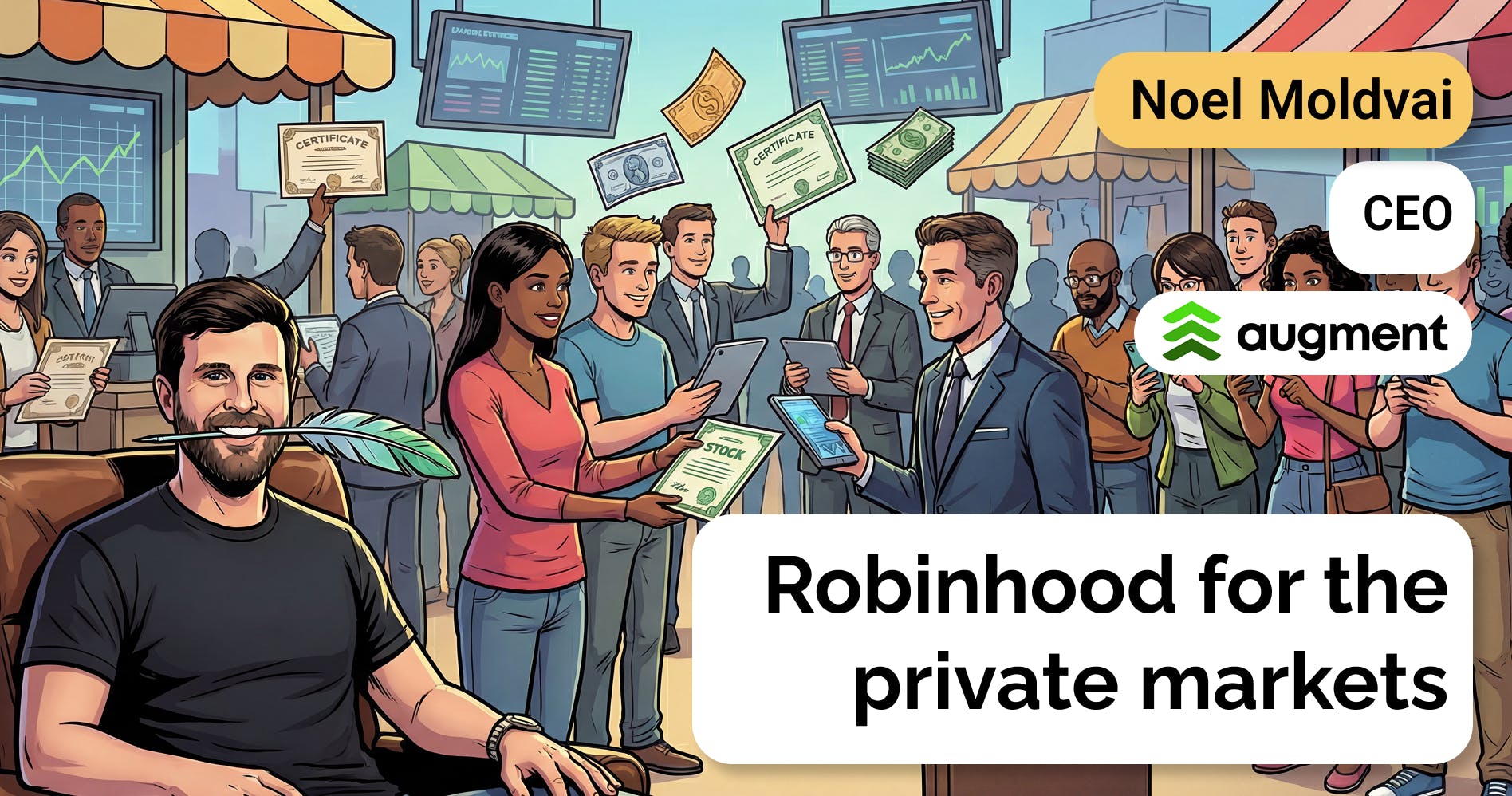
Noel Moldvai, CEO of Augment, on building the Robinhood for private markets
 Jan-Erik Asplund
Background
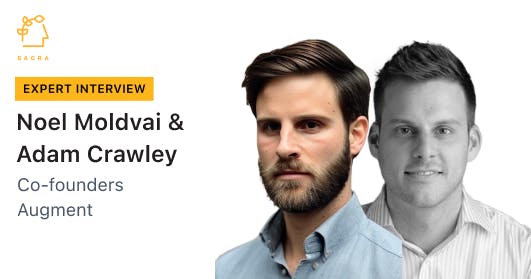
We first interviewed Noel Moldvai, co-founder & CEO of Augment and his co-founder Adam Crawley when Augment ($17M raised, Builders VC) was just getting started in 2023.
We recently caught up with Noel to discuss Augment's growth to now $750M in AUM and its vision for building the Robinhood for private markets.
Key points from our conversation via Sacra AI:
- Matching marketplaces still see ~50% of deals fail due to company ROFRs, transfer restrictions, and non-responsive issuers, pushing platforms toward a principal-trading model where they buy shares directly from sellers, warehouse them in SPVs, and resell slices to investors with instant settlement, no company approval, and retail-accessible minimums. "You could match a bunch of transactions, but 50% of them are not going to end up happening, even if you have a willing buyer and willing seller. The transactions just took really long, and time kills all deals... We said we don't want to be a service business. We want to build a real tech company."
- Stacked SPVs with 3-and-30 fee structures gave SPVs a bad reputation, but SPVs have evolved from a last-resort structure for capped-out angel syndicates into the dominant architecture for institutional private market exposure, as companies like SpaceX and Anthropic have grown so large that even $10M checks offer no information rights anyway, while SPVs deliver same-day liquidity and bypass the 30-day ROFRs that direct cap table holdings can't avoid. "Institutional investors used to be allergic to SPVs. They'd only want to go directly on the cap table. What we've seen recently is that these private companies are getting so big that if you're throwing a $10 million check into a $10 billion, $50 billion, $100 billion company, you're not getting access to management... But if you buy into an SPV, liquidity becomes a lot easier because if you're matched with a buyer, you can essentially execute that trade that same day."
- Consolidation by big banks and wealth management platforms—Morgan Stanley acquiring EquityZen, Charles Schwab acquiring Forge, and Goldman Sachs acquiring Industry Ventures—brings more participants into the ecosystem and creates an opening for those that stay independent to build direct-to-consumer brands and serve the broader retail market. "With some of those acquisitions, you're going to get two things. One, there's going to be a lot more distribution for privates, and there's going to be a lot more demand unlocked by integrating directly with those banks. But two, now you're kind of locked in. You're locked in because the whole point of those groups acquiring these platforms is for them to be able to offer that to their clients exclusively… there's also value in being independent and being direct-to-consumer, which is what we want to do.”
Questions
- You were just starting Augment in the early stages when we last spoke in 2023. Can you talk us through the last two years and what the key milestones and inflection points have been for you guys—raising a $12 million Series A, being profitable, all that kind of stuff?
- Can you speak a little bit to the software part of it and how this approach scales better than what you were doing before?
- There's been a lot of hay being made of family offices and hedge funds and crossover funds getting into venture, especially over the last few years. What have you seen on that front playing out? What are your key customer segments today? How has that changed over time?
- There was a lot of talk about SPVs this last year. I'd love to hear your take. What needs to be true of SPVs for them to be widely viewed as legitimate, reliable, trustworthy? How do you guys think about structuring your SPVs at Augment?
- In terms of these top names that you mentioned—a few like SpaceX and AI companies—what is your overall take on how the market is being skewed towards these top names? How does that affect the health of the market and possibly Augment's business? Are these blue chip names great because they drive so much volume? Is it important from a mix perspective for you guys to cultivate interest in a longer tail of names? How do you think about that?
- You mentioned the SpaceX IPO. How do you think about IPOs? Obviously that volume is lost, but is it good because it's sort of like liquidity for Augment users, closes the loop for them, and opens up space to invest in other names?
- Let's talk about the stuff you guys are excited about in 2026 on the product side and what you're looking forward to there.
- You mentioned Robinhood a few times as an analogy. How do you think about what Robinhood is doing with Robinhood Ventures fund and doing some stuff with tokenized stock, which got a little pushback from OpenAI and others? Other people are doing tokenized as well. How do you think about the Robinhood—maybe throw in Republic there—and their approach versus that of Augment, maybe versus that of Forge, Hiive, EquityZen?
- Maybe end off with this: last year there were big acquisitions in the space with Forge getting acquired, EquityZen acquired by Goldman Sachs and Industry Ventures. Do you see that as validation of the asset class being more prized now among some of these types of institutionals? Do you take anything else from that as far as what the future of private markets looks like?
Interview
You were just starting Augment in the early stages when we last spoke in 2023. Can you talk us through the last two years and what the key milestones and inflection points have been for you guys—raising a $12 million Series A, being profitable, all that kind of stuff?
To take us back, I'll give you a quick catch-up story. I started Augment because I wanted to solve for sellers like myself. I was at a tech company for six years—grew from 20 people to a few thousand people, left, and wanted to do my own thing. That's when I met you, and you guys put out the private company report. At the same time, I was trying to sell a portion of my Rubrik share so I could buy a house, get an engagement ring, and get married.
At the time, there were three problems in the market. One was that it was super fragmented. There were these quasi-platforms like EquityZen and Forge—actually, I think at the time it was SharesPost; I don't think the Forge thing was finalized yet. CartaX was coming up with all these big announcements.
When we did this interview last time, it was maybe just us, maybe a couple more people—maybe an engineer and someone on the biz dev side. The vision at the time was that buyers and sellers would come together in a centralized market that is more like a product as opposed to a service, where people could post buy and sell orders—what they're trying to buy, how much of it, and at what price. The platform would essentially match those buyers and sellers. They would go through a negotiation step, and then we would try to automate the execution of the transaction.
We launched this in 2023, probably around the same time that we did our interview last time. We were really trying to seed the marketplace, so we were working directly with employees, companies, founders, early-stage VCs, and then on the buy side, generally institutions that were doing blocks—call it $250K to $100 million.
That was going fine, but if you try to scale something like that, it's going to end up looking like a services business. The reason for that is that it's really complex to execute these transactions. You end up matching a buyer and seller, and you have to send that transaction to the company. The company can do a lot of things with it. One, they can approve the transaction, and then you go through this 30-day right of first refusal. You wait it out, and you fill out all these customized docs each time. Sometimes the company just doesn't respond to you. A lot of the time, especially recently, companies are very selective about who's buying and restrictive about who's selling. You could match a bunch of transactions, but 50% of them are not going to end up happening, even if you have a willing buyer and willing seller. The transactions just took really long, and time kills all deals.
In mid-2024, we said we don't want to be a service business. We want to build a real tech company. The high-level vision for us today is we want to build the Robinhood for private markets. What did Robinhood do? They had two really great innovations. They had a business model innovation in that it was zero percent commission trades, and they were doing this payment for order flow thing to enable that. The second thing was they just had a really great user experience, and it was mobile first at a time when mobile was pretty hot. This was like 2013, 2014, probably. Fun fact, I was probably one of the first 50 to 100 users on the waitlist in 2013, and I had never invested in stocks before.
How do we actually achieve that goal? We started buying up the shares ourselves. We started really small—we bought shares of Plaid and then would go and offer slices of those shares to our investors. Structurally, what this looks like is we set up an SPV. The SPV already had the securities in it, and then we'd go and sell off portions of that SPV to our investors. So the investor, instead of going through this matching process with a seller where you're negotiating on price and size—because a lot of the sizes just don't match—and you have this execution risk, we do away with pretty much all of that. We say, "Hey, do you want to buy SpaceX at this price?" If they say yes, then the next question is, "Well, how much do you want?"
Historically on Augment, that has ranged from anywhere from $5,000—some even lower, actually, call it $2,500—and the largest SPV transaction that we've done was about $35 million. To the user, it's like you go on the platform, you say, "Hey, I want to buy SpaceX at this price. I want to buy $50,000 of it." You send the money, and the transaction is closed. You can do that end to end in about five minutes, or however long it takes your bank to send out that wire. At the end, you have the shares listed, and you can track the value of those shares on Augment in your portfolio.
That's the thing that we've scaled over the last 18 to 24 months, and we call that product the Collective. Today we've surpassed $750 million in AUM, quickly approaching a billion. We've been profitable for the last five or six quarters now. We raised our Series A on the tail of that success and also to implement the vision of building the Robinhood for private markets, where you have an app, you log on, create an account, you deposit cash into your account, and instead of seeing public companies, you see a list of, call it 50 private companies, and you can buy essentially in seconds. Once you buy, you can then turn around and sell those shares with the same simplicity.
Can you speak a little bit to the software part of it and how this approach scales better than what you were doing before?
There are two parts to the strategy. The first part is still very manual, which is we have a capital markets team going out and sourcing shares in these private companies. The nice thing is that we still have these massive order books of who's buying and who's selling at what price, but we've taken the approach that we are probably going to be the buyers for the shares. We go and handle the complexity of dealing with the seller, dealing with the company, dealing with the GP if we're buying stakes in a fund as opposed to sitting directly on the cap table, dealing with all the paperwork that's involved in sourcing that transaction and then closing it. All that is a pretty manual process, and that's just step one. Step one is to take highly sought-after securities and put them into this container.
The second part of the strategy, where the technology comes in, is once you have the securities in the container, now you can just go out and build a really great product that makes it super simple for people to be able to buy those shares. Once they buy those shares, they close instantaneously. Build a really simple product where you can just put in a limit sell order, and if there's a match, that trade executes instantaneously without any person really being involved. There are no wire instructions sent back and forth. There's no negotiation. Generally, you don't even know who you're buying the shares from. All you know is this is the structure of the shares you're buying—interest units in a first-layer SPV, SpaceX for example—and you're done. Then SpaceX appreciates 2x over the next two years, you put in a limit order to sell, and just like the public markets, that order essentially sits there until it executes. Money shows up in your account, and you're done. You don't really do anything.
Stepping back, the first step is a really heavy manual process. We've hired a team that is really good at capital markets. My co-founder Adam has been in the space since Facebook was trading pre-IPO, back in 2012. We hired a lot of great people out of Forge, EquityZen, and NPM that know how to structure those transactions. Then step two is just a pure tech play. It's how do you create a really beautiful product where people can do all this stuff without a human coming and annoying them and pinging them and walking through all these legal docs every day?
There's been a lot of hay being made of family offices and hedge funds and crossover funds getting into venture, especially over the last few years. What have you seen on that front playing out? What are your key customer segments today? How has that changed over time?
We started pretty much 100% institutional just because the transaction sizes were so high. There were definitely some individuals selling, but the buyers tended to be all institutional. Today by volume, that's still true. We're probably 80% institutional by volume. But because we've made the process so simple to buy, and because we have this structure where you could buy any amount in an SPV, the smaller check sizes have started to come in. Those investments don't have brokers working on them. People can come in and buy stuff without ever really having to talk to us, and they come back and repeat by doing that same thing.
It's definitely trending more retail. By volume, it's an 80-20 split between institutional and retail. By number, it's probably flipped the other way—80% of the trades are retail, 20% are institutional. The nice thing about building out the tech is that you can end up doing trades for 10 bucks because a broker isn't going to go out there and work a $10,000 investment. They'll probably net maybe a few hundred bucks off that, and it's almost the same amount of work as doing a $10 million or $100 million deal. You don't really see a lot of action in that space. But if you have the tech that's actually doing the work, to us it's pretty much the same exact flow and cost, both in terms of capital and time. You can really bring down the minimums and democratize private markets this way.
There was a lot of talk about SPVs this last year. I'd love to hear your take. What needs to be true of SPVs for them to be widely viewed as legitimate, reliable, trustworthy? How do you guys think about structuring your SPVs at Augment?
The reason why SPVs have become so big as of late is that there are a relatively large handful of companies that are completely restricted in the sense that secondaries aren't allowed to happen. SpaceX is a classic example. They do twice-a-year tender offers, but good luck trying to get on the SpaceX cap table outside of those situations. If you have under a billion dollars, it's really difficult. There are a lot of relationships that have to form for that to happen. So the only way to get access is through SPVs. This is true for most of the really big marquee names.
These have really taken off. Also, there's just a lot of hype going on in AI and defense in particular that people want access to. So much so that a lot of these SPVs today—and why they get a bad rap—is that the prices are trading above the last round. There's a round that happened, and a week later they're trading at 10 to 20 to 30% above that round. Because they're using SPVs, the SPVs tend to have management fees and carry on top of them. When you have stacked SPVs—where you have a first-layer SPV that's charging a 1 and 10, then a second-layer SPV that maybe charges a 2 and 20—now the end investor is being charged a 3 and 30, and sometimes even more. Those investors aren't really getting the best deal out there, but they really still want that access.
The way that we think about this is we're really selective about what we put on the platform. We hear that a lot of people want access to this asset class, but there have been other stories out there where retail accredited investors are probably not going to make any money along the way just because of how the market has been going. Now, a year ago, these small accredited investors were buying these companies at these crazy prices, and now they're actually in the green after a ton of appreciation. But the way that we operate is we'll essentially fill a deal with mostly institutional investors that set the price. They're super price-sensitive, smart money. Then retail we just use to fill that gap. As long as you have some smart people setting the pricing and us being careful about what we offer our clients, that's not going to be a problem.
The second thing here is trust. Trust is probably the bigger thing here. If you're investing in a third-layer SPV in OpenAI as an individual, I don't really have the resources, the means, or the willingness with the GP that I'm working with for them to go and diligence every single SPV along the way. What we do is we have limitations in what we actually offer our investors. Typically, we will only offer investments where the SPV sits directly on the cap table or one layer removed, and we will only buy from GPs that have a strong proven history where all the share ownership is diligenced and has good fees.
The other requirement that we have is the vast majority of the offerings on our platform are 0 and 0. You're not paying any ongoing management fee, and you're not paying carry. Instead, how we make money is we just put one upfront fee on acquiring those shares. The way that we see this going is that we will make money on the tail. People buy shares, they'll eventually want to sell them, so we make money on that trade. That new buyer is going to eventually want to sell, so we'll make money on that trade. But we're absorbing a lot of the upfront cost. Typically, 0 and 0 structures are better in asset classes like this where it's not a very steady, slow appreciation. It's either going to go to zero or it's going to explode. If you think about carry on something that explodes, you're leaving a lot on the table. You might be paying a slightly higher price in a 0 and 0, but at the end of the day, you're investing in an asset class where you're really getting a binary outcome.
One more thing about SPVs—something that has changed over the last two years. Institutional investors used to be allergic to SPVs. They'd only want to go directly on the cap table. What we've seen recently is that these private companies are getting so big that if you're throwing a $10 million check into a $10 billion, $50 billion, $100 billion company, you're not getting access to management. You don't have a personal relationship with them, and you're not getting any information rights. Really, there's not a ton of benefit to sitting on the cap table other than that layer of trust that you have directly with the company where you know that you own the shares. That's what we're solving for.
The other piece here is if you're investing directly on the cap table, you're subject to the company's rules about liquidity. If you want to sell those shares, you still have to go through the ROFR process. You still have to manually find a buyer. There's risk in sending wire instructions back and forth and in the settlement and execution of these trades too. But if you buy into an SPV, liquidity becomes a lot easier because if you're matched with a buyer, you can essentially execute that trade that same day. There's no dealing with the company, and the company doesn't really want to deal with that because companies are subject to 2,000 shareholder limits on their cap tables, which has increased with the JOBS Act. They don't want to see a lot of small investors on there. Now all these SPVs are housing and removing that complexity from the company, and we're handling it ourselves.
In the last two years, a lot of institutions are really willing to go into these SPVs because they want to get that liquidity. They're acting more as traders rather than buy and hold—rather than "I'll buy at the Series B and hold it until IPO 10 years later," it's "I'll buy at the Series B and hold it until Series E and just start trimming from there." That trimming has become pretty easy to do.
In terms of these top names that you mentioned—a few like SpaceX and AI companies—what is your overall take on how the market is being skewed towards these top names? How does that affect the health of the market and possibly Augment's business? Are these blue chip names great because they drive so much volume? Is it important from a mix perspective for you guys to cultivate interest in a longer tail of names? How do you think about that?
The top names are always going to be in demand. One of the big limitations in how the shares of these companies trade in the secondary is information. The bigger companies just tend to have a lot more information out there. Whereas if you're a Series A company—we're a Series A company—other than doing stuff like this every once in a while, no one's going to know anything about internally what's going on at Augment. If someone wanted to come invest in us, they'd ask me for a bunch of information that I probably wouldn't be willing to give them unless I really trusted them. So information is really the big barrier for the big companies. Those are true pre-IPO companies—they're probably going to IPO. We've heard 2026, maybe SpaceX is coming out, maybe OpenAI, maybe Anthropic.
At the same time, the top companies—we have the Power 20, which is the top 20 most in-demand, liquid, and actively traded names that we publish in the report with you guys, plus the 10 up-and-coming. Those are the companies that trade the most. They're probably 90 to 95% of our transaction volume. But the thing is, they change every quarter. Companies go in and out of the Power 20 all the time. Those companies change, but really, over time, we're going to start to go downstream earlier and earlier, and we already have done this.
We're going earlier and earlier. We're getting access to more and more companies. Part of the thing that's driving that is AI. The AI companies have grown very quickly. Anthropic was started in 2021, so in five years it's grown to a $350 billion company. SpaceX has a nearly $1 trillion valuation. The earlier you get access to the hot names, the more credibility that you build. Just the simple fact that the volume is concentrated in these top companies—that's less of a risk. Those companies aren't going to disappear tomorrow, so our AUM isn't going to go down 95% overnight. In a downturn, if there were to be one, generally there's a flight to quality. Those are the names that are going to be even more in demand, and the other ones are going to drop off.
But what you see in a downturn is a pretty interesting phenomenon. When you're in a bull market, retail is really heavily involved—they're buying up this stuff left and right. Institutional investors are still very price-sensitive, still pretty actively involved. But in the downturn, retail essentially disappears unless they need liquidity—they have a bunch of money locked up, they need to go buy a house, there's a health emergency they need to pull out money for—they usually sit back. But institutional in a downturn is still buying because it's their job, and there are a lot of really quality names on the market that they can scoop up at cheaper prices.
All in all, once you build out the access, the transparency and liquidity starting with these really big names for which there's already a lot of demand, and you build trust with your customers by being around for a really long time, then you can go and pursue the tail pretty easily. At the end of the day, we're building infrastructure, and that infrastructure works for everyone.
You mentioned the SpaceX IPO. How do you think about IPOs? Obviously that volume is lost, but is it good because it's sort of like liquidity for Augment users, closes the loop for them, and opens up space to invest in other names?
We're super excited about it because at the end of the day, it will generally help our clients. The earlier you get access to these things, when they IPO, generally you're going to make money on them because you've gained so much. It's going to be interesting to see what happens. Are they going to pull that money out and go and reinvest into pre-IPO that made those gains happen? Or are they going to stick with those companies in the long term? I don't exactly know what's going to happen there.
What will be interesting with SpaceX in particular is the unpacking of all of those SPVs. If you have four layers of SPVs and Morgan Stanley is doing the distributions on them, what is that going to look like? Is there going to be regulation coming to either enable more people to invest in the SPVs? Really, the biggest limit to offering these things to a much wider swath of people at lower minimums is the 100 LP limit that you have in an SPV. If you're doing a $10 million offering, $10 million divided by 100 is $100K, so you have a $100K minimum on that. Obviously they decrease if someone's buying $8 million of that. But if you expand that to a thousand people, then your minimums can go lower. You can get a lot more people in those offerings. There may be some regulatory changes there too, and that would also help the layering of these things, because most of the layering is happening because people aren't getting access to the first layers, and so they have to go into deeper layers.
Let's talk about the stuff you guys are excited about in 2026 on the product side and what you're looking forward to there.
On the product side for 2026, we've proven out that we're the best product on the market for accessing pre-IPO shares. It's definitely the simplest product in the market to be able to invest in these things. Trust is a really big aspect here, especially when you're dealing with SPVs, which are now 99% of our business model. For us, it's getting more and more information out there to our clients and to our investors at a more frequent rate to be able to inform their decisions on what to invest in.
There's also regulatory—we've applied to be a registered investment advisor, which will give us a lot more things that we have to do on our end in terms of diligence and disclosure. But that will also help clients because another part of the SPV equation is, "Who is this GP that's actually managing my investment? Are they legit?" Most of them are not registered with the SEC. Some of them are exempt reporting advisors, which have a lower bar than RIAs. We're trying to build out that trust for clients coming back to us.
The second thing that we want to build out is liquidity. A couple things there. First, on liquidity, we want to realize the vision of actually having a Robinhood for private markets. You're probably going to see that in the first half of 2026, where you can actually do what I just said—have an app, deposit cash, put money in, buy instantaneously, and then go and recycle that capital and just keep trading. That's applicable both to retail and institutional.
Finding more distribution is kind of like the Kalshi playbook. Kalshi did this thing where they built a direct-to-consumer market on their own rails, in their own ecosystem. Then they started these partnerships with the big retail brokerages and others that essentially used their exchange and hosted it and brought it to their brokerage's customers. Kalshi and Robinhood is the classic example. Now Kalshi doesn't have to be direct to all those Robinhood customers—they tap into this partnership and they get a lot more liquidity happening on the platform. Volume is going to be a really big focus for us.
For us, that means tackling the wealth channel. There's a lot of money locked up with a bunch of people that want access to these things but don't really know how. A lot of that is the really wealthy people on the coast. If you're with a private bank or you have a financial advisor, they will help you get access to these things, albeit at pretty high check sizes. But the really untapped space here is the RIAs and the advisors in the middle of the country, where it's like your advisor is your friend that you met at the country club and he manages your money for you. But there's really no easy way for those advisors to get access to private market stuff at scale. The missing piece there is the financial rails and integrations with wealth to make that happen. Then also, same thing as Kalshi, we're tackling the retail brokerages as well and finding distribution there.
You mentioned Robinhood a few times as an analogy. How do you think about what Robinhood is doing with Robinhood Ventures fund and doing some stuff with tokenized stock, which got a little pushback from OpenAI and others? Other people are doing tokenized as well. How do you think about the Robinhood—maybe throw in Republic there—and their approach versus that of Augment, maybe versus that of Forge, Hiive, EquityZen?
As far as the legacy private markets platforms, none of them know how to build product. At the end of the day, we want to build a product. We don't want to be a big services-based investment bank. We want the product to speak for itself and to have these transactions really be automated and speak to the new generation of people that are coming up that know how to use technology and are on their phones all the time. That's first and foremost.
There are a lot of different ways to get people access to private markets. Tokenization has been a really big theme. Eventually it will happen, but it's going to take longer than people think. We decided now is really the time to build the rails for this stuff on the traditional finance networks and traditional finance rails. The path we take on tokenization, whether we get involved or not, is really dependent on regulatory clarity on tokenizing private securities.
There's also another question of what does tokenization actually get you at the end of the day? Maybe a couple things. One, you get 24/7 trading. Two, you can do it on any platform, not just ours. If that is true, the magic is really in being able to source quality supply, which we're pretty good at doing. That puts us in a pretty good position to be able to do that.
There are a bunch of people building a bunch of different things in this space. You can do Reg A offerings, which enable access for retail non-accredited investors. You can do 40 Act funds, which we've seen tried before—multi-asset 40 Act funds. Destiny, Robinhood—sounds like they're releasing something like that, which is essentially a basket of goods that you can sell to someone. But people still want access to individual names that they want to place big bets on, and that's what we're going to tackle. I am leaving the possibility open for us to be able to do a multi-asset fund as well though.
Maybe end off with this: last year there were big acquisitions in the space with Forge getting acquired, EquityZen acquired by Goldman Sachs and Industry Ventures. Do you see that as validation of the asset class being more prized now among some of these types of institutionals? Do you take anything else from that as far as what the future of private markets looks like?
You're spot on there. It's validation that people—especially these big wealth platforms and banks—want to offer this to their customers. They really don't know how. I've seen a couple of investment banks spin up secondaries desks, shut them down, spin them up again, shut them down on repeat because it's a really niche, esoteric space to play in that you need a lot of expertise in. We have an advantage there in that we've already built that up.
With some of those acquisitions, you're going to get two things. One, there's going to be a lot more distribution for privates, and there's going to be a lot more demand unlocked by integrating directly with those banks. But two, now you're kind of locked in. You're locked in because the whole point of those groups acquiring these platforms is for them to be able to offer that to their clients exclusively because it's a great pitch to be able to say, "Hey, we also offer you access to SpaceX, Anthropic, OpenAI—all these companies that you've been trying to get into for a long time." But there's also value in being independent and being direct-to-consumer, which is what we want to do.
Disclaimers
This transcript is for information purposes only and does not constitute advice of any type or trade recommendation and should not form the basis of any investment decision. Sacra accepts no liability for the transcript or for any errors, omissions or inaccuracies in respect of it. The views of the experts expressed in the transcript are those of the experts and they are not endorsed by, nor do they represent the opinion of Sacra. Sacra reserves all copyright, intellectual property rights in the transcript. Any modification, copying, displaying, distributing, transmitting, publishing, licensing, creating derivative works from, or selling any transcript is strictly prohibited.