Exa at $10M growing 11x YoY
 Jan-Erik Asplund
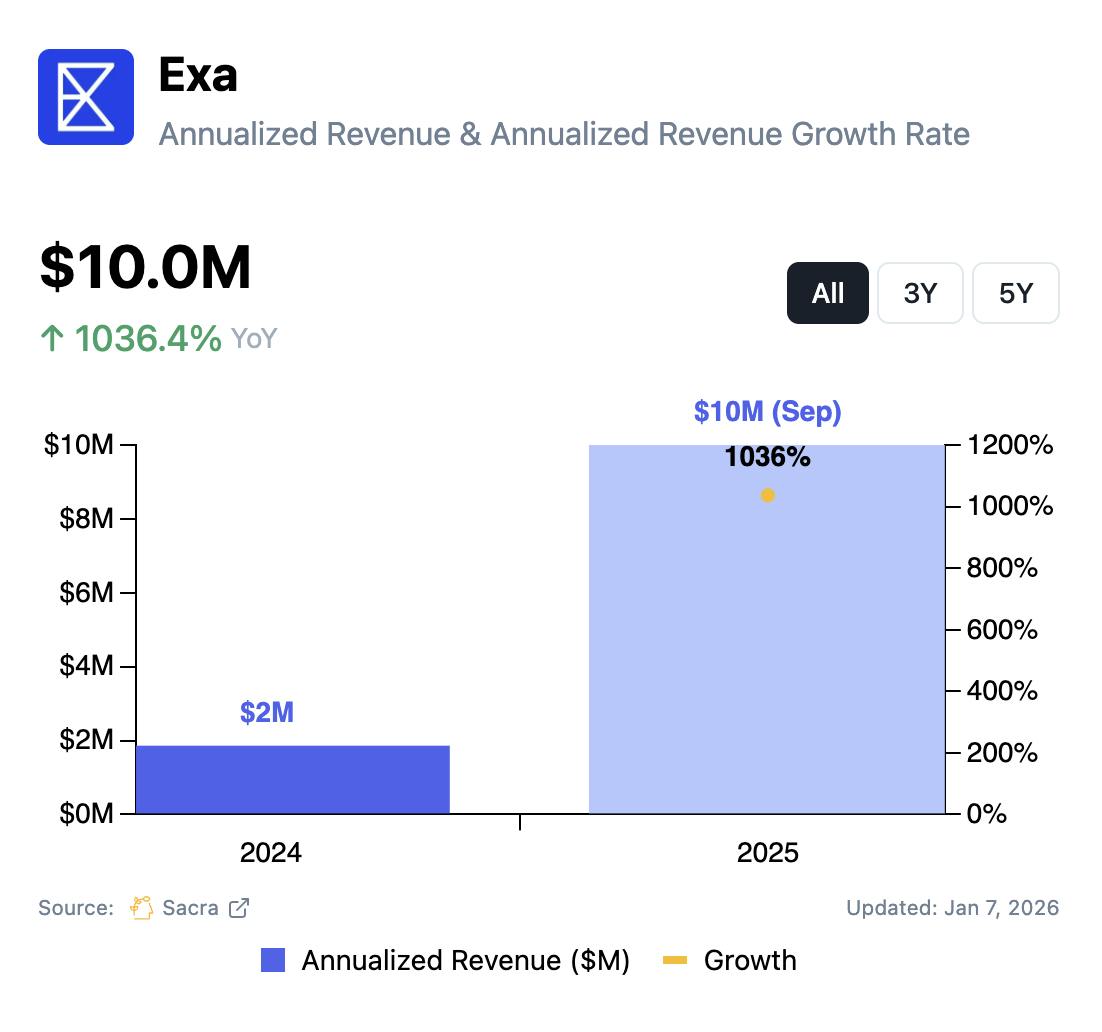
TL;DR: As retrieval augmented generation took off in 2023, Exa’s embedding-based search index was positioned as a core developer API for building AI applications with access to real-time data. Sacra estimates Exa hit $10M annualized revenue in September 2025, up ~11x YoY from ~$880K, raising an $85M Series B at a $700M valuation from Benchmark. For more, check out our full report and dataset on Exa.
Key points via Sacra AI:
- After GPT-4 launched in March 2023 with a September 2021 training data cutoff, developers building chatbots, writing assistants, and research tools on the OpenAI API needed a way to serve up-to-date information from the web like Perplexity, creating the opportunity for Exa's ($111M raised, Lightspeed) search API based on embedding-based semantic search (rather than keyword matching) built to return high-quality, long-form results from a curated subset of the web and give LLMs the best retrieval inputs possible. Where SerpAPI and other Google/Bing SERP scraper APIs charge ~$25/month for 1K searches that replicate Google's keyword-matching and ad-optimized rankings—and forcing developers to filter out SEO spam & ads—Exa charges $5 for 1K searches against its own search index with upsells for Deep Research searches ($15 per 1K), & direct answers backed by citations ($5 per 1K).
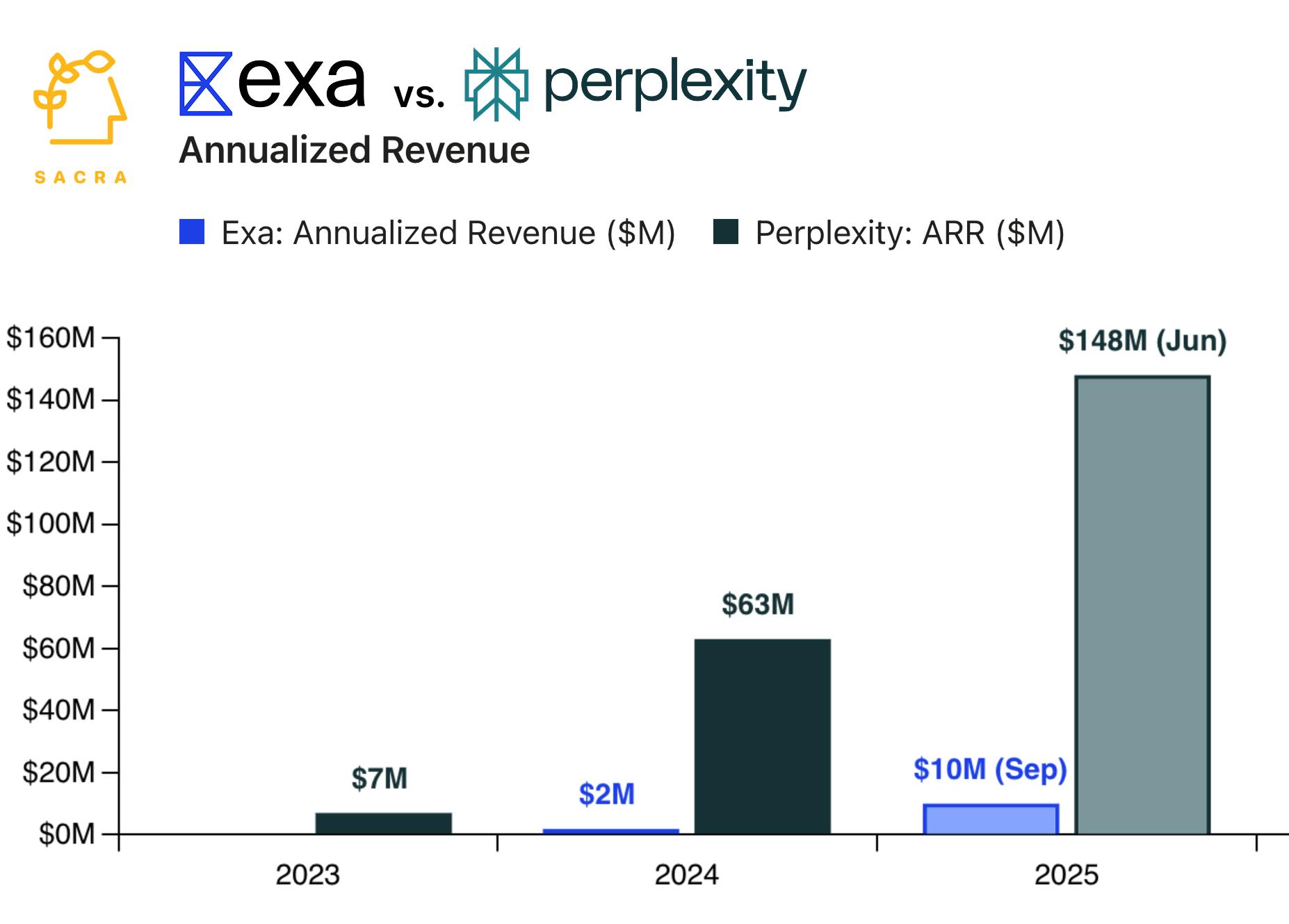
- Driving code snippet search and documentation retrieval for fast-growing AI vibe coding tools like Cursor ($500M ARR in May 2025), Vercel's v0 ($200M ARR in May 2025) and Lovable ($206M ARR in November 2025), Sacra estimates Exa hit $10M ARR in September 2025, up ~11x YoY from ~$880K, and up from ~$1.86M at the end of 2024, raising an $85M Series B from Benchmark in September 2025 at a $700M valuation for a ~70x revenue multiple. Compared to AI search engine Perplexity at $148M annualized revenue in June 2025, up from $63M at the end of 2024, valued at $20B for a 135x forward revenue multiple and AI API infrastructure platform OpenRouter at $5M annualized revenue in May 2025, up from $1M at the end of 2024.
- As AI agents evolve from single-turn assistants to autonomous multi-step workflows, Exa's "deep" agentic search—which expands queries into multiple variations and runs parallel searches 350ms for fast answers—positions it as infrastructure for the next generation of AI applications that need to reason over web data rather than just retrieve it. The emerging "agentic search" category is splitting between answer engines with an API bolted on (Perplexity), SERP wrappers that scrape Google/Bing (SerpAPI, Bright Data), browser-native search APIs (Brave), and AI-native search APIs like Exa, Parallel ($130M raised, Kleiner Perkins & Index Ventures), Tavily ($25M raised, Insight Partners) and Jina AI (acquired by Elastic in October 2025).
For more, check out this other research from our platform:
- Exa (dataset)
- Will Bryk, CEO of Exa, on building search for AI agents
- Replit (dataset)
- Vercel (dataset)
- $172M/year Heroku of vibe coding
- Vibe coding index
- Why OpenAI wants Windsurf
- Lovable vs Bolt.new vs Cursor
- Bolt.new at $40M ARR
- Claude Code vs. Cursor
- Cursor at $200M ARR
- Cursor at $100M ARR
- Lovable (dataset)
- Bolt.new (dataset)
- Anthropic (dataset)
- OpenAI (dataset)
- Scale (dataset)
- Cursor (dataset)
Read more from


+1 others
+1 others
Read more from

Peec vs. Profound
Free Report
Continue Reading
Peec revenue, growth, and valuation
Unlocked Report
Continue Reading
Exa revenue, growth, and valuation
Unlocked Report
Continue Reading
Read more from

Roam revenue, growth, and valuation
Unlocked Report
Continue Reading
$4M/year Discord for work
Free Report
Continue Reading

Read more from


Mirakl at $218M ARR
Free Report
Continue Reading