

$75M/year Mercury for main street
 Jan-Erik Asplund
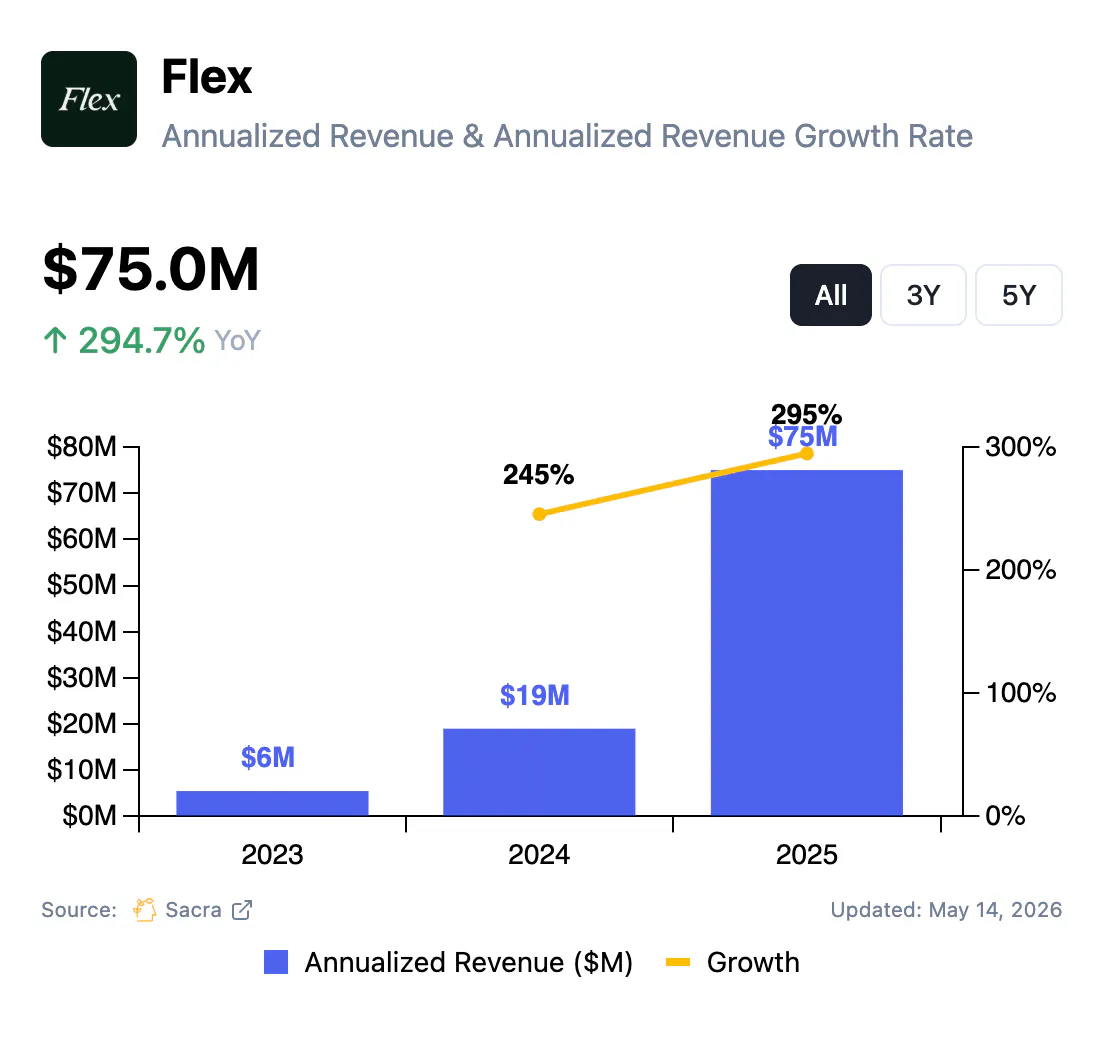
TL;DR: Where Brex and Mercury focused on VC-backed startups, Flex launched in 2023 to serve profitable owner-operators in the mid-market, giving them a Net-60 business credit card that doubles as a rolling zero-interest working capital line. Now it's positioned to absorb the SMB exodus from collapsed D2C neobanks like Parker and expand into any vertical where owners face tight cash conversion cycles. Sacra estimates Flex hit ~$75M in annualized revenue in 2025, up ~295% YoY. For more, check out our full report and dataset on Flex.
Key points via Sacra AI:
- As Brex (2017) and Mercury (2019) built corporate cards and B2B banking for VC-backed startups, Flex (2023) launched to serve owner-operated, profitable, mid-market businesses in middle America with high card spend, slow receivables, and no venture cushion, giving them a Net-60 business credit card that functions as a rolling zero-interest working capital line. Where Mercury makes money on parked investor cash via sweep networks & partner lending, Flex monetizes primarily through 1) interchange on card spend, 2) interest on Net-60 payments (26.9% APR) & 3) a 1% FX fee for cross-border transactions, meaning revenue scales with spending, aligning them with their owner-operator customers—bootstrapped ecommerce brands, home-services & logistics companies, startups—with high card volume and low working capital.
- Rather than target coastal VC-backed businesses like most B2B neobanks, Flex used city managers & community events to win over owner-operators in cities like Houston, Atlanta, and Dallas, with Sacra estimating that Flex hit ~$75M in annualized revenue in 2025, up ~295% YoY, with less than 13% of their customers in New York or California. Compared to Mercury at $650M in annualized revenue in September 2025, up 41% YoY, valued at $3.5B for a 5.4x multiple; Slash at $200M annualized revenue in December 2025, up 220% YoY, as the high-risk SMB neobank for solopreneurs, resellers, agencies, and ecommerce businesses; Brex at $700M annualized revenue, up 50% YoY, acquired by Capital One for $5.15B or 7.4x; and Ramp at $1B in annualized revenue in August 2025, up 110% YoY, valued at $22.5B for a 22.5x multiple.
- Vertical B2B corporate cards & neobanks are differentiating on payment terms, workflow tools & go-to-market to win “main street” segments and the 98% of companies that don’t yet use the big horizontal tech players Brex & Ramp—including Flex for mid-market owner-operators, Slash ($200M annualized revenue in December 2025, up 220% YoY) for high-risk performance marketing agencies, crypto-native businesses & ecommerce merchants, and Altir (acquired by Ramp in 2025) for franchisees. With the ecommerce corporate card Parker filing for Chapter 7 this week, Flex has been the beneficiary of a small-scale Silicon Valley Bank-like exodus of D2C retailers looking for a bank & card with similar Net-60 properties, demonstrating how Flex has the upside to expand into verticals where owners focus on cash flow and have tight cash conversion cycles.
For more, check out this other research from our platform:
- Flex (dataset)
- $200M/year Whop of B2B neobanks
- Slash (dataset)
- Ramp (dataset)
- Brex (dataset)
- Mercury (dataset)
- Whop (dataset)
- The neobank capital cycle
- The future of interchange
- Brex: the $400M/year anti-Amex
- Ramp at $1B/year
- Brex at $700M/year growing 50% YoY
- Kapital at $184M/yr growing 156% YoY
- Whop at $142M revenue


