

$250M/year Notion of personal injury litigation
 Jan-Erik Asplund
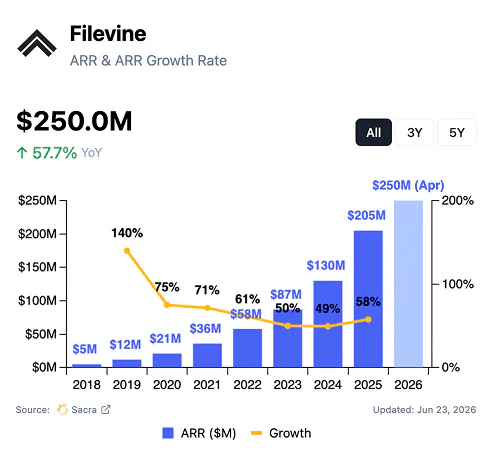
TL;DR: Originally a cloud replacement for desktop case management software, Filevine expanded from paralegal workflow automation into back-office billing & payments and then AI tools for attorneys. Sacra estimates Filevine hit $250M annual recurring revenue in April 2026, up from $205M at the end of 2025 (+58% YoY), last valued at $3B for a ~16x multiple. For more, check out our full report and dataset on Filevine.
We’ve covered legal AI from Harvey (Jan 2026, Dec 2025, Jul 2025, Jan 2025) to Legora (Jun 2026) to Clio (May 2026, Jul 2025) and interviewed the VP of Corporate Development at Clio and the CEO of Spellbook.
To go deeper on the litigation-first player now crossing into AI, we researched Filevine ($548M raised, Signal Peak Ventures).
Key points via Sacra AI:
- For decades, personal injury firms relied on legacy, desktop software like Needles (founded 1985) for case management, creating the opportunity for PI attorney Ryan Anderson to launch Filevine (2014) as a cloud workspace where paralegals could drop documents, notes, contacts, tasks, deadlines & signatures while integrating with email & other task management SaaS. At ~$87/user/month, Filevine costs a fraction of the $250-$1K/seat/month charged by Harvey & Legora, targeting SMB litigation firms where the daily users are paralegals and case managers with the pitch that support staff can handle more cases at the same headcount.
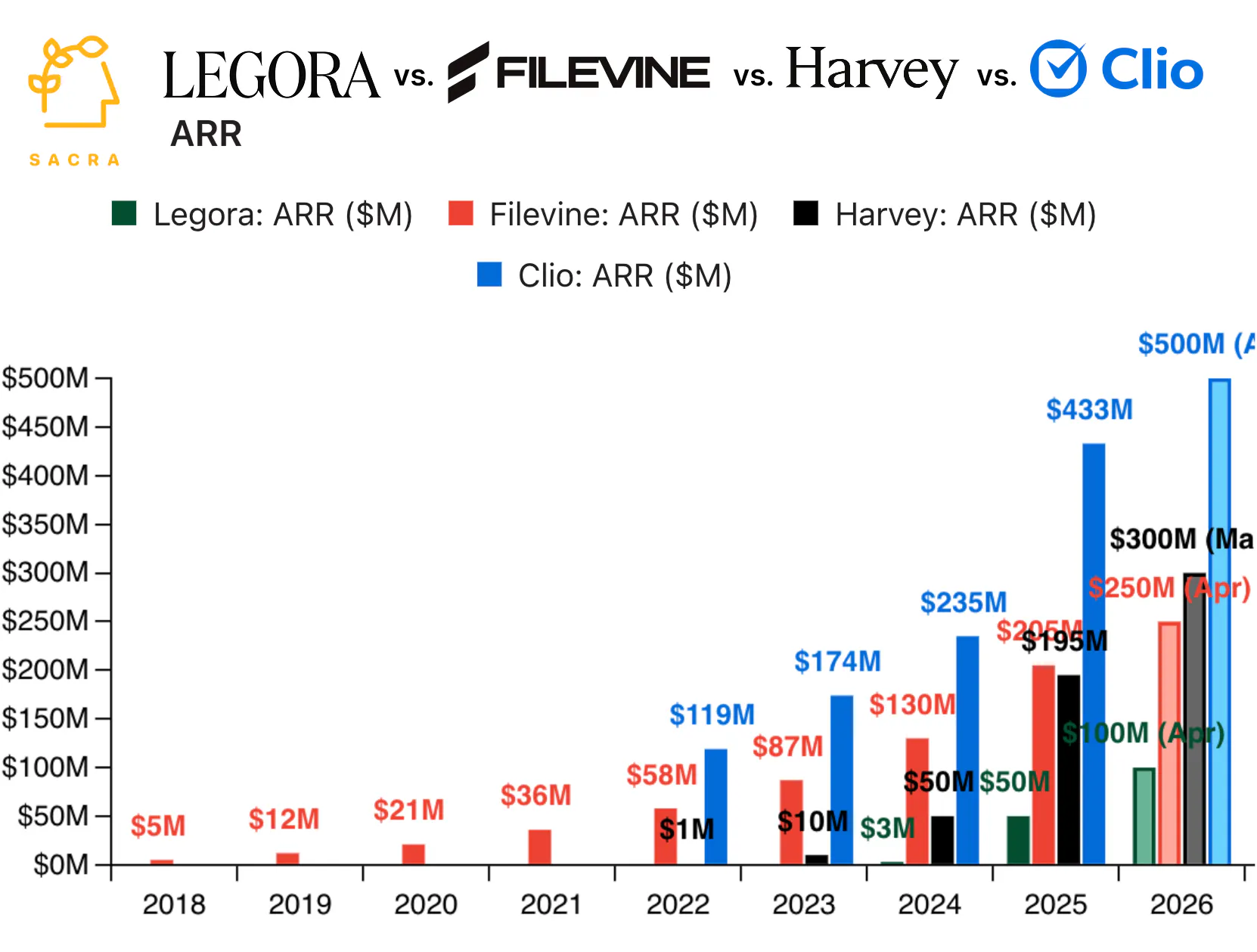
- Expanding from support-staff workflows into the back-office via payments & billing (2023) and then into tools for front-office lawyers like case Q&A, demand drafting & deposition prep (2025), Sacra estimates Filevine hit $250M annual recurring revenue (ARR) in April 2026, up from $205M at the end of 2025 (+58% YoY), valued at $3B as of its September 2025 Series F (Insight, Accel) for a ~16x multiple on ~$186M in ARR. Compare to Clio at $500M ARR in April 2026, up from $433M at the end of 2025 (+84% YoY), valued at $5B for a ~11.5x multiple, Harvey at $300M ARR in May 2026, up from $195M at the end of 2025 (+290% YoY), valued at $11B for a ~44x multiple, and Legora at $100M ARR in April 2026, up from $50M in 2025 (+1,567% YoY), valued at $5.6B for a 56x multiple.
- Where most startups in plaintiffs' litigation started with a narrow wedge from EvenUp ($385M raised, SignalFire) with demand letters, Eve Legal ($164M raised, a16z) with document review, and Filevine with task management, the category is converging on the end-to-end litigation platform as every player expands across client intake, document collection, medical-record review, deposition prep, testimony capture and settlement workflows. Filevine has acquired startups across the case lifecycle including Lead Docket for intake (2020), Outlaw for contract/document assembly (2021), Parrot for depositions and medical-record review (2025), and Pincites for Word-native contract redlining (2025), folding point workflows into the matter record to make Filevine the system where all litigation work can be done.
For more, check out this other research from our platform:
- Filevine (dataset)
- Legora (dataset)
- Healthcare company associate GC on where legal AI products break down
- Legal tech VP of cloud operations on evaluating legal AI tools
- Director of Innovation at large law firm on why firms adopt Harvey over Legora
- Scott Stevenson, CEO of Spellbook, on building Cursor for contracts
- Shubham Datta, VP of Corporate Development at Clio, on Clio's $1B acquisition of vLex
- Harvey at $195M ARR
- Harvey at $150M ARR
- Glean for law
- Harvey at $75M ARR
- Harvey (dataset)
- Clio vs. Filevine
- Clio at $300M/year
- Clio (dataset)


