

Thoropass automates cybersecurity compliance audits, SOC 2, ISO 27001, HITRUST, and PCI, for enterprise software companies, and has raised $98 million. Austin Ogilvie co-founded it after selling his first startup, Yhat, to Alteryx.
He's also an angel investor with around 50 companies in his portfolio. “You don't have access to investor-grade research tools like you would at one of the big funds,” he says. “And you don't do this full time. It's just you.” Both jobs run on just the Sacra web app and the newsletter
We talked to Austin about how that works.
Inside Austin's diligence workflow
When an entrepreneur raising a round lands in Austin's inbox, or a “does anybody know this company?” goes up in one of his syndicate Slacks, the first stop is the Sacra company page. “Sacra is a great place where I often will just go look at that page,” he says.
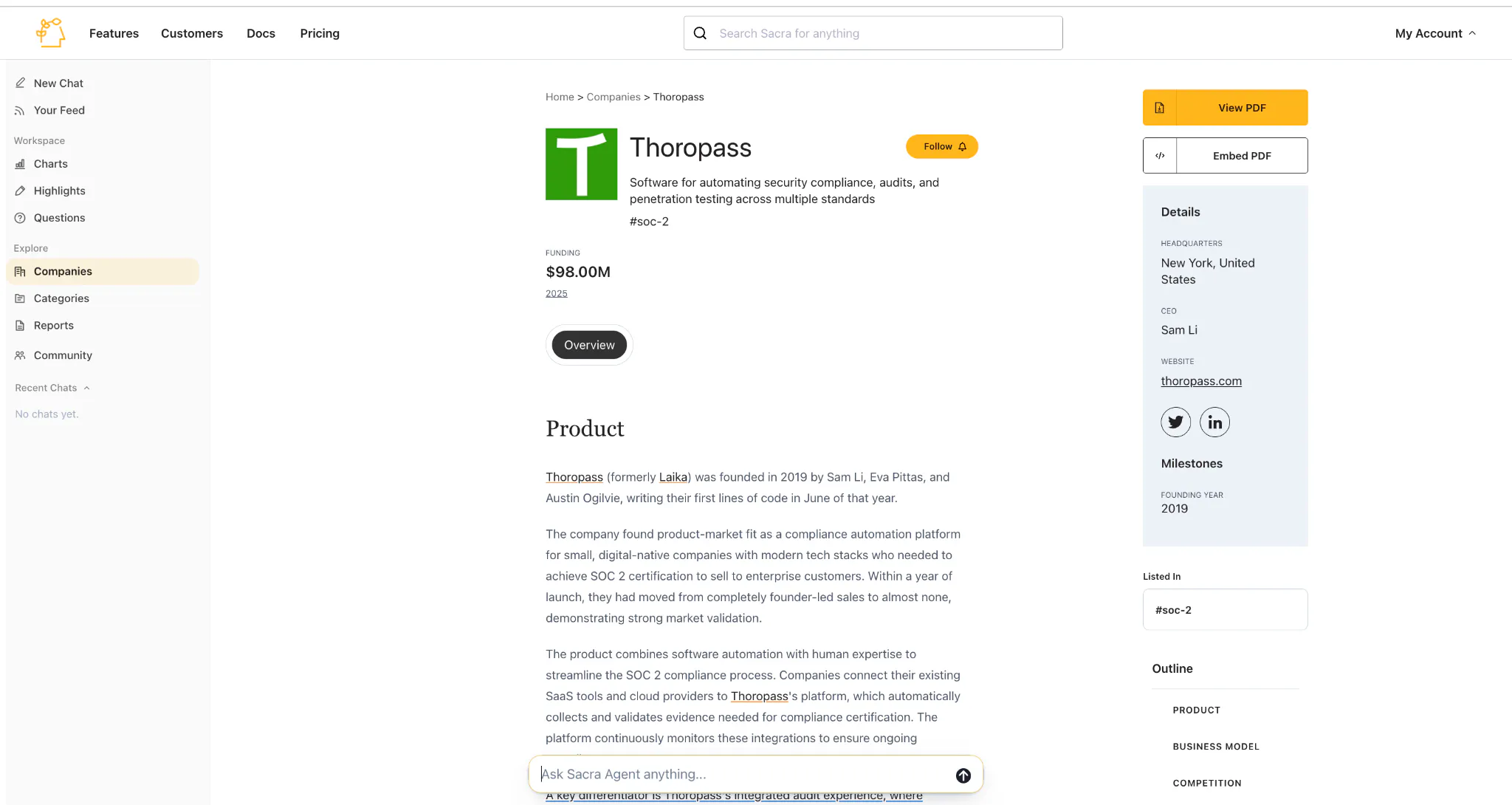
When a deal gets serious, with check size and valuation on the table, he widens out from the company page to the competitor pages Sacra links and the industry write-ups around them. “The pages will mention specific companies, but the pages are industry specific,” says Austin. “It's more like, here's the whole landscape, with actual real meat on the bone.”
The output reads finished. “It's basically like you have a pre-read from a professional analyst who has done all of the polish on all of the facts,” he says. “The facts are all traceable back to some primary source, and it’s easy to digest.”
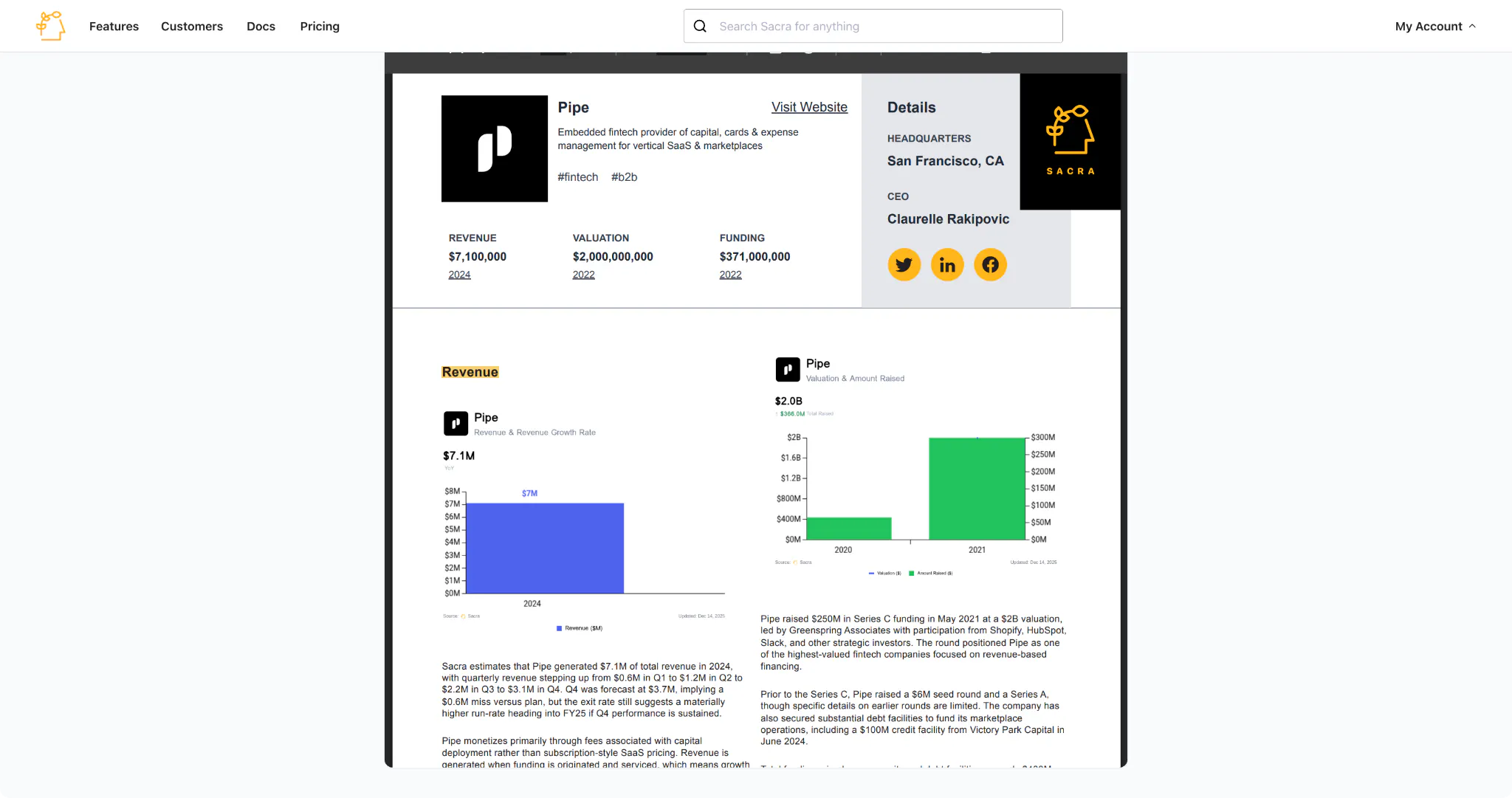
For Austin, Sacra shows up in two more places:
- Thoropass. The other half of the dual use is his day job: competitive intelligence and market research for the compliance space, and funding data on the companies that make relevant comps.
- The Sacra newsletter. "It's the full contents of some other page, but brought to me," usually on his phone. It puts companies on his radar before he's actively researching anything. "A lot of the time I'm like, I don't even know about this, and I should."
None of it required an integration. “I just pop open the web app and find that Sacra is everything that I need,” says Austin.
Why the professional research stack is off limits to angels
“Startups have a probability distribution for success and failure, and if you're picking worse than the average investor, you miss out on the one winner,” says Austin. “That means your whole portfolio is a zero.”
When he started researching what became Thoropass in 2019, the tooling was limited to advanced Google search operators used to run searches across blogs, industry reports, and news articles. “There was no one-stop shop to surface that information,” he says. “Certainly it was not organized very well.”
The professional alternative was expert networks, which he admires and rules out just as fast. “The problem with them is very simply cost. They're cost-prohibitive to almost every startup, except very well-funded ones.” Starting subscriptions at the big names run north of $50,000 a year, and the real value sits in the calls themselves, which cost hours more.
Even with transcript access, the work stays manual. “If there's a dozen transcripts available, you want to build a consensus,” says Austin. “You've just sunk a week of your life reading, and then you have to synthesize it. That's professional-grade research right there. It's better than Google, but that's a lot of work.”
The dedicated VC and private equity databases sit behind the same wall. Thoropass paid for one and turned it off; Austin puts the entry subscription at $20,000 to $25,000 a year. “It doesn't make any sense” for a small company, he says, “definitely not for an individual.”
“I would class all of those as mandatory, essential, non-optional for professional investors, and most of them are off limits to individual angels because it's too expensive,” says Austin. “Sacra is the one that is accessible. You're at a serious disadvantage if you don't have it.”
A check into a market he'd never studied
One of Austin’s checks is Reality Defender, a deepfake detection company. The round was hard to get into, competitive and oversubscribed, in a space that's hot precisely because so few people understand it. “I haven't spent my career specifically thinking about how deepfakes work and how to counter them,” says Austin. “There are dozens of companies trying to worry about this. Which one is worrying about it in the right way? Which one has the lead?”
He knew he liked the tailwinds. Deepfakes worry him personally. “But also, it's one where I just don't know anything.” Sacra's landscape coverage closed that gap far enough to write the check.
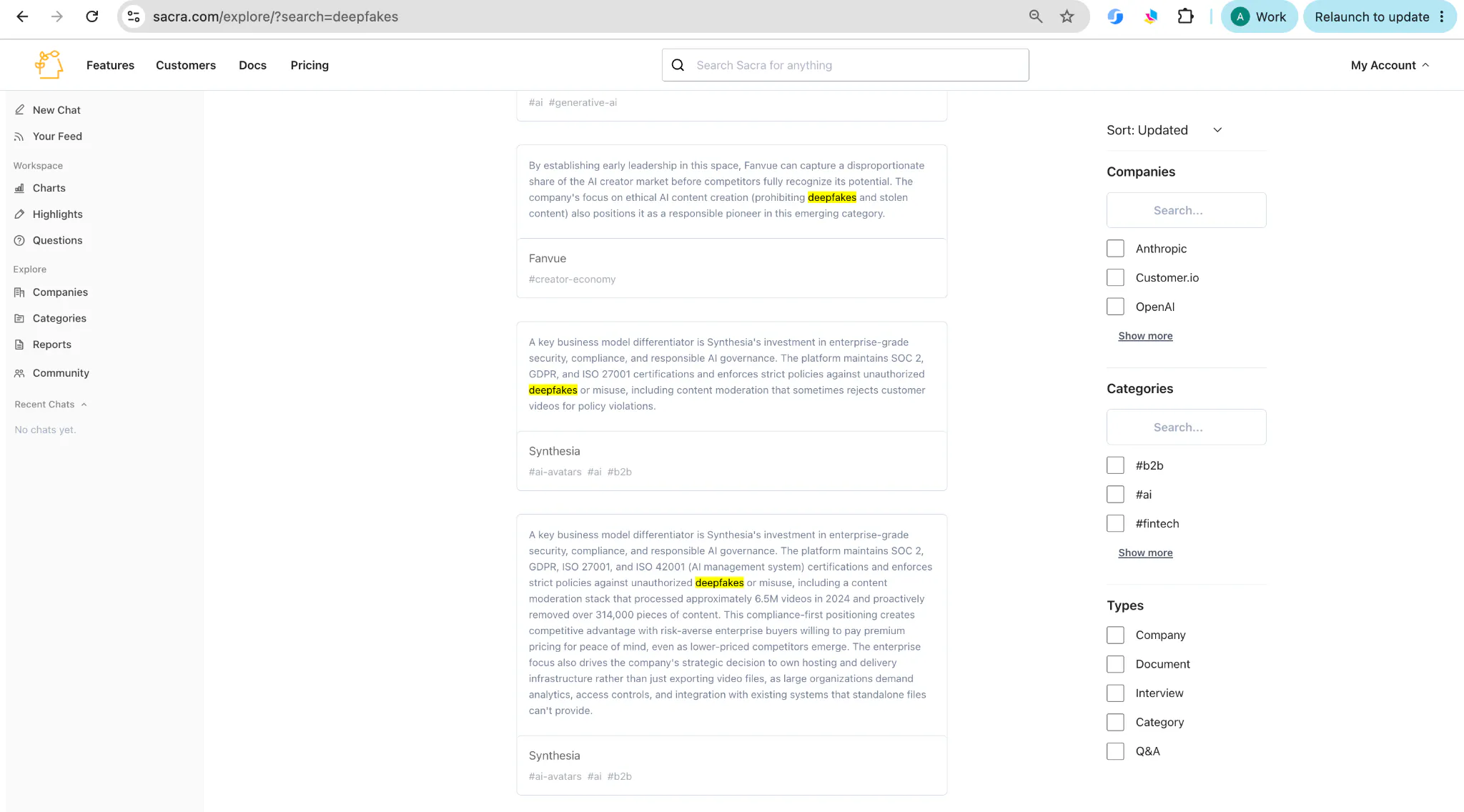
Research only works in moments like that if it holds up. “I have done so much counterchecking of various things in consequential moments where I really needed it to be true for me to action on something,” he says. “It proves to be true every time, reliably, which is pretty amazing.”
Get started with Sacra
Austin's advice for anyone piloting Sacra is the test he'd run himself: pull up your own portfolio and read the Sacra page for ten of your actual investments, winners, losers, and the ones in between. “You will learn something that you didn't already know. You will see no facts at all that are incorrect,” he says. “That's the aha wow factor that should do the convincing.”
Everything Austin uses comes with a standard Sacra subscription: the web app and the newsletter. When you want the same research inside your own tools, Sacra MCP puts it in Claude and ChatGPT, and the API puts it in your product.
If you're evaluating Sacra for your own diligence, email us at founders@sacra.com.