

Waymo vs. Tesla vs. Baidu
 Jan-Erik Asplund
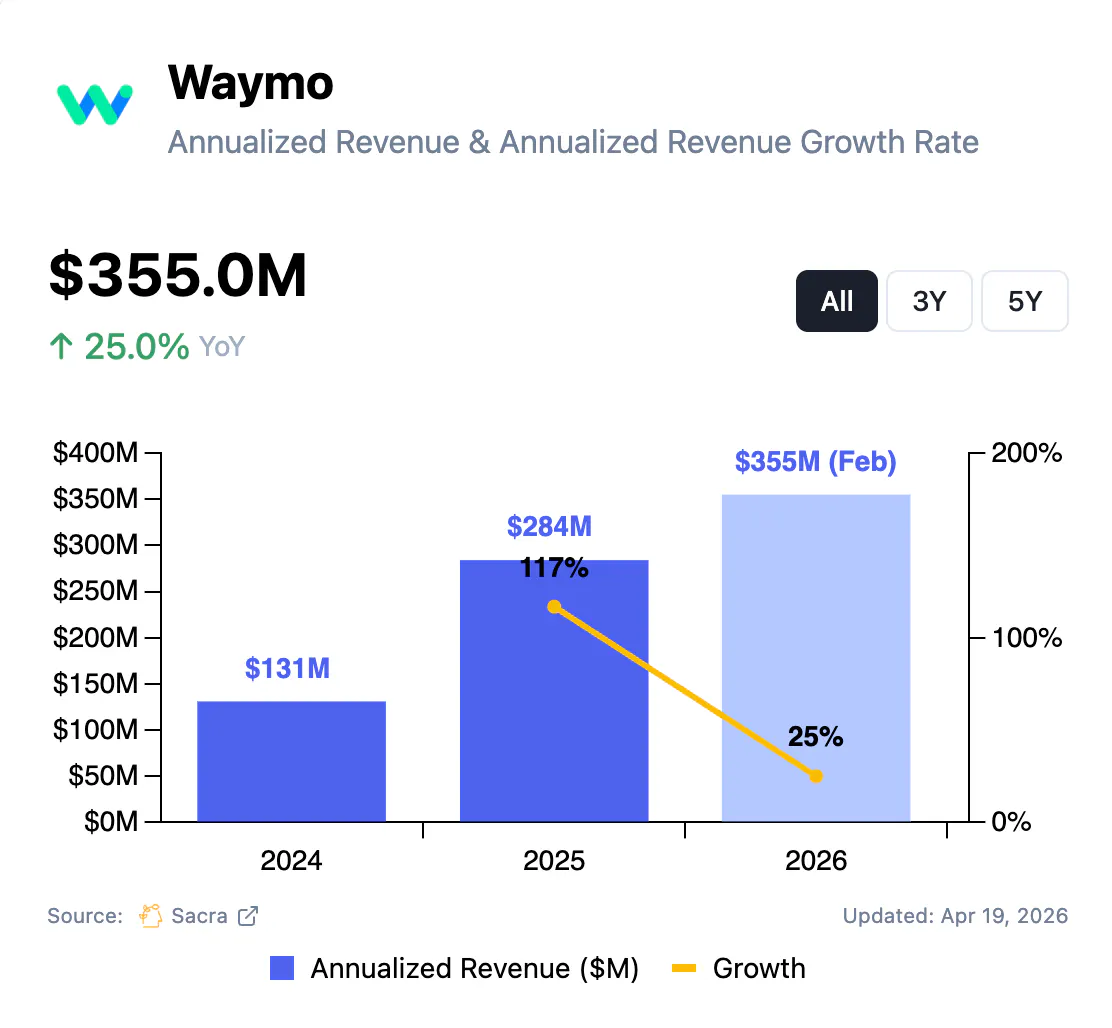
TL;DR: Waymo is the first AV company to prove real consumer demand and operational autonomy at scale, but the bull case depends on converting a capital-intensive, city-by-city fleet business into a high-utilization transportation network whose hardware cost curve falls faster than pricing pressure from Tesla, Baidu, and other AV operators. Sacra estimates Waymo hit $355M in annualized revenue in February 2026, up from $284M at the end of 2025. For more, check out our full report and dataset on Waymo.
Key points via Sacra AI:
- The ~2015 autonomous driving boom saw ride hail startups Uber & Lyft forming autonomy programs and car manufacturers Tesla launching Autopilot, GM acquiring startup Cruise for $1B (reaching a $30B valuation in 2021), and Ford & Volkswagen investing in autonomy startup Argo AI (peak $7.25B valuation in 2020)—before COVID forced these public companies to offload these massive fixed-cost R&D teams as the ongoing capex costs became unbearable given extending timelines for achieving autonomy. Waymo (founded in 2009), Tesla Autopilot (2014) & Baidu Apollo (2017) survived the crunch because they were attached to massive, durable businesses that could fund the long game of autonomy, with Alphabet investing $1.1B+ in Waymo before the spinout and Waymo taking in $27B+ in total funding, and $13B of Waymo’s $16B Series D coming from Alphabet itself.
- A common misconception about Waymo is that it positions as a cheaper alternative to Uber & Lyft without a driver cut or tip—when it’s actually more expensive at ~$20/ride vs ~$17/ride with 15-20 minute wait times vs. ~6 min—rather, Waymo looks to win against ride share with superior user experience offering a private, predictable & stress-free ride. Where Uber & Lyft’s marketplace UX matches riders with human contractors who can cancel, call, miss the pickup, expect a tip, take the wrong route or make small talk, Waymo makes the experience deterministic: the app routes users to a legal pickup spot, assigns an idle vehicle, displays the rider’s initials on the roof dome, idles for 5 minutes at the pickup spot, unlocks by phone and follows Google Maps directions after the rider hits “start”.
- Starting with public launches in Phoenix (October 2020, now ~100K weekly rides) and then San Francisco (2024, ~250K weekly rides) and Los Angeles (2024, ~90K weekly rides), Waymo’s strategy has been focused on launching autonomous ride hailing within geofenced, validated service areas, a progressive operational roll out, then expanding that geofence within that city and launching city-by-city to serve more geographies (now 10 metropolitan areas). Contrast that with Tesla, which has focused on supervised driving everywhere, collecting miles from across its ~7M consumer car fleet and building towards a generalized AI driving system that powers personal Tesla ownership and Robotaxi rideshare (launched supervised in Austin in 2025 & unsupervised in 2026).
- After growing from 50K weekly paid rides across 5 commercial markets in 2024 to 500K weekly rides across 11 as of April 2026 by adding Austin, Atlanta, Nashville and others as well as freeway rides & airport service (extending geofencing), Sacra estimates Waymo reached $355M in annualized revenue in February 2026, up from $284M at the end of 2025 and $125M at the end of 2024. Compare to ridesharing apps Uber at ~$43B in 2024 revenue growing 18% YoY and trading around 3.5x and Lyft at ~$5.8B growing 17% and trading around 1.2x, car manufacturer Tesla at $97.7B growing 1% and valued around $1T for ~10x, and physical AI platform Applied Intuition at $415M ARR growing 100% and valued at $15B for ~36x.
- While Tesla’s data flywheel produces roughly 50x the number of miles driven per month as Waymo’s (~1B vs ~20M miles/mo), Tesla trails Waymo in unsupervised miles with Tesla’s consumer Full Self Driving (FSD) subscription requiring driver supervision and its Robotaxi rollouts in Austin (June 2025), Houston (April 2026) & Dallas (April 2026) including safety monitors mixed in with unsupervised rides. Baidu (Apollo Go) looks to win the battle for Rest of World by replying on China’s favorable regulatory posture towards autonomy to accumulate miles and China’s advantages on the EV & sensor supply chain to produce purpose-built robotaxis with cheap domestic LiDAR for $28-30K apiece (which tariffs & restrictions prevent U.S. operators like Waymo from using and Tesla has chosen to go without as a core part of its strategy).
- In its most mature markets like San Francisco, Waymo is approaching profitability (~63% contribution margin) with ~25% market share (vs. 55% for Uber), operating with small fleets to “skim” the densest, highest-utilization periods of demand (weekday morning commutes & evening rushes) rather than overbuilding and falling victim to the 4x daily peak-to-trough demand swings that Uber and Lyft are better positioned to handle since their human drivers can flex off whereas Waymo’s cars incur continuous depreciation and overhead. The path from contribution-margin positive to profitable requires three things to move together for Waymo: 1) costs coming down from ~$150K Jaguar retrofits toward the new sub-$50K purpose-built Zeekr & Hyundai cars, 2) utilization rising from its current ~35% toward an Uber-like 55%, 3) “deadhead miles” reducing where cars are operating without fares.
- With the upside of replacing car ownership at stake, Waymo has chosen to optimize for speed in scaling city rollout with a mixed go-to-market that includes its own app Waymo One, contracting with Moove ($400M ARR in June 2025, up from $275M in 2024) on vehicle ops, charging and maintenance & partnering with Uber to supply Uber’s marketplace with Waymo cars (20% of Uber rides in Austin) & drivers to rent Uber demand & distribution and scale city rollout faster. Tesla’s vertically integrated strategy where it owns the vehicle, autonomy stack, app, fleet, customer relationship, and economics trades off a slower rollout with higher upside in its ability to drive down the cost per mile (~$0.81 per mile vs. Waymo at ~$1.40 per mile) with its full stack ownership, particularly in suburban markets.
For more, check out this other research from our platform:
- Waymo (dataset)
- Applied Intuition at $830M/year up 2x YoY
- Applied Intuition at $415M/year
- Bobby Healy, CEO & founder of Manna, on drone delivery for the suburbs
- Orest Pilskalns, CEO of Skyfish, on building autonomous drone infrastructure
- Scale at $760M ARR
- Scale: the $290M/year Mechanical Turk of machine learning
- America First vs. American Dynamism
Read more from


+2 others
Booking.com of robotaxi
Free Report
Continue Reading
Waymo revenue, growth, and valuation
Unlocked Report
Continue Reading
Read more from

Runway revenue, growth, and valuation
Unlocked Report
Continue Reading

Kling revenue, growth, and valuation
Unlocked Report
Continue Reading
Read more from

Moove revenue, growth, and valuation
Unlocked Report
Continue Reading