
Ro vs TrumpRx
 Jan-Erik Asplund
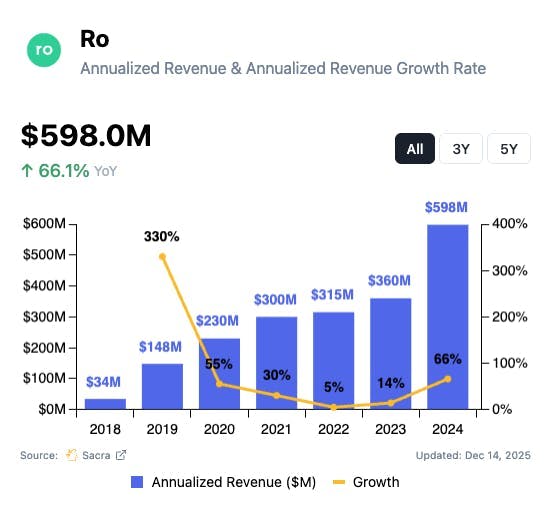
TL;DR: D2C telehealth platforms like Ro and Hims & Hers scaled from high-margin ED generics to even more lucrative GLP-1s, but Trump's TrumpRx platform now threatens to commoditize their obesity business. Sacra estimates that Ro hit $598M in annualized revenue in 2024, up 66% YoY from $360M in 2023. For more, check out our full report on Ro (dataset).
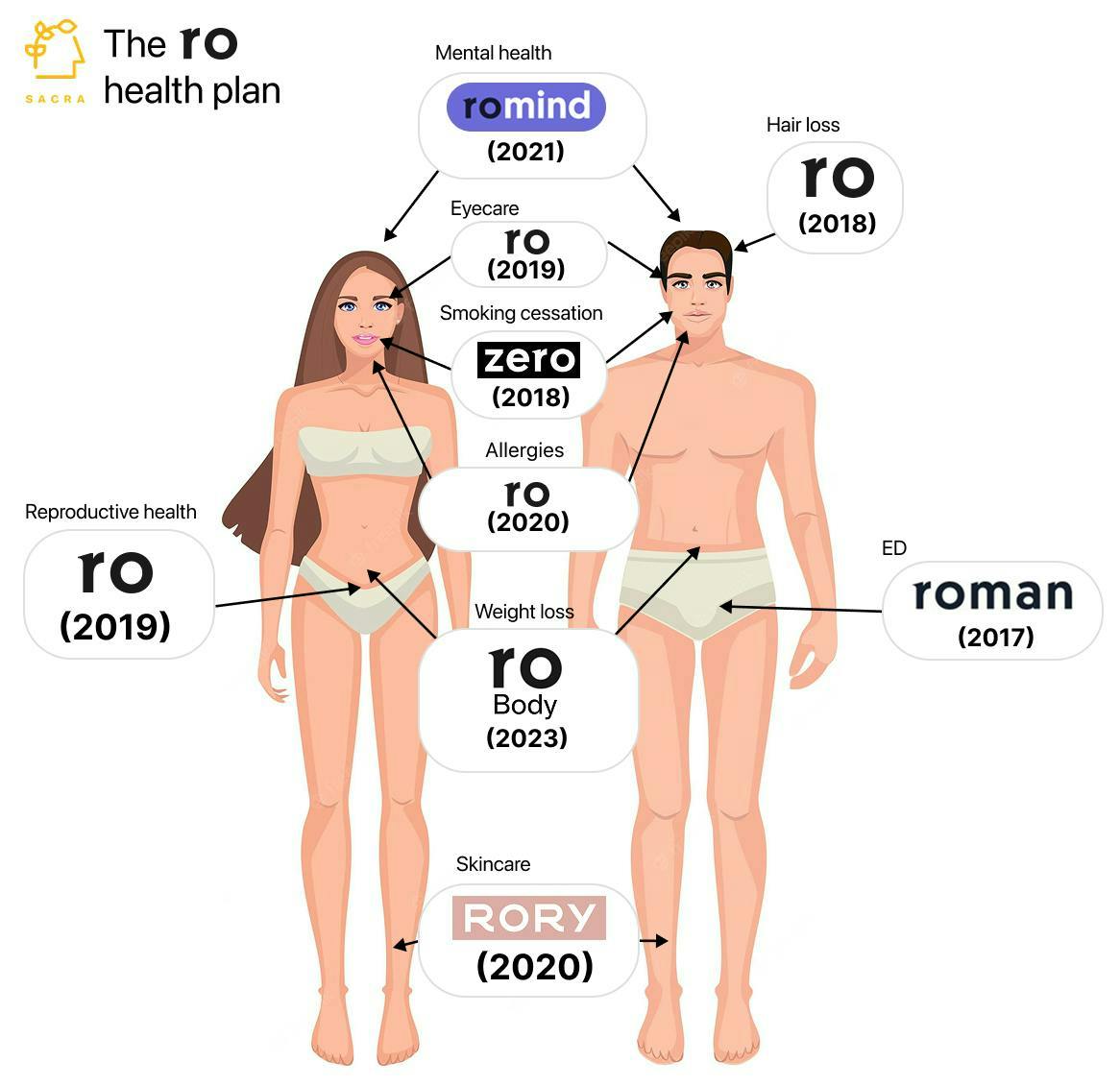
In November 2025, the Trump administration announced TrumpRx, a federal direct purchasing platform using tariff threats to extract Most Favored Nation (MFN) pricing from pharmaceutical manufacturers & bringing the cost of GLP-1s like Ozempic down to $350/month for cash payers (from $1,350/month).
For Ro, Hims & Hers, and other D2C telehealth platforms which saw rapid growth from the rise of GLP-1s over the past two years, TrumpRx threatens to commoditize away their pricing advantage.
Key points via Sacra AI:
- D2C telehealth platforms like Ro (founded 2017, $1.03B raised) and Hims & Hers (NYSE: HIMS, $2.21B in TTM revenue, up 50% YoY) replaced the traditional, embarrassing path to ED medication of scheduling a doctor, sitting through an awkward appointment, and taking a prescription to CVS—with async intake forms, clinician review within hours, and generic sildenafil shipped directly to the patient's door, charging no fee for the consult & monetizing on the drug fulfillment with ~65% gross margin. Because the workflow, from intake & async clinician review to prescription & ongoing messaging, was largely identical regardless of condition, Ro and Hims & Hers could go on to replicate it across hair loss, dermatology, and fertility, with ED accounting for ~60% of Ro's revenue as late as 2021 and Hims & Hers growing from $82M revenue in 2019 to $527M by 2022.
- Weight loss via GLP-1s like Ozempic ($17.45B in 2024 sales, up 25% YoY) proved even more lucrative than erectile dysfunction, with Ro's GLP-1 sales 3x'ing between January 2023 and August 2024, pushing topline growth to 66% in 2024 (vs 14% in 2023 and 5% in 2022) and lifting average transaction value from ~$93 to ~$134, while Hims & Hers hit 100K GLP-1 members and ~$343M in annualized GLP-1 revenue by the end of 2024. Where the proliferation of widely available generics for ED created ~50% yearly churn at times for Ro and Hims & Hers, Ozempic provided a drug with structurally high customer lifetime value (CLTV) because the drugs must constantly be tweaked & are designed to be taken for life & ~40% of Americans meet the clinical criteria for prescription.
- Unlike ED pills that require only a one-time consultation, GLP-1 treatment demands ongoing clinical management including lab work, dose titration, side-effect monitoring, and adherence coaching, leading Ro to launch a $145/month subscription program (Ro Body) that bundles 24/7 telehealth access with structured obesity care on top of the drug cost itself. To deliver this more operationally demanding service, Ro vertically integrated via acquisitions including Workpath (in-home phlebotomy), Kit (at-home diagnostics), and Modern Fertility (hormone testing), stitching these together with its own lab and 6 owned pharmacies, allowing the company to collect labs via home kits, run them in its own facility, adjust GLP-1 dosing based on results, and ship medications next-day.
- As nationwide shortages hurt GLP-1 availability in 2023-2024, Ro and Hims & Hers were able to build a universal access model that worked regardless of insurance status, providing telehealth appointments, taking insurance & routing patients to the cheapest option whether that was 1) insurance-covered prescriptions, 2) cash self-pay, or 3) the $199-$499/month generics available from compounding pharmacies that mix their own raw semaglutide powder, replacing the fragmented experience where coverage-denied patients had to visit brick-and-mortar doctors and then hunt down trustworthy compounding pharmacies online. This one-stop-shop positioning let D2C platforms monetize compounded supply at ~80% gross margins while solving the convenience problem for the ~60% of patients whose commercial insurers and Medicare excluded GLP-1 coverage for weight loss, with Ro's vertically integrated stack handling intake, prescription, fulfillment, and ongoing care through a single interface.
- After the FDA declared GLP-1 shortages resolved in early 2025 and began cracking down on compounding pharmacies, Ro and Hims & Hers shifted to partnering with Eli Lilly and Novo Nordisk's direct-to-consumer cash-pay pharmacies, LillyDirect (launched January 2024) and NovoCare (launched March 2025), that the manufacturers had built to bypass insurance and PBM channels and capture the unprecedented consumer demand around by GLP-1s, for which ~60% of patients are denied coverage by their insurers. The manufacturers needed direct-to-consumer distribution they lacked & D2C platforms needed legitimate branded supply as compounding became illegal, leading to a symbiotic relationship where Ro pipes prescriptions and payments directly into manufacturer pharmacies behind the scenes while maintaining a unified Ro-branded front door, bringing the cost down from $1,349 list price to $499/month and driving over 50% of Ro's GLP-1 business through these channels by mid-2025.
- TrumpRx, a federal purchasing portal announced November 2025 and launching January 2026, uses the threat of 100% tariffs on pharmaceutical imports to force Novo Nordisk, Eli Lilly, and other manufacturers into Most Favored Nation pricing agreements that bring GLP-1 injectables down to ~$350/month for cash-pay users, bypassing the insurance, PBM, and traditional pharmacies & competing directly with Ro by redirecting patients who search for drugs on TrumpRx.gov to the same manufacturer cash-pay pharmacies Ro pipes into. The core threat is disintermediation, where patients get a one-time prescription from their primary care doctor and then access GLP-1s directly through TrumpRx rather than paying $145/month for Ro's subscription that bundles telehealth, labs, titration, and coaching, forcing Ro to immediately cut Wegovy prices to $349/month to match TrumpRx's floor and raising the strategic question of whether Ro's care management can justify a subscription when patients can route around it.
- With TrumpRx and cash-pay commoditization threatening Ro's D2C margins, the emerging battlefield shifts to the employer benefits market where 160 million Americans with employer-sponsored insurance face 85% plan restriction rates on GLP-1 coverage for weight loss, putting Ro on a collision course with Omada Health ($450M raised, U.S. Venture Partners) and Virta Health ($402M raised, Venrock) that have always derived the majority of revenue from employer and payer contracts built on outcomes-based chronic disease management. Self-insured employers are increasingly requiring GLP-1 patients to participate in structured management programs rather than writing blank-check prescriptions, creating an opportunity for Ro to sell HR benefits teams on its combination of brand recognition, vertically integrated care infrastructure, and manufacturer partnerships but also forcing it to prove it can compete on adherence rates & long-term outcomes rather than only access, convenience, and pricing.
For more, check out this other research from our platform:
- Ro (dataset)
- Ro and the telehealth capital cycle
- Hone Health at $114M ARR growing 82% YoY
- Rula at $471M/year growing 100% YoY
- Function Health at $100M/year
- Maven Clinic at $268M ARR
- Commure at $105M ARR
- Virta Health at $175M revenue
- Noom at $1B ARR
- Hone Health: the $55M/year D2C testosterone startup
- Sweden’s $215M/year telehealth giant
- Johannes Schildt & Claes Ruth, CEO and CFO of Kry, on the AI future of telehealth
- Marc Atiyeh, CEO of Pawp, on building telehealth for pets
- Brendan Keeler, Senior PM at Zus Health, on building infrastructure for digital health
- Noom at $1B ARR