

Decagon vs Sierra
 Jan-Erik Asplund
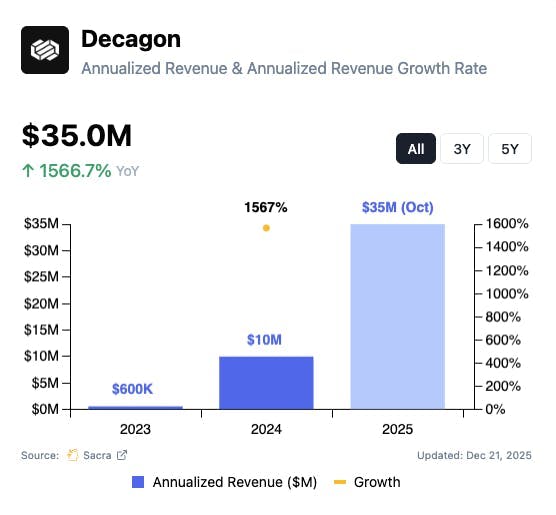
TL;DR: As AI chatbots emerged as enterprise LLMs' first breakout use case, Decagon launched in August 2023 to build AI customer service agents that go beyond Q&A to take backend actions like processing refunds and canceling subscriptions, handling 70-75% of support conversations without human intervention. Sacra estimates Decagon hit $35M annualized revenue in November 2025, up 2.5x from $10M at the end of 2024 and up ~283% YoY, valued at $1.5B for a 42.9x multiple. For more, check out our full report and dataset.
Key points via Sacra AI:
- Like Sierra ($104M ARR growing 354% YoY as of November 2025), Decagon was founded in 2023 to harness the power of GPT-4 for enterprise customer service by putting guardrails around its non-deterministic output, making it auditable, and arming it with the ability to not just respond but change customer information, process refunds, & update key systems of record. Starting first with a model that charged for all conversations touched, Decagon has evolved to a per-resolution model at ~$1.50/resolution, coming out to ~10% the cost of human support agents that enables teams to freeze or reduce support headcount.
- Driving deployments through a forward-deployed, high-touch model where engineers build custom integrations for each customer, Decagon’s customer base tilts slightly more tech-centric (Notion, Rippling, and Duolingo) vs. Sierra (WeightWatchers, SiriusXM), with Sacra estimating Decagon hit $35M annualized revenue in November 2025, up 2.5x from $10M at the end of 2024 and up ~283% YoY, valued at $1.5B for a 42.9x multiple. Compare to AI customer service market leader Sierra at $104M ARR in November 2025 growing 354% YoY, valued at $10B for a 96x forward revenue multiple, Intercom at $343M revenue in 2024, valued at $1.3B for a 3.8x revenue multiple, and Gorgias at $69M ARR in 2024, up 34% YoY, valued at $710M for a 10.3x multiple.
- The AI customer support market has become co-opetitive with AI agent integrations into the existing support stack enabling faster and more seamless deployments, e.g., using Decagon as the AI agent on top of Intercom as the support platform, versus incumbent support platforms Zendesk ($2B ARR) & Salesforce (NYSE: CRM) which have moved (with varying degrees of speed & urgency) to launch vertically-integrated AI support agents. With Agent Operating Procedures (AOPs) that let non-engineers build conditional workflows for escalations, API actions, and proactive outreach, some Decagon customers are using agents to guide new users through onboarding, pitch new features, & qualify sales leads, pointing to the larger opportunity where conversational AI via Decagon agents becomes the interface across the full customer lifecycle.
For more, check out this other research from our platform:
- Decagon (dataset)
- Sierra (dataset)
- Front: Inside the $1.3B Startup Slackifying Email [2020]
- Front (dataset)
- Intercom (dataset)
- Intercom's $250M/year AI bet
- Eoghan McCabe & Des Traynor, CEO and CSO of Intercom, on the AI transformation of customer service
- Gorgias at $69M ARR
- How AI is transforming B2B SaaS
- Colin Nederkoorn, founder & CEO at Customer.io, on the CDP layer in messaging
- Klaviyo: the $665M/year HubSpot for ecommerce
- Brian Whalley, Co-Founder of Wonderment, on Klaviyo's product-market fit Klaviyo (dataset)
Read more from

+1 others
Growth at Whop - Decagon
Free Report
Continue Reading

+3 others

Read more from


Spellbook revenue, growth, and valuation
Unlocked Report
Continue Reading

Read more from
AI support agents vs help desk SaaS
Free Report
Continue Reading
Sierra vs Decagon
Free Report
Continue Reading
Sierra revenue, growth, and valuation
Unlocked Report
Continue Reading