
CoreWeave of space
 Jan-Erik Asplund
TL;DR: Completing a tender at $800B and guiding towards a reported $1.5T 2026 IPO, SpaceX is now positioning itself & Starlink as core infrastructure for the scaling of AI inference & training via space data centers. For more, check out our SpaceX report and dataset.

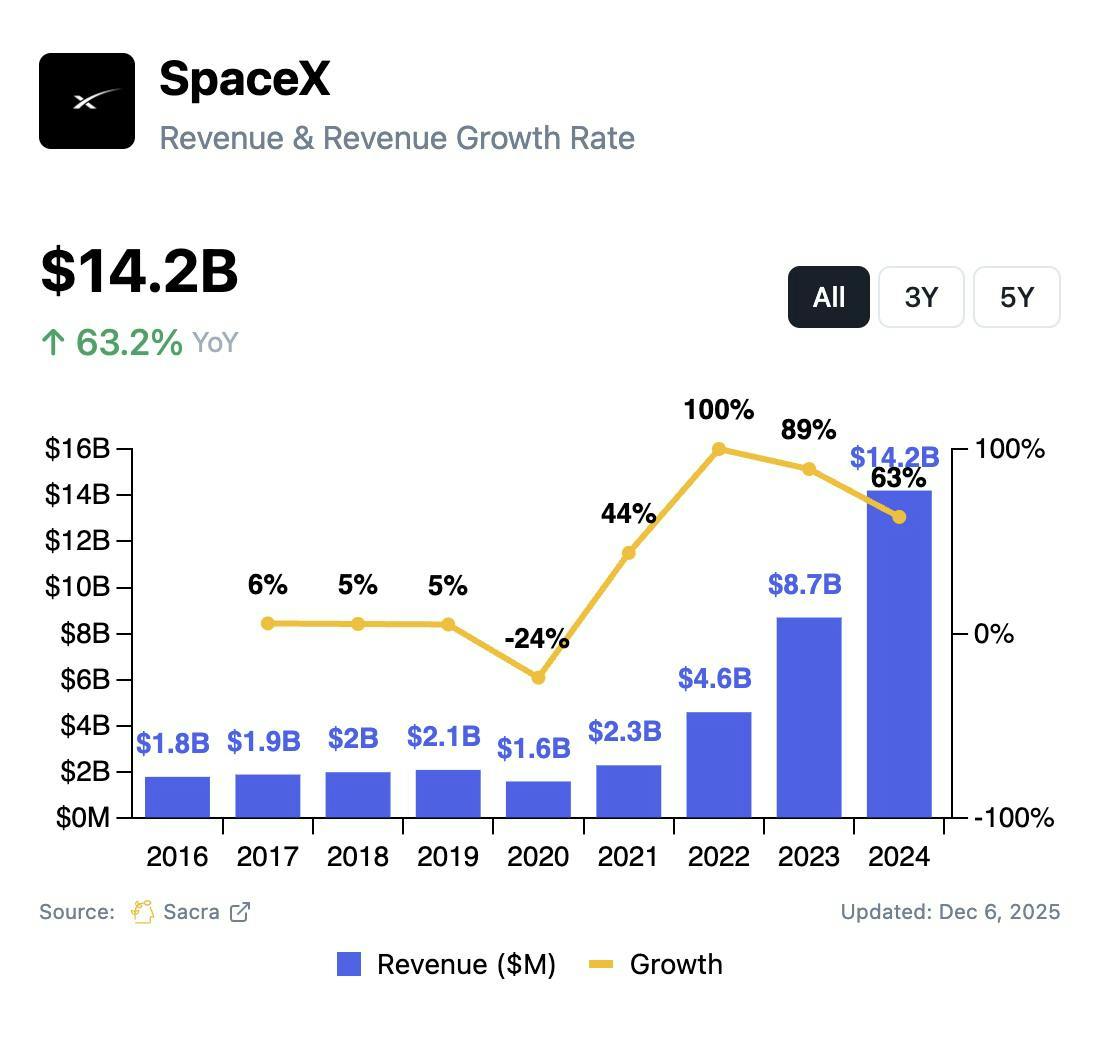
Last week, SpaceX announced the completion of a tender offer valuing the company at $800B, and reports now suggest the company is targeting a 2026 public listing at a $1.5T valuation.
The company’s multiple expansion thesis increasingly hinges on positioning itself as core infrastructure for data centers in space, forming the third pillar of the business alongside the launch business and Starlink.
Key points via Sacra AI:
- As global data center power demand triples toward 800 TWh by 2030 while operators face 1) utility interconnection queues stretching 3-5 years & 2) water moratoriums in drought prone regions, SpaceX ($14.2B revenue in 2024, up 63% YoY) is betting that the future of data centers is in orbit. While there is a near-continuous supply of free solar power in space and ambient temperature of -455 degrees, the lack of air means that data centers have to dump heat via massive radiators (~250m² for every one GPU rack) that only work out to be cheaper than terrestrial data centers (with their cheap air & water cooling) if launch costs drop below $200/kg, meaning space data centers are a bet on Starship's cost curve.
- Like with Tesla’s vision of FSD or SpaceX’s mission to colonize Mars, the orbital compute concept is less a guarantee of space data centers by 2030 and more a directional bet that focuses capital & talent across Elon’s empire of companies around a set of hard but commercially valuable problems around launch capacity & thermal engineering (SpaceX), satellite communication (Starlink), power systems (Tesla), and AI training (xAI). SpaceX's expected 2026 IPO at a market cap of ~$1.5T embeds this kind of optionality the way Tesla embeds FSD, re-rating the company from a launch utility to be valued like a Boeing or Lockheed (.3 to 1x) to an infrastructure platform like Nvidia (30x+).
- While startups like Starcloud ($28M raised, YC S24) look to win as pure play space data centers, Blue Origin (founded 2000) & Relativity Space ($1.34B raised) are competing with SpaceX to own both the satellites & rockets, with SpaceX uniquely positioned to capture the upside of 1) vertical integration with xAI ($3.2B annualized revenue in July 2025, up 3,100% YoY) for cheaper training & inference, 2) being core infrastructure for Google (NASDAQ: GOOG), Microsoft (NASDAQ: MSFT) and Nvidia (NASDAQ: NVDA) for the next trillion dollars in spend on AI. With the potential for xAI to train Grok on orbital GPUs and Tesla to run FSD model training on space-based compute, SpaceX’s “CoreWeave in space” has built-in demand from its sister companies while Musk can capture the launch fees, the Starlink connectivity, and the compute revenue all within his own ecosystem.
For more, check out this other research from our platform:
- SpaceX (dataset)
- SpaceX vs Verizon vs AT&T
- Starlink at $4.1B/year growing 121%
- Anduril, SpaceX, and the American dynamism GTM playbook
- The biggest mistake defense startups make
- Ross Fubini, Managing Partner at XYZ Capital, on the defense tech opportunity
- Shield AI (dataset)
- Scott Sanders, chief growth officer at RRAI, on the defense tech startup playbook
- Anduril (dataset)
Read more from

Why SpaceX acquired xAI
Free Report
Continue Reading
SpaceX vs Verizon vs AT&T
Free Report
Continue Reading
Read more from


SpaceX's app layer
Free Report
Continue Reading
Read more from

Pocket revenue, growth, and valuation
Unlocked Report
Continue Reading
Pocket at $27M annualized revenue
Free Report
Continue Reading