

$778M/year Bending Spoons of mobile consumer apps
 Jan-Erik Asplund
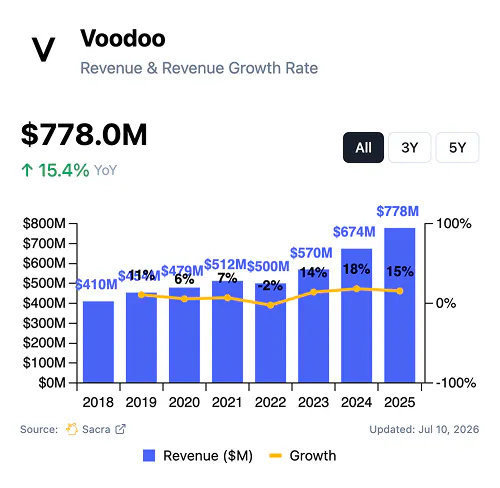
TL;DR: Voodoo went from $0 to $400M in revenue in two years by building a hyper-casual gaming empire on cheap, ad-bought mobile installs, and now it's pointing that same machine at a portfolio of consumer apps, starting with BeReal. Sacra estimates Voodoo hit $778M in revenue in 2025, up 15% YoY. For more, check out our full report and dataset on Voodoo.
Key points via Sacra AI:
- Zynga (2007) built a $1B/year gaming business on Facebook, distributing microtransaction-based casual games like FarmVille and Mafia Wars on the News Feed until Facebook throttled organic distribution for 3rd-party apps (2012), creating the opportunity for Voodoo (2013) to launch as a mobile-native Zynga, pioneering the “hyper-casual” genre of rapidly iterated, one-finger games whose installs could be bought profitably across Facebook, Google, and emerging ad networks like AppLovin (2011). Where Zynga spent $100K and 3-6 months per game building persistent virtual worlds that monetized whales' attachment to their farms and mafias (50% of revenue from 1% of users), Voodoo focused on experimentation & fast iteration, spinning out 1-2 games per week at $5K each, quickly shutting down the duds, and pouring money into those where ad revenue (95% of all Voodoo revenue) exceeded the cost of buying the initial install.
- Off the breakout success of their game Paper.io, Voodoo launched Voodoo Publishing to let third-party studios & indie developers plug their games into Voodoo’s user acquisition & monetization machine, growing from 0 outside studios & $1M in revenue in 2016 to 800 outside studios & $400M in revenue in 2018. In 2021, Apple's changes to ad targeting made gaming ads 30% more expensive and removed the ability to track players from game-to-game, driving a 34% YoY drop in hypercasual ad spend and forcing Voodoo to shift towards creating more free-to-play (F2P) casual games like Clash of Clans (Supercell), Candy Crush (King) or Angry Birds (Rovio) with virtual economies, live events and in-app purchases.
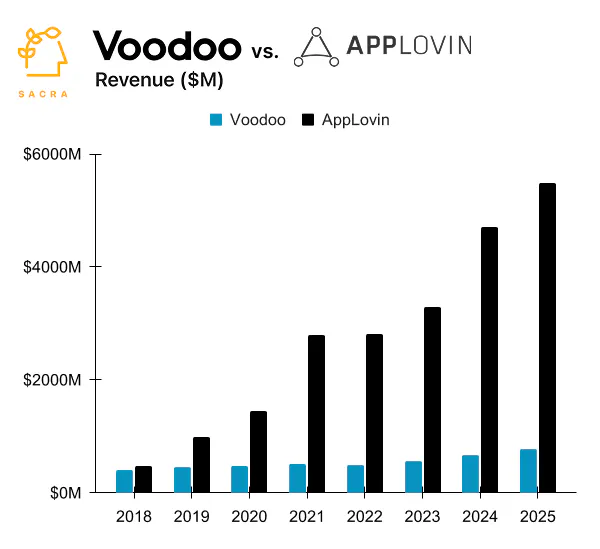
- After revenue growth slowed down in 2020 and 2021 (6-7% YoY) and then declined in 2022 (-2% YoY) with the combination of Apple’s ad changes & saturation in hypercasual gaming, Voodoo accelerated in 2023, with Sacra estimating that Voodoo hit $778M in revenue in 2025, up 15% year-over-year, valued at $1.8B as of its 2021 Series E for a 3.5x multiple on $512M in 2021 revenue. Compare to Supercell at $3B in 2025 revenue, down 4% YoY, acquired by Tencent for $8.6B in 2016, AppLovin (NASDAQ: APP) at $5.5B in 2025 revenue, up 70% YoY, valued at $144B for a 26x multiple, and Unity (NYSE: U) at $1.85B in 2025 revenue, up 2% YoY, valued at $13B for a 7x multiple.
- As hypercasual cratered from 100% of revenue in 2021 ($512M) to a Sacra-estimated 9% as of 2025 ($73M), Voodoo has rebuilt its revenue mix around casual games, now at 84% of revenue in 2025 ($653M), with consumer apps like BeReal ($34M) contributing to the remaining $52M (7%). Along with the shift to casual games, Voodoo cut its partner studio network from ~800 to ~100, concentrating spend on fewer, deeper games and taking EBITDA margins from 3% in 2022 to 22% in 2024 while making revenue more durable, with games live for 2+ years generating 80% of 2024 revenue versus the weeks-long lifespans of the hypercasual era.
- Now, Voodoo is using the cash flow and mobile growth infrastructure of its gaming business to acquire apps with strong engagement but underdeveloped growth or monetization that it can scale through user acquisition & advertising, building toward a mobile consumer conglomerate that includes BeReal (€500M, June 2024), teen chat app Wizz, mothers’ community WeMoms, and live-shopping app Jamble. Voodoo sits on both sides of AppLovin, paying it to place ads inside other games to acquire players while selling it ad impressions inside its own games to fill, making Voodoo simultaneously one of AppLovin's major customers and major suppliers, as well as a potential competitor with its Voodoo Ads business.
For more, check out this other research from our platform:
Read more from
Voodoo Revenue and Growth
Unlocked Report
Continue Reading
Read more from

Discord at $600M/year
Unlocked Report
Continue Reading

Fortnite at 120M MAUs
Unlocked Report
Continue Reading

