

$112M/year Hereticon of nationally chartered banks
 Jan-Erik Asplund
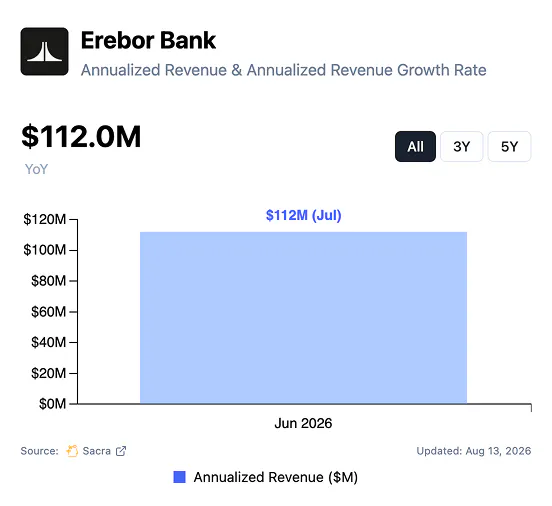
TL;DR: Founded by Palmer Luckey and backed by Founders Fund, 8VC, Haun Ventures & Lux Capital, Erebor launched in February 2026 as a bank for capital-intensive AI, defense & crypto companies, taking deposits, lending against nontraditional assets and moving money through APIs & stablecoins. Sacra estimates Erebor hit $112M in annualized revenue in July 2026, up 38% MoM from $31M in March, in talks to raise at a $9.5B valuation for an 85x multiple. For more, check out our full report and dataset on Erebor.
Key points via Sacra AI:
- Co-founded by Palmer Luckey (Anduril founder) and backed by Founders Fund (~$17B AUM), Joe Lonsdale’s 8VC ($8.5B AUM), Haun Ventures ($2.5B AUM) & Lux Capital ($7B AUM), Erebor launched in February 2026 as a federally chartered, FDIC-insured national bank built to provide financial infrastructure for American technological leadership (i.e. “American dynamism”), focused on serving defense, AI and crypto companies. Biden-era crypto de-banking circa 2022-2023 along with the March 2023 collapses of Silicon Valley Bank, Silvergate Bank and Signature Bank spurred Luckey & team to found Erebor as a nationally chartered bank that could not be cut off by an upstream banking partner, vertically integrated like Column (founded by Plaid co-founder William Hockey & his wife Annie) to consolidate the money supply chain, to support today’s heretical companies & industries that could become tomorrow’s strategic powerhouses for the U.S. over the long term.
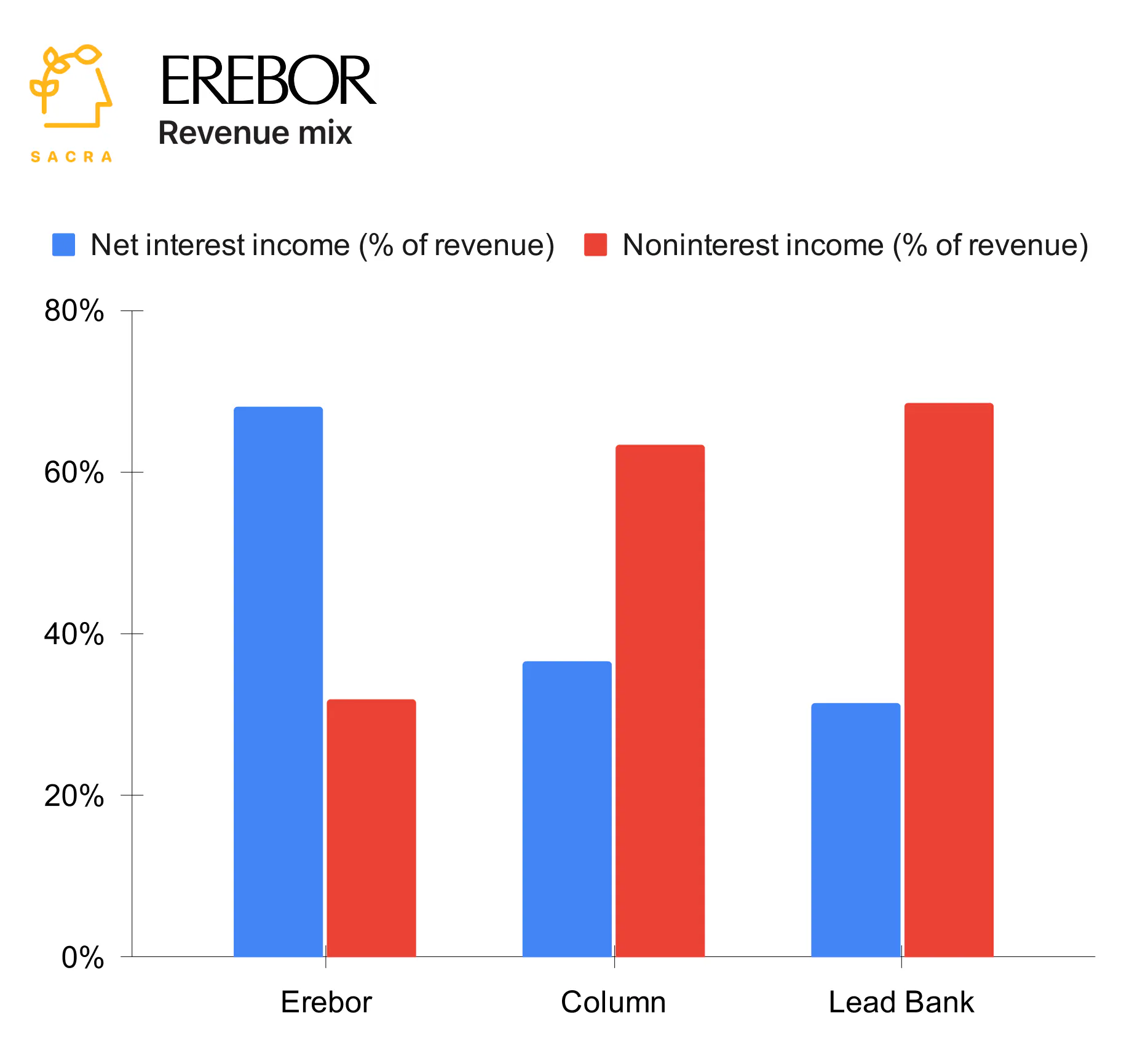
- Erebor monetizes its ~500-600 large, capital-intensive customers (companies like nuclear energy startup Valar Atomics, $1.35B raised, Sequoia) primarily through interest on their deposits (68% of Q2 revenue), with the remaining 32% coming from its banking API business serving startups like Yellow Card ($90M raised, Valar Ventures) in B2B stablecoin payments & Internet Backyard ($4.5M raised, Basis Set Ventures) in AI FinOps. Like Mercury (first a neobank and now a federally charted bank) & SVB, Erebor serves venture-backed startups with high burn, minimal revenue initially, and a tendency to withdraw rather than deposit money over time, but Erebor differs in having a much higher revenue per customer ($200K vs. ~$35K) and it was built from day 1 to serve both as a commercial bank and as programmable banking API infrastructure, not either/or.
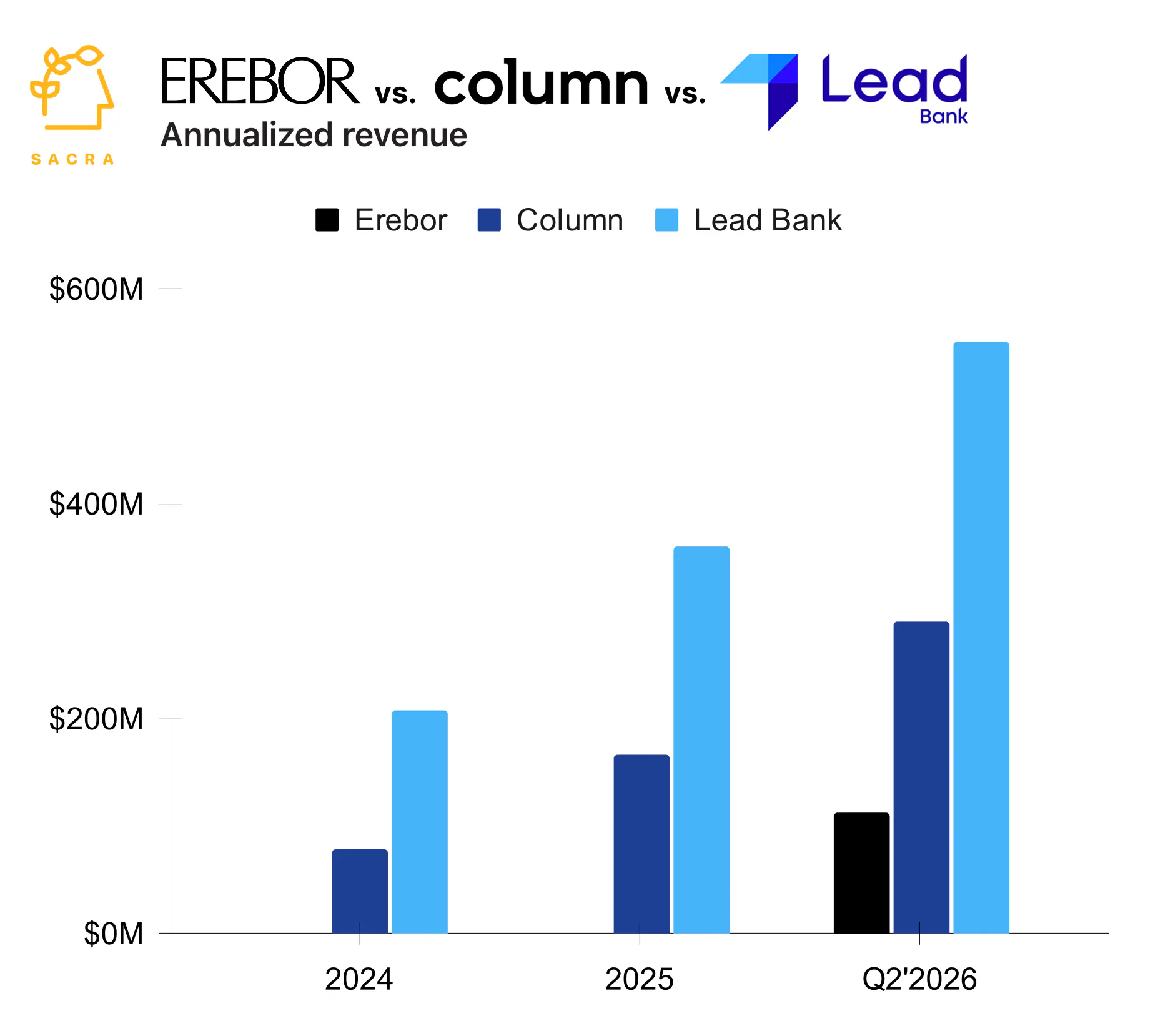
- Seeding deposits with capital from its network, then growing deposits from $1.1B after its first seven weeks to $4.1B at the end of Q2 and $4.6B by the end of July (still without a public-facing website signup form), Sacra estimates Erebor grew from $31M in annualized revenue at the end of March 2026 to $112M in July, growing at 38% month-over-month, with the company in talks to raise at a $9.5B post-money valuation for an 85x revenue multiple. Compare to Column at $291M in annualized revenue in June 2026, +114% YoY in 2025, Lead Bank at $551M, +75% YoY, valued at $1.47B for a 5x multiple on ~$287M annualized revenue, and Mercury at $650M, +97% YoY, valued at $3.5B for a 6.4x multiple on $550M annualized revenue.
For more, check out this other research from our platform:
- Erebor (dataset)
- $55M/yr mom & pop BaaS
- Column (dataset)
- Cross River Bank (dataset)
- Celtic Bank (dataset)
- Choice Financial Group (dataset)
- Lead Bank (dataset)
- Mercury (dataset)
- Brex (dataset)
- Ramp (dataset)
- Anthony Peculic, Head of Cards at Cross River Bank, on building a fintech one-stop shop
- Bo Jiang, CEO of Lithic, on the power of the cards as a digital payment rail
- Art Levy, Chief Business Officer at Brex, on the strategy of Brex Embedded
- Immad Akhund, CEO of Mercury, on the business models of fintechs vs. banks
- Mercury: the unbundling of Silicon Valley Bank
- Geoff Charles, VP of Product at Ramp, on Ramp's AI flywheel
- Karim Atiyeh, co-founder and CTO of Ramp, on the future of the card issuing market
Read more from
Read more from


+1 others
Stripe's stablecoin bank
Free Report
Continue Reading


Read more from


Post-Brex Ramp vs Mercury
Free Report
Continue Reading

$200M/year Whop of B2B neobanks
Free Report
Continue Reading