Why SpaceX acquired xAI
 Jan-Erik Asplund
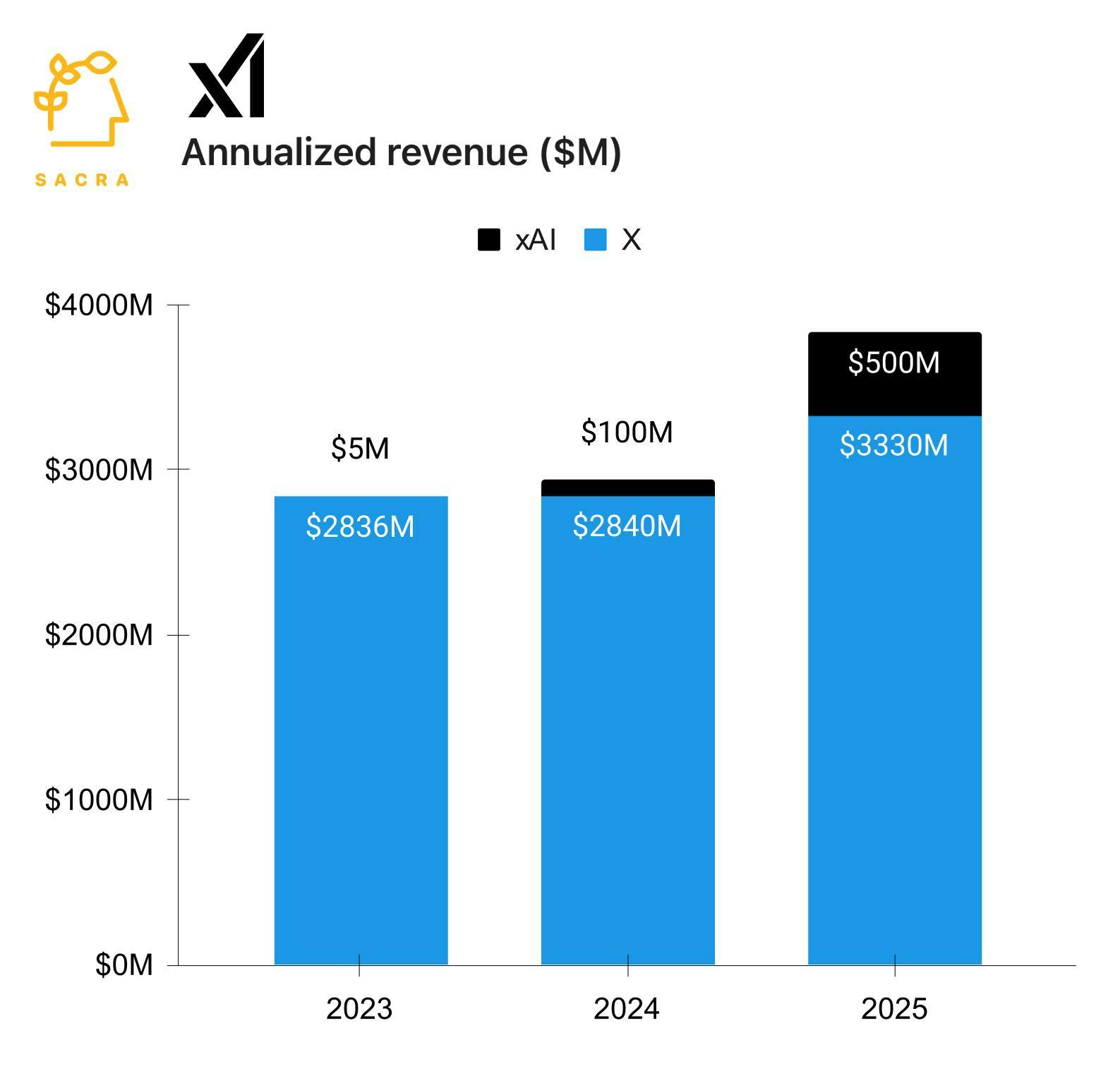
TL;DR: SpaceX's all-stock acquisition of xAI at a $250B valuation gives xAI investors a path to liquidity through SpaceX's anticipated 2026 IPO while consolidating Musk's AI and space ambitions around orbital data centers. Sacra estimates combined xAI and X revenue hit ~$3.8B annualized at the end of 2025, up 38x from ~$100M in 2024. For more, check out our full report and dataset on xAI.
We first covered xAI in January 2025 at $100M in annualized revenue, positioning Grok as the "free speech" ChatGPT alternative with deep X integration.
Since then, xAI acquired X from Musk's private holding company, launched Grok 3 (February 2025) and Grok 4 (July 2025), and raised a $20B Series E (January 2026).
On February 2, 2026, SpaceX announced it would acquire xAI, merging Musk's AI lab and social media company with his space infrastructure company.
Key points via Sacra AI:
- Sacra estimates xAI reached $3.8B in annualized revenue at the end of 2025, up 38x YoY from $100M in 2024, with X's advertising and premium subscriptions contributing $3.3B, up 17% YoY, and xAI's standalone AI business (SuperGrok subscriptions and enterprise API) contributing $500M, up 400% YoY. When Musk acquired Twitter in October 2022 for $44B, the company was losing ~$200M annually on ~$5B in revenue—xAI now (~$42B in total raised) is burning ~$1B per month, picking up $20B in their January Series E (Nvidia, Fidelity)—compare to OpenAI burning ~$10B per year on ~$60B raised and Anthropic burning $5.2B per year on $40B raised.
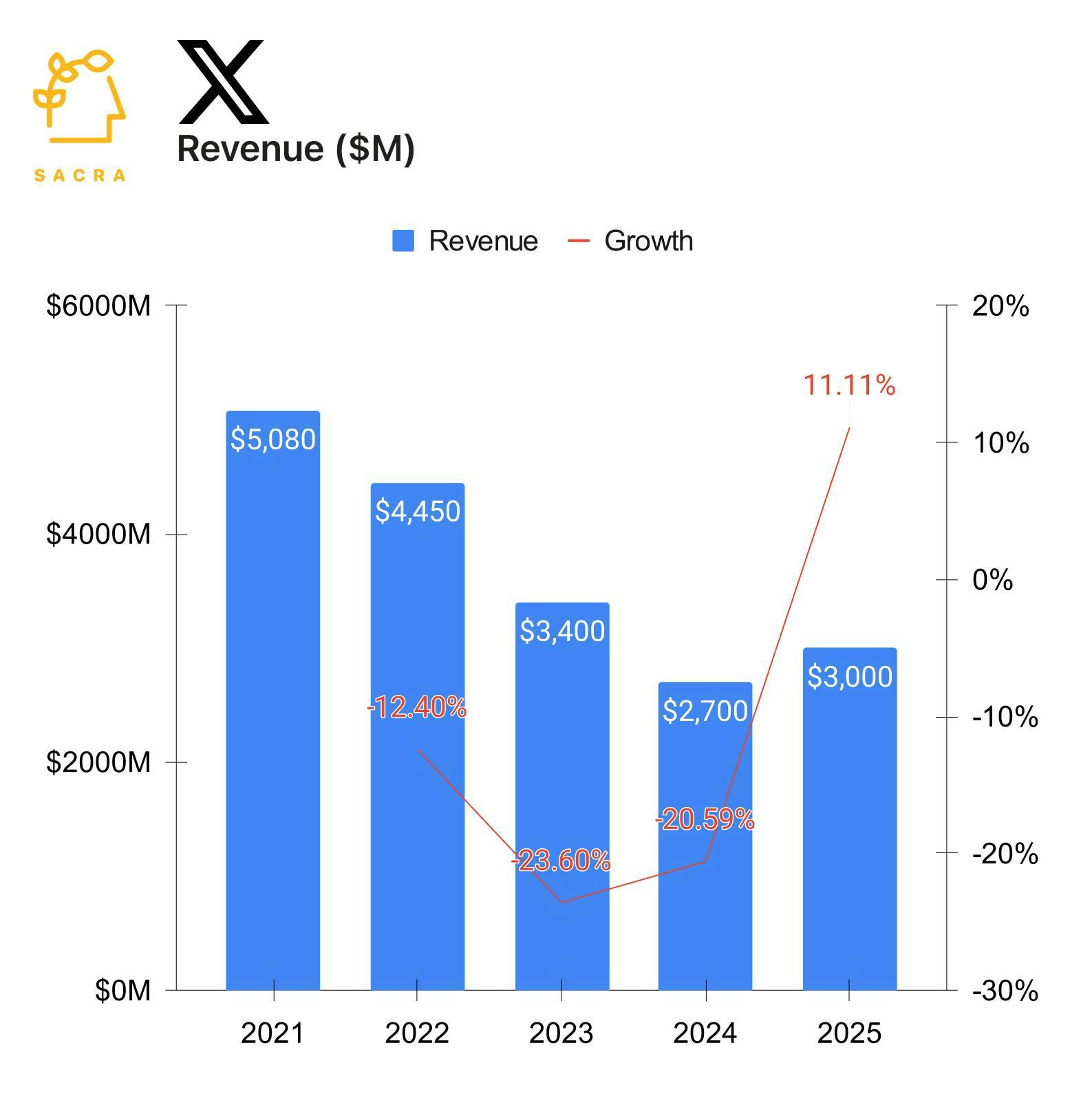
- xAI has established Grok as an LLM with strong vertical applications in enterprise, leveraging exclusive access to real-time X data to become a default model for use cases from quantitative trading and algorithmic sentiment analysis (finance & prediction markets) to brand reputation monitoring (customer support & PR). Where Elon Musk's confrontational & uncensored public persona along with his “free speech” approach to content moderation drove revenue at X down 47% from $5.1B in 2021 to $2.7B in 2024 amid advertiser boycotts, it hasn’t materially affected xAI’s enterprise pipeline—with 2025's ~$3.0B in TTM revenue post-xAI acquisition marking the first growth year post-acquisition—with the reservation that brands building customer-facing, generative content applications on Grok typically have to build in their own guardrails on outputs.
- SpaceX announced its all-stock acquisition of xAI on February 2, 2026, valuing xAI at $250B within a combined $1.25T entity for a ~66x multiple on xAI & X's combined revenue—compare to OpenAI at $20B annualized revenue, up 233% YoY, valued at $500B (25x) and Anthropic at $9B annualized revenue, up 800% YoY, valued at $170B (19x). By giving xAI's investors a path to liquidity through SpaceX's anticipated ~$1.5T 2026 IPO—not to mention the investors he recruited to take Twitter private at a $44B valuation in 2022—the deal continues Musk's track record, established with Tesla's $2.6B SolarCity acquisition, of ensuring that investors in Musk projects do not lose money.
- While Grok ranks #5 on foundation model adoption behind OpenAI, Google, Anthropic, and Meta, xAI ranks #2 on owned compute ahead of every AI lab except Google—with an infrastructure execution capability unmatched in the industry. xAI built its 100,000-GPU Memphis supercomputer Colossus in 122 days (which NVIDIA CEO Jensen Huang called "superhuman") versus the typical 3-4 years, then doubled it to 200,000 GPUs in 92 days and broke ground on Colossus 2 in Mississippi, the world's first gigawatt-scale data center with 550,000+ GB200 GPUs and $20B+ in committed capital.
- The strategic driver behind the SpaceX-xAI combination is Musk's vision of orbital data centers running on 24/7 solar, bypassing the terrestrial bottlenecks of 3-5 year interconnection queues & water moratoriums, with the merger positioning the combined entity to capture launch, connectivity, and compute revenue while xAI provides captive first-customer demand before external hyperscaler interest materializes. The thesis hinges on Starship V3, SpaceX's 200+ ton payload rocket (3x the capacity of the Falcon Heavy) which will see its first test flight in March, targeting the $10-100/kg launch costs (250x cheaper than NASA's Space Launch System) that would be necessary to make space data centers economically viable.
For more, check out this other research from our platform:
- xAI (dataset)
- xAI vs OpenAI vs Anthropic
- CoreWeave of space
- Anthropic (dataset)
- OpenAI (dataset)
- OpenAI vs. Anthropic vs. Cohere [2023]
- CoreWeave: the $465M/year cloud GPU startup growing 1,760% YoY
- Edo Liberty, founder and CEO of Pinecone, on the companies indexed on OpenAI
- Pinecone: the MongoDB of AI
- Will Bryk, CEO of Exa, on building search for AI agents
- AI talking heads growing 1024%
- Kyle Corbitt, CEO of OpenPipe, on the future of fine-tuning LLMs
- Together AI: the $44M/year Vercel of generative AI
- Scale (dataset)
- Databricks (dataset)
- Hugging Face (dataset)
- Groq