
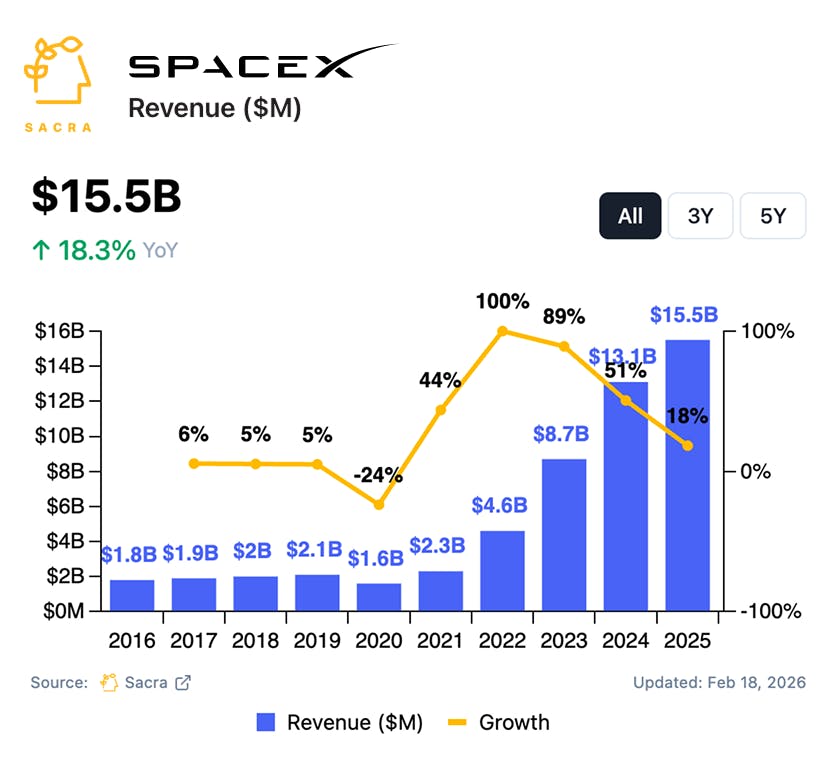
SpaceX at $15.5B/year growing 18% YoY
 Jan-Erik Asplund
TL;DR: SpaceX is targeting mid-March for the first test flight of Starship V3, the flagship SpaceX vessel that unlocks next-gen Starlink, expanded Starshield military contracts, and the build-out of space data centers. Sacra estimates that SpaceX hit $15.5B in revenue in 2025, up 18% year-over-year. For more, check out our SpaceX report and dataset.
We first covered SpaceX in September 2023 at $4.6B in revenue with 66% US launch market share—we followed up as Starlink took off to $4.1B annualized revenue (June 2024), as SpaceX acquired EchoStar's spectrum for $17B to expand Starlink to mobile (September 2025), as the company first announced its plans for orbital data centers (December 2025), and lastly when SpaceX acquired xAI for $250B earlier this month (February 2026).
Now at $15.5B revenue (up 18% YoY), SpaceX is preparing for the most consequential test flight in company history—the mid-March test of Starship V3 targeting the sub-$100/kg launch costs that could make entirely new businesses like orbital data centers economically viable.
Key points from our February 2026 update via Sacra AI:
- SpaceX's arc over the last fifteen years has been a march toward heavier payloads at lower costs, from Falcon 1 (670 kg, ~$10,000/kg) to Falcon 9 (22 tons, ~$2,700/kg) to Falcon Heavy (64 tons, ~$1,500/kg) to Starship (200+ tons, targeting $10-100/kg), with each generation of rocket unlocking markets the previous one could not serve. Falcon 9 enabled Starlink (~$10B in revenue) and Falcon Heavy unlocked heavy military and deep space payloads, while Starship took eleven test flights from a launchpad explosion (Flight 1, April 2023) through the first reusable booster catch (Flight 5, October 2024) to a simulated Starlink deployment (Flight 11, October 2025) before V3, launching in March, would become the first operationally capable version delivering its full 200+ tons at sub-$100/kg.
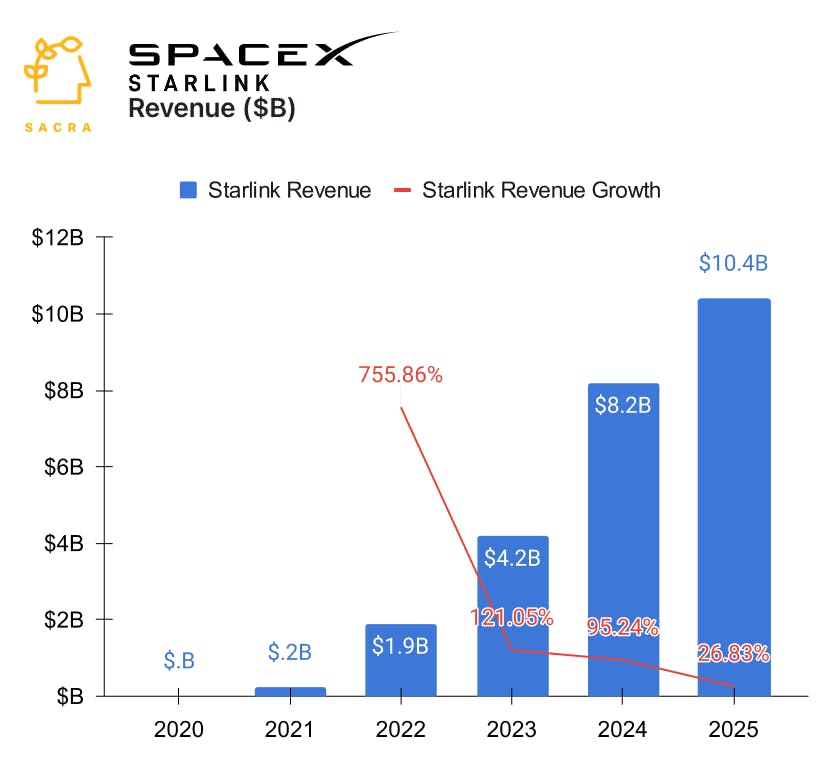
- Becoming the primary driver of SpaceX’s revenue growth starting in 2022 when it nearly 10x’d and became a $2B+ line of business, then growing 95% YoY from $4.2B to $8.2B in revenue in 2024, Starlink slowed to 27% YoY in 2025 as it expanded deeper into India, Indonesia, the Philippines and Africa to grab as much market share & as many regulatory footholds as possible before Blue Origin & Amazon Leo (formerly Project Kuiper) can scale, doubling users from 4.6M to 9.2M but with compressed ARPU priced 50-70% below US rates. Starlink’s slowdown dragged top-line SpaceX growth from 51% YoY in 2024 ($13.1B) to 18% YoY in 2025 ($15.5B), alongside launch services which slowed from 20% YoY in 2024 ($4.2B) to 5% YoY ($4.4B) as SpaceX filled ~66% of its total flights with internal Starlink missions rather than external customers, prioritizing long-term satellite deployment revenue vs. one-off external contracts.
- The path back to reaccelerating 50%+ growth hinges on the March launch of Starship V3, with SpaceX planning to scale to 100+ flights per year by 2028, each carrying roughly 10x a Falcon 9 payload, so that just 20 Starship flights would match the total mass of all 165 Falcon 9 launches in 2025, unlocking Starlink V3 deployments into higher-ARPU suburban and urban markets & leaving surplus capacity earmarked for orbital AI infrastructure where Starlink's 9,000+ satellites provide the backbone and xAI serves as the built-in first customer before hyperscalers arrive. Starship V3 deployments unlock Starlink V3 satellites with 1 Tbps downlinks (25x V2's 40 Gbps), high enough bandwidth to finally serve suburban and urban markets in the USA and Western Europe, while upgrading direct-to-cell from emergency texting to 4G LTE speeds anywhere on Earth, with tiered pricing for higher speeds driving ARPU recovery as higher-income, developed-market users come online in 2027-2028.
For more, check out this other research from our platform:
- SpaceX (dataset)
- Why SpaceX acquired xAI
- CoreWeave of space
- SpaceX vs Verizon vs AT&T
- Starlink at $4.1B/year growing 121%
- Anduril, SpaceX, and the American dynamism GTM playbook
- The biggest mistake defense startups make
- Ross Fubini, Managing Partner at XYZ Capital, on the defense tech opportunity
- Shield AI (dataset)
- Scott Sanders, chief growth officer at RRAI, on the defense tech startup playbook
- Anduril (dataset)