
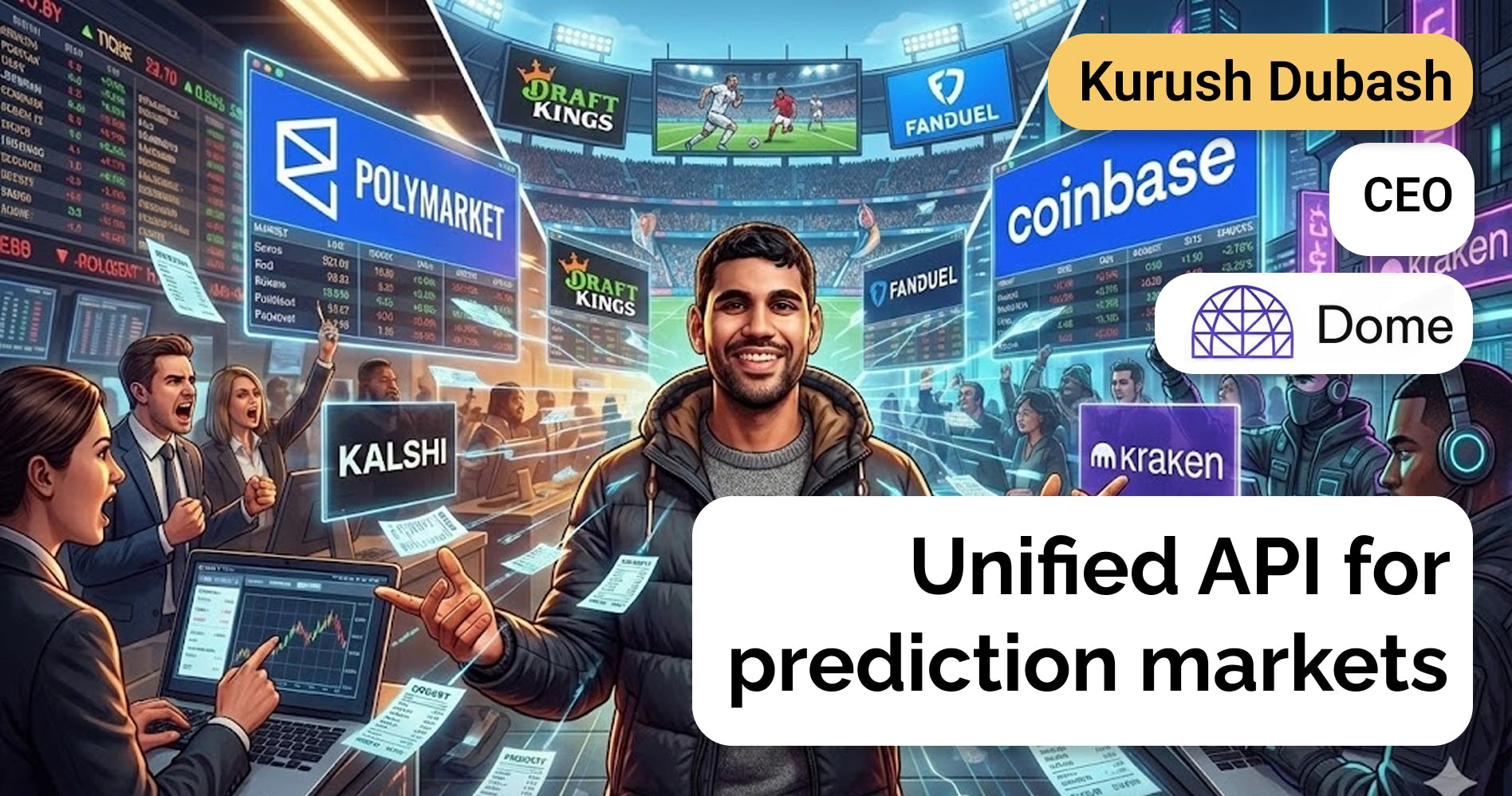
Kurush Dubash, CEO of Dome, on unified API for prediction markets
 Jan-Erik Asplund
Background
After peaking during the 2024 election cycle, Kalshi (~$17B in trading volume for 2025) & Polymarket's (~$22B in volume in 2025) trading volumes have continued to grow, hitting $10B+ per month driven by sports betting & crypto.
To learn more about the state of the prediction market ecosystem, we reached out to Kurush Dubash, co-founder & CEO of Dome (YC F25), the unified API for prediction markets.
Key points via Sacra AI:
- Still in a pre-institutional stage by volume, 80% of prediction market trading is driven by the 0.5% of traders, made up of whales (wealthy individual retail investors), 1-2 person algorithmic trading shops, and small hedge funds, using strategies like arbitrage (exploiting price differences on different platforms), copy trading (following top traders' transactions) and agentic trading generally (bots that auto-buy markets when Trump tweets). "There are about 1.4 million unique users who have used [Polymarket] over the last two and a half years. Despite that 1.4 million, less than 8,000 of them have made over a thousand trades. It's very concentrated—the power users are very power hungry... But those 8,000 folks command 80% of the volume moved. You have a very large retail use case, but as far as the dollars moved, you have a lot of big power players moving the majority of the money around."
- To deepen engagement & expand transaction volume, every investing, gambling & crypto platform is launching its own in-app prediction market experience including Robinhood (horizontal), DraftKings (sports), Fanduel (sports), Fanatics (sports), PrizePicks (sports), Coinbase (crypto, sports & more) & Kraken (crypto), either partnering with Kalshi (Coinbase), acquiring or standing up its own CFTC-regulated exchange (DraftKings & Kraken) or in Robinhood’s case, launching with Kalshi as a segue into its own regulated venue. "Robinhood will be a player in this space, and it goes to our thesis: yes, there are going to be multiple big winners. There's going to be fragmentation. You have the sportsbooks all launching their own prediction markets as well—DraftKings, FanDuel, PrizePicks, etc. Even Coinbase just launched theirs."
- Betting on the continued fragmentation across platform architectures (Kalshi's regulated, closed-source database model vs. Polymarket's international, crypto-native approach), market verticals (sports on DraftKings & FanDuel, crypto on Kraken & Coinbase), and geographies (Opinion Market & Advina in LatAm, PredicXion in Asia-Pacific)—startups like Dome (YC F25) are building an aggregation layer for traders & app builders with a unified API and cross-platform market matching, order routing & order execution. "We started noticing the same gaps that we saw with crypto and blockchain when we first started at Alchemy... We opened up access to other folks and said, 'Hey, does anybody need this data? Does anybody need these tools?' Within four hours, we got 50 DMs."
Questions
- Before Dome, you were at Alchemy. How did the experience and learnings at Alchemy translate over to Dome or inspire you to build Dome?
- What does Dome do for folks and what does your initial product-market fit look like?
- Are you mostly building for builders, or are you also building for traders executing market strategies directly with Dome?
- Is there any tension between what those different users request from you?
- To go back to the market matching—is that for arbitrage pretty much, or are there other applications?
- How does a product like Dome facilitate liquidity, particularly for markets that aren't seeing as much as might be ideal?
- Mechanically, how is it that Dome facilitates liquidity?
- How should people think about the relationship between prediction markets and traditional financial markets? Are they complements or substitutes?
- Is Dome a bet on the fragmentation of prediction markets?
- Are you constantly thinking about depth versus breadth trade-offs? Do you build for specific verticals?
- What's the relative weight of participation by true retail versus high-frequency traders, whales, and financial players? What's the market structure?
- Can you talk about how fast these markets move and whether that gives an advantage to whales or algorithmic traders to respond to information?
- Are market makers a core constituency for you?
- How are Kalshi and Polymarket different? Architecturally, in terms of affordances, mechanics, market structure?
- How do you think Robinhood will impact the category?
- What's the incentive to Kalshi, Polymarket, and Robinhood maintaining open APIs? Is there a scenario in which they might close that off?
- Do you see more regulation waves and pullbacks ahead, or do you think this is clear sailing for prediction markets?
- What would it take to bring institutional money into prediction markets the way they eventually have gotten into the crypto market?
- One challenge with prediction markets being great sources of alternative data seems to be this concentration of liquidity in sports. If you want to use prediction markets for insurance applications, you probably need a good amount of liquidity in the corresponding markets—weather markets, etc. What needs to happen for liquidity to even out a little bit more? Can Dome play a role in that?
- What's the future for products you can build internally on top of what you've already done? Is it synthetic data products, composite data products, just more coverage across more markets?
- The archetypal person using Dome right now is building some form of a trading experience. Is that fair?
- What is still most misunderstood about prediction markets right now? Even within VC or tech circles, what do people still get wrong or just have a misconception about?
- In terms of the whole fragmentation-consolidation question, presumably you're still going to have localized markets. That's how financial markets work—you still have local stock exchanges pretty much everywhere in the world. At the very least, if history is any guide, that would be one way in which the market would fragment. Or do you think that's not the case with prediction markets in the same way?
- Is there anything else you wanted to leave us with?
Interview
Before Dome, you were at Alchemy. How did the experience and learnings at Alchemy translate over to Dome or inspire you to build Dome?
Very much so. To give a little more color on that background: my cofounder and I were both founding engineers at Alchemy—first very early engineers, maybe three, four, or five. We started off as a really small, tight group of people and helped scale that up to 250 people with a $10 billion valuation. It was obviously a great zero-to-one startup experience, but Alchemy was also an infrastructure provider, so we learned a lot about managing customer relationships, enterprise deals, and how that space grew.
One of our earliest customers was Polymarket themselves. We worked very closely with Polymarket throughout that experience. During the 2024 election, we actually built custom infrastructure on the Alchemy side to help builders on Polygon scale because Polymarket was sending so much volume through the Polygon chain that it was breaking.
We gained a lot of experience on the infrastructure side, building zero-to-one, and working in prediction markets. We started working on prediction markets on the side around that time too, and we started noticing the same gaps that we saw with crypto and blockchain when we first started at Alchemy.
When we decided to build this technology, we weren't actually trying to build a company out of it—we were just doing it for ourselves. We opened up access to other folks and said, "Hey, does anybody need this data? Does anybody need these tools?" Within four hours, we got 50 DMs. It was a very clear signal: we've seen the exact same problems that Alchemy faced early on in crypto, and we're seeing those exact same problems occurring in prediction markets since it's a new industry and tooling just doesn't exist.
What does Dome do for folks and what does your initial product-market fit look like?
I'm careful to not say we have product-market fit because as a founder, you always want to make sure you're listening to customers and being nimble. But we're definitely getting market pull.
In a nutshell, Dome is a unified API for prediction markets like Polymarket and Kalshi. In simple terms, we allow users to analyze and trade across multiple platforms at once.
To give a little more concrete depth: we provide developers and users all the read data infrastructure tools they need to build on prediction markets—whether they're building a prediction market app, maybe building their own prediction market themselves, or maybe building a prediction market on top of Polymarket's liquidity or Kalshi's liquidity. All of those aspects need data, tools, and APIs. While some of these providers have public APIs, there's a lot to be desired from developers who want deeper insights, historical data, faster latency, and things like that. That's the initial product we serve.
Then there's also the other side: aggregation. You have a lot of these platforms doing great things—Limitless is building really great stuff—but they don't talk well with each other. They don't interoperate very well. Unlike crypto and equities, where I can take crypto from Coinbase and move it to Binance very easily, you can't do that with prediction markets despite 80% of the markets being the same underlying event across these platforms.
What we basically do is match these platforms internally and say, "This market on Kalshi is the same as this market on Polymarket," so the end user gets larger access to liquidity. We also have an order router, so we can intelligently route orders to the best execution venue. We're really focused on building an entire developer ecosystem for anyone building in prediction markets.
Are you mostly building for builders, or are you also building for traders executing market strategies directly with Dome?
It's both. Our initial audience was developers and builders building in the space. But what we've noticed is a lot of the customers talking to us are institutional—traders, market makers. They need data to intelligently do these types of things. They may be sweepstakes apps pricing their parlays.
The user base for prediction markets in general is very vast. It's not just retail traders. There's a lot of information gathering and analysis that is also done. A good chunk of our users are developers building platforms, but probably 25% or so are using our data for backtesting, for analytics, for high-frequency trading.
Is there any tension between what those different users request from you?
There are differences, but it's maybe not as vastly different as in other industries. Each side has 20% differences, and we're really focused on finding the core problem that both these customers are facing and trying to solve that first. Then as we expand and grow, we can serve each individual ICP after that.
Luckily, majority of their requests have been fairly overlapping. One of the challenges of a young startup is really understanding where to allocate your resources and where to double down.
To go back to the market matching—is that for arbitrage pretty much, or are there other applications?
Arbitrage is the first thing that everyone thinks of because it makes sense—guaranteed output. A lot of people use that as their gateway: "I'll just arbitrage these two things." But what they actually realize is there's a lot more application for it.
This is not a new thing—aggregating markets across platforms. This is very typically done in the sportsbook world. They have pricing points across multiple platforms. A lot of folks use this for pricing parlays. They'll see the same market and what the prices are across multiple platforms so they can price their internal parlay because they're the house and they don't want to lose. The more data points you have, the cleaner your signal is.
It's not just arbitrage. It's also information and data. As we're building towards a unified view where we can abstract away the specific implementations, from the end user's perspective, you get deeper liquidity, more optionality, better pricing points—better pricing and better edge and better price discovery.
How does a product like Dome facilitate liquidity, particularly for markets that aren't seeing as much as might be ideal?
Right now, we follow the data and the numbers. A good chunk of Kalshi's data right now is sports. About 40 or 50% of Polymarket's data is sports. Sports out of the gate is a good chunk of the volume, and there are very overlapping markets there.
You're starting to see new categories of prediction markets pop up, and that's where the liquidity is a little bit slower. The way we're trying to solve this is to win by breadth—integrating multiple different platforms, multiple different niche prediction markets. You're seeing prediction markets specifically focused on sports, specifically focused on crypto, specifically focused on niche markets. While you're getting specialization—that's what a lot of new markets are finding as their wedge—they create overlapping Venn diagrams.
While maybe there's a certain category that Polymarket and Kalshi don't overlap on very well, there will be an overlap for Polymarket and this other new platform, or there might be another platform that overlaps with Kalshi. By ingesting all that data internally, we can still unify them even if it's not just Polymarket and Kalshi, which are the biggest players. You'll start to see these smaller niche categories that tend to have localized events or niche categories that will still overlap with other competitors either in that space or with Polymarket and Kalshi themselves.
Mechanically, how is it that Dome facilitates liquidity?
For context, we don't add liquidity ourselves. We're not backing liquidity ourselves. We're completely aggregating and routing.
The way we get deeper liquidity is by saying, "Hey, you're trying to trade—say you're trading on the Bulls-Lakers game. You would typically go on platform A, and they only have so much volume or so much depth. But if we know that same event is on a couple of different platforms as well and they have the same resolution criteria, we can combine that into one."
We take all the liquidity on those three platforms, sum that together, and then the end user can see that entire depth as full liquidity. By aggregating the different markets—whatever the category or platform—and simplifying that view as just the event, the end user sees way more depth and liquidity than if they were to go to just one of those platforms individually. That's how we're expanding access to liquidity to the end user. From their point of view, they just see that this market has this much liquidity. They can use our smart router, and our smart router will find liquidity on whatever platform we've joined in the background.
How should people think about the relationship between prediction markets and traditional financial markets? Are they complements or substitutes?
I truly believe prediction markets are a new financial asset class that is very complementary to other asset classes. They don't necessarily replace because you can have differentiation—I can buy equities in a company and also still buy prediction markets for that same equity as well. They're very complementary in that sense.
But I definitely strongly believe it is a new financial asset class that can be used for more than just speculative gambling. That's the most common view from years ago: "This is just speculative retail gambling." But the reality is there's a lot more application for it. There's information gathering from it. There's hedging from it.
A lot of customers we talk to are using this for hedging. For example, we were talking to one person in their fifties who writes insurance for mortgages in Florida. We were curious: why are you into prediction markets? We thought initially it was mainly just speculative gambling. They said, "When we write a premium, it's locked for an entire year. If there's a bad hurricane in Florida, those premiums are underwater. But if we can now buy prediction markets as hedges, we can adequately hedge our losses there."
You're absolutely seeing it as a very mature derivative tool and hedging tool for a lot of institutional players. It's still very early in that space, but you're going to see a lot more development over the next couple years.
Is Dome a bet on the fragmentation of prediction markets?
We've definitely thought about this in a couple ways: what happens if it ends up as a duopoly versus some other fragmentation?
To answer your question directly: yes, our bet is that there will be fragmentation. We've seen a very similar playbook in crypto in our time at Alchemy. With cryptocurrencies, you have the big Bitcoin, Ethereum, Solana, but you have this very long tail of other currencies. Whether they have value or not, they command a good amount of volume—non-negligible volume.
We also anticipate that prediction markets will be that as well. You're going to have three or four big players—Kalshi, Polymarket, Limitless, Clearing Co, etc. But you're also going to get a long tail of other markets that are specific niches, specific verticals. You have a bunch of sports players that are already jumping in: DraftKings, FanDuel, Robinhood, etc. Our bet is, yes, that this space will get fragmented to some degree. You'll still have big oligarch players, but there will be enough volume in the other space as well.
Are you constantly thinking about depth versus breadth trade-offs? Do you build for specific verticals?
That's a great question. Being a startup and not having a lot of resources, you have to be very intentional with how you allocate resources. That's where we start focusing a little bit more on the data and where the current PMF is.
Sports is by far the largest PMF in prediction markets right now. We also have the data that shows crypto markets are also really hot. Obviously, politics and earnings markets are picking up steam as well. Cultural events are also one of the fastest growing categories, but majority of the volume is still in sports. For Kalshi, I don't know the exact numbers, but maybe 80%. For Polymarket, it's about 45-50%.
As far as how that translates to how we focus: obviously, we're taking a look at the breadth, and that's what we want to tackle. But anytime we're launching a new product or new feature, we start with where the PMF is. We typically tend to start with data or APIs for sports and then expand wide out after that. That's an example of how we hit breadth but focus on the PMF first.
What's the relative weight of participation by true retail versus high-frequency traders, whales, and financial players? What's the market structure?
At a high level, we've talked with a lot of hedge funds. These funds tend to be on the smaller side. We're not looking at Jane Street or Citadel. The volumes are just not high enough for those types of players to jump in yet. The HFT players that are coming in are the five-to-ten person shops or even one-to-two person trading types of funds.
As far as the customer shape: a large chunk of the individual transactions—the uniqueness of the people in the space—are mainly retail. That being said, the folks who actually move majority of the volume tend to be very concentrated, either algorithmically trading or very rich individuals.
For context on the data we have on Polymarket: we did some analysis about a month ago. There are about 1.4 million unique users who have used their platform over the last two and a half years. Despite that 1.4 million, less than 8,000 of them have made over a thousand trades. It's very concentrated—the power users are very power hungry. This is a very common power law function that you see in a lot of these types of markets. But those 8,000 folks command 80% of the volume moved.
You have a very large retail use case, but as far as the dollars moved, you have a lot of big power players moving majority of the money around.
Can you talk about how fast these markets move and whether that gives an advantage to whales or algorithmic traders to respond to information?
I would say these markets respond fairly quickly. Over time, the edge as far as speed is getting reduced more and more because more players are coming in and trying to find their edge.
One really beautiful part of this whole space is a lot of it is built in public. You can copy trade. You can see how folks are doing things. You can trace their transactions and reverse engineer their algorithms. You can find out people who are acting on information quickly.
Our goal is not to give any one player any edge, but to democratize the information and give it to users as quickly as possible. For example, what we do is read directly from the blockchain source in as many ways as possible. That way, we're not just wrapping around an end provider. A lot of times, we're giving the information faster than the platforms update themselves. That's one of the ways we're trying to help users use it for speed. A lot of users also use it for market making because that's a very important edge as far as latency.
As far as how quickly things resolve: you would typically see it on par with probably traditional sportsbooks as an example. If somebody was sitting courtside at a game, a sportsbook might update within a second. You probably see the same thing with prediction markets as well. They recently started introducing delays to make sure their market makers aren't getting destroyed by front runners. But outside of that, for maybe the non-sports markets, you see very fast information execution time—within a second.
Are market makers a core constituency for you?
I wouldn't say necessarily a core focus. We just see them as another user group that is interested in this data. Both sides are obviously very interested in how each other plays. The market maker wants best odds and to figure out their edge. The end user wants to know how they can have edge and have pricing power as well.
Both users are basically trying to tackle the same problem just on different sides. We have a good amount of information and can tell the trading patterns—which users are market making versus which users are trading based on just prediction markets or even edge themselves. But underlying, both folks are interested in the same dataset.
How are Kalshi and Polymarket different? Architecturally, in terms of affordances, mechanics, market structure?
As far as the API differences—you noticed we have three endpoints for Kalshi versus eight for Polymarket in our documentation—it's more that we just started with one platform and are expanding to add Kalshi. We'll have the same number of Kalshi endpoints as well. We focused on one platform first to get that up and running. We started with Polymarket, so now we're working on offering the same amount for Kalshi.
But to your second question about why it's a little bit slower: the technologies are completely different. Kalshi is a closed-source platform. They're a regulated environment. They run it on their database. Polymarket went the exact opposite route. They went blockchain-based. They went international.
While they're very much in the same space and constantly fighting each other for market share, they are very, very different in the technology themselves. With Polymarket, it was initially a lot easier to get up and running because we could read from the blockchain themselves as the source of truth. You don't have that option with Kalshi, which is why we started with Polymarket—we have a lot more data there to start with.
As far as the differences: they have very similar markets, but the actual structure of the content is night and day. Kalshi has been doing a better job recently trying to get more on-chain native. They partnered with DFlow and Jupiter to offer prediction markets on-chain. But I would say they're halfway there. It's not purely on-chain. That's just a mechanism of interacting with their traditional platform via crypto.
Whereas Polymarket—literally every single trade is written to the chain. It's public for everyone to see. You can copy trade and whatnot.
To answer your question: the content is similar. Their information, the structure, the technology are completely different.
How do you think Robinhood will impact the category?
They're already capturing a good amount of market share. Robinhood's distribution is one of the best. They have an incredible product, and them expanding into prediction markets just makes a lot of sense for them.
Prior to this, they had partnered with Kalshi to provide prediction market swaps, and it was a very large chunk of Kalshi's volume. I don't know the exact public percentage, but it was a good chunk. It'll be interesting to watch how that relationship changes as they now enter this space.
But to answer your question: reality is Robinhood will be a player in this space, and it goes to our thesis: yes, there are going to be multiple big winners. There's going to be fragmentation. You have the sportsbooks all launching their own prediction markets as well—DraftKings, FanDuel, PrizePicks, etc. Even Coinbase just launched theirs. They just acquired Clearing Co.
You're clearly seeing a lot of these big institutional players—the folks that already have really good distribution—doubling down on prediction markets. Kalshi and Polymarket recognize this. They understand they win by just becoming the liquidity engines, the volume plays themselves. Yes, Robinhood will definitely be a player that is part of this ecosystem.
What's the incentive to Kalshi, Polymarket, and Robinhood maintaining open APIs? Is there a scenario in which they might close that off?
There is a scenario, and there's definitely platform risk. That's something we have thought about greatly. But from all the angles we've looked at, in my opinion, it doesn't make a lot of sense for them to do so.
One reason that Polymarket is the world's largest prediction market right now is they went the route of: "We're going to be open. We're going to give a lot of APIs. We're going to give to builders." They have a lot of builder incentives. They're literally incentivizing users to build on them.
One thing they recognize, and Kalshi sees this as well, is they win ultimately by being liquidity engines. They win by volume. Obviously, in their ideal world, you open up the Kalshi app and you use Kalshi. But if you use a Coinbase app and that still gets routed to Kalshi, they still win in that transaction flow. The endgame is these folks are basically trying to capture as much volume as possible. In those types of situations, it works against you if you are a closed walled garden and only have internal APIs because you're cutting off a lot of those liquidity channels.
That was one of the biggest arguments—one of the strongest strengths as far as the value of Dome: "We are sending more volume to you that you wouldn't typically get otherwise." We're trying to grow the pie versus just take market share from anyone else.
You have a player like Robinhood where you see the opposite of that. They have a bigger incentive to maybe have a little bit more of a closed source and try to capture as much of the market as they can. But that's where it's going to get competitive. Is their distribution enough to be closed source? We don't know yet. They may also have to open up their APIs to get that added liquidity if Kalshi and Polymarket are starting to get everyone else's liquidity as well.
It's going to be a race to get volume, and that competitive nature in itself will promote building and expansion and openness.
Do you see more regulation waves and pullbacks ahead, or do you think this is clear sailing for prediction markets?
Obviously, the blunt truth is it's administration-dependent. The tides change and flow as far as regulatory environments. But if you ask anyone who's worked in prediction markets—even worked in crypto—a very common misconception is that regulation is bad and it's going to hurt the industry. This is so far from the truth.
Majority of the big players I've spoken with or worked with actually want regulation. They want common-sense regulation. They say, "We want to protect consumers. We want to protect institutions. Just let's create the right bounds so that we all know the rules to play by the system."
What I do see is, hopefully, regulation coming in a good sense where you want to close those loopholes. You want to ensure that purely insider trading that's super obvious is closed up so that folks can't profit off of their positions. Even Kalshi and Polymarket would probably prefer that.
What they don't want is red tape. For example, with Kalshi, it took them three or four years to get their CFTC license, their DCM, just to be able to create these contracts. That's the type of regulation that is prohibitive and constrains the market.
What we really should be encouraging is regulation that says, "This is clearly a high-value asset class. There's clearly a lot of value here. What type of regulation can we put forward that protects consumers, that makes things a fair playing field, but allows this space to grow as well?" Both Kalshi and Polymarket are super supportive of that.
What would it take to bring institutional money into prediction markets the way they eventually have gotten into the crypto market?
Two things. One: volume. The volumes are doing really well right now, and they're growing rapidly. But it's still in the smaller phase where Citadel's not going to drop $5 billion in this market because they're just going to move all the lines. You need a little bit more volume. Our goal is also, if we join all the liquidity together, it becomes a little bit more enticing.
Two: we're still just so early in this space. It's an emerging tech. You just still need the more mature tooling, institutional tooling, institutional gates—security, privacy. Those types of tools and companies just don't exist yet. Majority of the platforms—the initial versions—have been built around retail consumption. It's just a different product. We need to build pro trading tools, institutional trading tools, brokers and stuff like that.
That's part of the goal of what we're trying to build. We're trying to build those picks and shovels so that you can get companies that come and can build an institutional trading desk and advanced trading desk. Those types of tools are still missing for the institutional folks to come in.
One challenge with prediction markets being great sources of alternative data seems to be this concentration of liquidity in sports. If you want to use prediction markets for insurance applications, you probably need a good amount of liquidity in the corresponding markets—weather markets, etc. What needs to happen for liquidity to even out a little bit more? Can Dome play a role in that?
Absolutely, you need more liquidity. If I'm an insurance broker and there's only a thousand dollars on the book, that's probably not enough to protect my premiums in whatever industry I have.
But you're seeing a lot of growth in those sectors specifically. For example, weather contracts do a couple million dollars in volume a day. You've seen a huge surge in crypto prediction markets because, again, it's another asset class. Now you can take crypto prediction markets, match them with perpetuals, or match them with the end cryptocurrency. So there are many different derivatives there and different ways to hedge that.
But as these tools become more popular, especially as more volume starts coming in, the liquidity players—the market makers—also follow as well because the incentive mechanisms are there.
To answer your question directly: yeah, in order for large institutional folks or the hedging funds to come in, you need more liquidity. The best case we've seen this is political events. When you have a really big presidential election or a mayoral election, those types of events tend to be rare, so they get a lot of liquidity there. You get $400-500 million, even billions of dollars in volume there. That's when the information from those markets is super valuable.
You're actually going to see a lot of opinion polling start shifting towards prediction markets because they are a much more accurate and granular version of getting real-time sentiment.
What's the future for products you can build internally on top of what you've already done? Is it synthetic data products, composite data products, just more coverage across more markets?
In the most immediate terms: first, give the builders the tools they need to build. There's such a glaring gap as far as the developer experience. Our immediate focus is giving developers the tools they need to build, whether they're building a prediction market app or a prediction market skin, creating markets, whatever it is, or an analytics dashboard. They just simply don't have enough data or tools right now to build. So our most immediate focus is on that.
The second platform: the matching markets and the order router. That's going to be a huge emphasis next year. That's going to be a lot of where the value we provide comes from.
But further down the roadmap, as this space starts to mature, as you start to see the volume numbers go from billions to trillions, there's a lot of opportunity to abstract a lot of the pain away. We'll eventually get all the licenses needed to be a brokerage. We can custody the assets for our end users, make it a lot easier. As this product goes global, we'll also start to pull KYC away from the developers. We'll handle the KYC, handle the regulatory environment.
Our end goal is, in four or five years, we want it to be so simple for anyone to embed prediction market swaps into their application, their website, whatever it is. They just put in the Dome SDK—three lines—and boom, they get access to all the markets, full liquidity. They can trade, browse, or whatever it may be. They don't have to worry about licenses. They don't have to worry about brokerage, just similar to how they handle equities and crypto today.
That's the end goal and what we're headed towards, but there's a lot of steps in between that we need to hit first. We have to make sure—the biggest thing I emphasize is—first and foremost, we've got to give the tools to builders to build because this space does not grow without those builders building real-time products.
The archetypal person using Dome right now is building some form of a trading experience. Is that fair?
When I said 75%, I was comparing that 75% are builders versus 25% are traders or market makers.
Of the 75%, you see a lot of different types of builders. Some people are building very large analytics sites—trying to be the analytics platform that gets you the Greek values of specific trades or specific markets. Some folks are building copy trading—that's a very hot space right now. A lot of people are tracking other people's trades, trying to reverse engineer their algorithms, giving tools to end users to follow the best traders or specify a trader.
Agentic trading is actually super popular. We're seeing a lot of applications move a good amount of volume through it that are doing: "I talk to a chatbot, and it goes and automatically buys markets for me," or it can act on information when Trump tweets and go buy a share of a market, etc.
And then, of course, you're seeing a lot of prediction market platforms and skins themselves. They're offering a better UI or a better trading experience.
You're seeing a lot of different categories of apps. It's not just skins on top of that. There's a very large set of applications folks are using to build.
What is still most misunderstood about prediction markets right now? Even within VC or tech circles, what do people still get wrong or just have a misconception about?
Full transparency, I'm biased here, but I strongly believe that, one, this space is going to be massive. You're going to see trillions of dollars in volume in three or four years.
And two, you are going to see fragmentation. That is a very large bet that we're betting our company on.
With industry experts or VCs, it's kind of a split vote right now whether this gets consolidated or whether there's a long tail of players. There's also a subset of folks that might see this as a fad: "This is just a trend that's hot right now, and it'll die off."
I strongly disagree with that one. As I said, I've worked in crypto for over ten years, and you tend to see a lot of different shapes, but they tend to all mirror things. With cryptocurrency and blockchain, you see a lot of boom and bust cycles. There's a lot of hype on a certain technology—maybe NFTs or a crypto price. There's craze, and then it pops, and everyone's like, "Okay, well, that's done, and we're dead." But behind the scenes, builders are still building. Every time that cycle happens, the floor gets raised.
When you actually chart out the growth and the volume, you see these huge booms and busts like a sinusoidal wave, but you can draw a straight line where the entire space is growing.
You've absolutely already seen this with prediction markets. That's why I said there are so many parallels. In 2024, you saw the 2024 election. Prediction markets actually blew up and were pretty popular then too. There was massive usage in the New York Times and whatnot. Then after the election ended, everyone said, "Okay, cool. This is a fad. We'll see you in 2028."
But the folks at Polymarket, Kalshi, and the others—hats off to them—they kept building. They kept creating stuff, and the floor just kept getting raised. Now the opening week of the NFL's weekend did more volume that weekend than during the 2024 election.
It just goes to show: you're going to have these boom and bust cycles, but the overall space is going to continue to grow. Those are the two largest misconceptions as far as where the space is headed.
In terms of the whole fragmentation-consolidation question, presumably you're still going to have localized markets. That's how financial markets work—you still have local stock exchanges pretty much everywhere in the world. At the very least, if history is any guide, that would be one way in which the market would fragment. Or do you think that's not the case with prediction markets in the same way?
I 100% think it follows history in this case. You will absolutely see localized markets.
A large reason—our theory—is just the conversations with folks we've had. We've had conversations with customers and potential customers where they're in four different countries trying to launch either prediction markets on top of these platforms or their own for their own localized events: one in Latin America, South Africa, India, Australia.
They recognize it's very difficult as a new emerging tech to go conquer the world. Polymarket and Kalshi are doing a good job. They're building their events—global events—that are probably international or at least US interest. But you don't see a Polymarket market for the winner of a local mayoral election in Brazil. You don't see the local sports team on Polymarket or Kalshi. It's just too niche there.
For example, this Latin American company said, "We want to build markets specifically for this industry. We know our community way better than Kalshi and Polymarket. They're not here. So we can build a community for our own prediction market, create localized events."
You'll see fragmentation in two ways. You'll see localized specific events for a specific region, and you'll see vertical-specific events. You're seeing prediction markets that are: "We purely just do crypto prices," or "We just do niche markets," or "We're just the politics prediction market."
You'll see specific niches in that case, or you'll see specific niches of: "We're the prediction market for Brazil. We're the prediction market for South Africa. We dominate this space." That's how you'll see the complements between that and Kalshi and Polymarket.
Is there anything else you wanted to leave us with?
I'm just really excited. This is a great space to be in, and it feels like early days in blockchain. If you know anyone who is trying to get started in the space and needs data, or any engineers who want to work with us, send them our way.
Disclaimers
This transcript is for information purposes only and does not constitute advice of any type or trade recommendation and should not form the basis of any investment decision. Sacra accepts no liability for the transcript or for any errors, omissions or inaccuracies in respect of it. The views of the experts expressed in the transcript are those of the experts and they are not endorsed by, nor do they represent the opinion of Sacra. Sacra reserves all copyright, intellectual property rights in the transcript. Any modification, copying, displaying, distributing, transmitting, publishing, licensing, creating derivative works from, or selling any transcript is strictly prohibited.