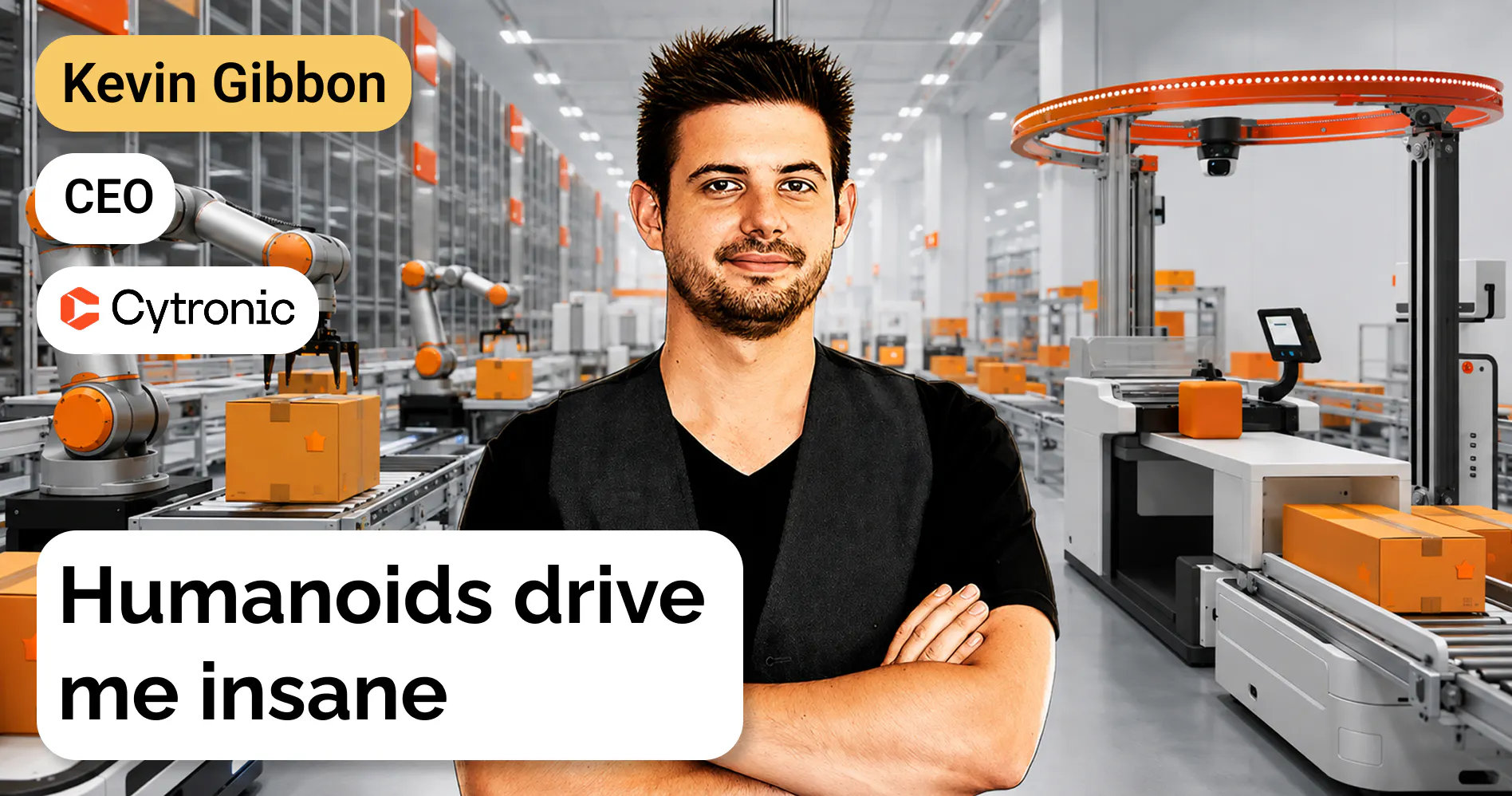
Kevin Gibbon, CEO of Cytronic, on physical AI for ecommerce
 Jan-Erik Asplund
Background
After talking to Sankaet Pathak, co-founder & CEO of humanoid robotics company Foundation, about why humanoids will win in robotics, we turned to the non-humanoid side of the market.
We reached out to Kevin Gibbon, co-founder & CEO of robotic fulfillment company Cytronic ($13.5M raised, Slow Ventures) and previously founder & CEO of Shyp ($62M raised, SherpaVentures) and Airhouse, to understand how robotics is reshaping commerce.
Key points via Sacra AI:
- Fulfillment & delivery consume $15-25 of every $100 spent in e-commerce, and because that cost is embedded in human labor (pickers walking 15-20 miles a day through warehouses), software-only players like tech-enabled 3PLs can’t bend the cost curve, putting a nice UI and better tracking on top of a fundamentally unchanged labor model. "You can have the best interface and a new UI, but you're not fundamentally changing anything behind the numbers... I've been in the logistics technology industry for 15 years, and cost is always the biggest way to get more customers, but you can't bend that curve unless you control the end-to-end experience. Without an enabling technology like robotics, you can't really do that."
- Like in self-driving cars, general-purpose humanoid robots built for open environments carry monumental engineering costs, while purpose-built robots in closed, controlled environments running a single, narrow use case can reach production reliability today and still serve a trillion-dollar market. "Self-driving cars are a great example, the amount of effort to react to every possible situation is monumental. What we're doing is a closed environment, one use case, that happens to be a trillion-dollar global market, and we're going to do that very, very well... You see a lot of humanoids, things built for a world with humans in it, and that's where a lot goes wrong."
- In warehouse robotics, robots don’t match the cost of human labor, they beat it decisively with healthy gross margins, dropping per-order labor cost in fulfillment from $2-5 to roughly $0.30 and enabling facilities that break even at just 5% capacity utilization. "What used to cost $2 to $5 in labor now costs us about 30 cents, and we're getting that even lower... You're not just replacing humans, you need to be cheaper than them, and you still need a healthy gross margin to survive as a business. You can only do that by focusing on one thing and doing it very well."
Questions
- Cytronic is not selling robots to warehouses or simply operating a traditional 3PL with some automation. What is Cytronic, and who is the core customer today? How do you define the category you're building?
- Is robotic fulfillment a fair description of the category, or would you describe it differently?
- In terms of core customers today, is it mostly a certain kind of brand or seller?
- Shyp ran its own warehouses but was built around infrequent consumer demand. Airhouse was built around recurring demand from e-commerce brands but outsourced fulfillment to partner warehouses. With Cytronic, you're back to running your own in-house fulfillment. How has your thinking evolved about which parts of the process you need to control?
- Walk us through an order from the moment it enters Cytronic to when the package reaches the carrier. Which steps are fully automated, and where are humans still involved?
- We see a lot of robotics plays trying to build a horizontal platform layer, an example might be Prometheus. Is your message to founders that a more specialized, narrow approach, building from the bottom up, is the better path?
- Cytronic buys robotic arms, storage systems, and other proven hardware while building the orchestration software itself. Which parts of warehouse robotics have become commodities, and where does the defensible work sit? Where does customization become necessary?
- Some robotics founders have talked to us about the China supply chain. Is that a cost tailwind for you, or is there also supply chain risk to think about?
- How does a data flywheel work in your space, and what kind of data you generate internally is most useful for it?
- To paraphrase: controlling the system in a closed loop, being P&L-minded in a hard-nosed way, and knowing you have a fixed environment you can tweak matters more, especially once you get started, than some super fancy AI model training. Is that right?
- If you were mapping the fulfillment and warehouse-automation market, Amazon, ShipBob, ShipMonk, Nimble, Locus, Symbotic, Geek+, and so on, what are the important dividing lines, and where does Cytronic sit?
- We noted that in May Amazon said they were opening their fulfillment to brands that don't necessarily sell through Amazon. It seems like a lot of people think of Amazon as a leader in fulfillment technology. Yet you don't seem very worried about competing with them. Can you unpack that?
- You mentioned going into returns. To what extent do you handle returns today? And more broadly, how do you decide on the next adjacency to pursue, is it about where the technology is ready, or a market decision that pulls the technology in that direction?
- If everything goes right for Cytronic over the next five years, what does it become, and how is the world different?
- We saw stats showing you can process around 75% of what's sold on Shopify today, and that roughly half your customers sell on TikTok. Given that DTC focus tends to mean variable capacity and unpredictable SKUs, is it that because your warehouses can be profitable even at low capacity, you're essentially starting with the hardest problem, and it only gets easier as you move into higher-volume, more predictable merchants?
Interview
Cytronic is not selling robots to warehouses or simply operating a traditional 3PL with some automation. What is Cytronic, and who is the core customer today? How do you define the category you're building?
We are physical AI for commerce. We figured out a way to make fulfillment a lot cheaper than it currently is, and by doing that, we hope to help people sell more online. That's the simplest way to put it. We use robotics as the enabling technology behind everything, but we're a service, just like AWS or Stripe. We use a bunch of different technologies, and robotics is the key piece that makes this possible today. At the end of the day, a brand comes to us to get their items from their manufacturer to their end customer as fast and as cheap as possible, and we help them do that.
Is robotic fulfillment a fair description of the category, or would you describe it differently?
No, I think we're really in physical AI. The enabling technology is robotic fulfillment, but we're much broader than that. Fulfillment is the wedge, but the overall goal is bringing the total cost of selling goods lower. Fulfillment is first. Returns and delivery are the two obvious adjacencies, but we haven't decided the sequence yet. We want to make it cheaper and faster for all these different merchants, and we can do that by vertically integrating into this entire industry. You can't move the cost curve of a cost center you don't control.
It's very similar to what SpaceX did. Did they reinvent the rocket? No. We're doing something similar, but as we continue to evolve through new product cycles, it'll be about controlling the end-to-end fulfillment process. It could be a software change that fundamentally shifts the margin structure for a brand. So it's much broader than just the fulfillment piece, but that's the initial hook for people right now.
In terms of core customers today, is it mostly a certain kind of brand or seller?
We've only been live, servicing customers, for about three months, so it's still new. The first brands were very small, and now we're onboarding brands that are expected to spend millions of dollars with us annually once fully live. The same pain point a seller just getting started has is the exact same problem a brand doing $100 million or $500 million in revenue has: cost.
I've been in the logistics technology industry for 15 years, and cost is always the biggest way to get more customers, but you can't bend that curve unless you control the end-to-end experience. Without an enabling technology like robotics, you can't really do that. You can have the best interface and a new UI, but you're not fundamentally changing anything behind the numbers. We figured out one specific use case, direct-to-consumer e-commerce fulfillment, and do it very, very cheaply, with robotics that does this one thing well. We're not going to be good for everybody, but for the people we are good for, we're going to change their business.
Shyp ran its own warehouses but was built around infrequent consumer demand. Airhouse was built around recurring demand from e-commerce brands but outsourced fulfillment to partner warehouses. With Cytronic, you're back to running your own in-house fulfillment. How has your thinking evolved about which parts of the process you need to control?
It's not about controlling everything, it's about controlling the entire network. The first piece is fulfillment, the journey from after you manufacture something until it gets to the end customer. We've created a much better, cheaper, faster solution than exists anywhere else in the marketplace, and that's our wedge in.
Delivery and returns are both things we eventually want to provide a similar service for, but we don't today. We do returns the same way any other company does. Same with delivery, we don't actually do any of it ourselves, we pass it off to the major carriers.
But those are two very adjacent, massive markets we can go into, because we control fulfillment, we're able to insert different products, potentially owned end to end, that change the cost curve. For any other founder listening: you can't do everything for everybody. That's what I think people get wrong with robotics. Self-driving cars are a great example, the amount of effort to react to every possible situation is monumental. What we're doing is a closed environment, one use case, that happens to be a trillion-dollar global market, and we're going to do that very, very well. Not for everybody. It's about 75% of e-commerce, small parcel. We're not going to do kayaks. We'll say no to a lot of customers, but the ones we say yes to, it's a complete game changer.
I had an anecdote from a customer we just signed, actually going to be our largest customer. They used to run flash sales doing a million dollars in revenue in five minutes, and they stopped selling online because fulfillment costs were too high. Based on our pricing, we expect to give them back roughly 5–10 points of gross margin. That's the piece we're looking to completely change, but it's for a very narrow use case. We'll widen it eventually, but we've really nailed that first. I think that's what the broader robotics industry hasn't gotten. You see a lot of humanoids, things built for a world with humans in it, and that's where a lot goes wrong. We're a closed ecosystem within our own warehouses, from getting the land and permits for our automatic storage and retrieval systems to operating everything.
Walk us through an order from the moment it enters Cytronic to when the package reaches the carrier. Which steps are fully automated, and where are humans still involved?
Today, we still have humans who take goods from a manufacturer's LTL or FTL shipment into one of our warehouses, and place those goods into our automated storage and retrieval system. If you've seen our video, there are these big 3D grids with totes. That process of getting items from the truck into totes isn't standardized yet, since labeling varies, so it's still manual.
Everything after that, the actual picking, is where non-robotic warehouses spend a lot of labor: people walking 15-20 miles a day to pick items into a cart, then handing off to a packer. That's completely automated for us. Our 3D automated storage and retrieval system gets any item to a pick station in about 7 seconds per port, we have around 14 ports on this machine. At the top, robotic pickers move items, typically one SKU per bin, to a packing port, where a robotic picking arm we've assembled, using a lot of off-the-shelf software plus our own R&D, picks the items into a box or bag, seals it, and automatically sorts it to the different carriers.
That end-to-end process is about 90% automated, and that's where the massive savings come from. What used to cost $2 to $5 in labor now costs us about 30 cents, and we're getting that even lower. That's why we can offer such a lower price point, and our gross margins are still very large, which I don't think the robotics industry as a whole really understands. You're not just replacing humans, you need to be cheaper than them, and you still need a healthy gross margin to survive as a business. You can only do that by focusing on one thing and doing it very well.
We see a lot of robotics plays trying to build a horizontal platform layer, an example might be Prometheus. Is your message to founders that a more specialized, narrow approach, building from the bottom up, is the better path?
I'm glad there are founders working on point solutions, without them, we wouldn't exist. But my view is that it's going to be a dogfight for point solutions targeting a broad category, you don't have network effects, so you'll get a lot of competition, and a lot of VC capital will pour into hot categories. For a service layer, that's where you can reap the benefits. I think that's where all the VC returns are going to be: service layer companies that take a bunch of these point solutions and turn them into something they can actually sell.
You've seen that happen for digital AI, and I think the same thing will happen for physical AI, just with a much more narrow use case than broad digital AI. But you're also replacing a lot of mundane work, so the opportunity might actually be even bigger for physical AI.
I love the SpaceX example. Whether their first rockets were mostly for press or not, they had an underlying business they exposed over the years, but it started very narrow, and profits didn't come for a while. Being vertically integrated let them control cost and reusability, they couldn't have done that without controlling everything. I think that's going to be the winning combination for physical AI: not horizontal like digital, but very specialized. I think we'll see a lot less of these generalized humanoid companies raising huge seed rounds where you don't even know what they do. Great robotics talent exists. What's much harder to find is a use case where you can build a business that's fundamentally better for customers. That's what you should focus on versus horizontal plays. I don't see them working out. Honestly, I don't know one company outside marked-up internal valuations that's proven it. Our revenue is probably larger than some companies valued at $50 billion.
Cytronic buys robotic arms, storage systems, and other proven hardware while building the orchestration software itself. Which parts of warehouse robotics have become commodities, and where does the defensible work sit? Where does customization become necessary?
Every time we look at buying versus building, we ask: is this strategic to our defensibility? Does it not exist already? Will it extend our capability, lower our costs, or reduce our reliance on other products?
Take automated storage and retrieval systems, that's core to what we do, but luckily there are dozens of companies globally that make them, so we're not relying on a single provider. If we were, that's something we'd want to bring in-house, because if it stops working, our whole system seizes up. From day one we've had a robotics team internally, mostly making sure everything works together. We have at least four disparate robotic systems in our first warehouses, a vision system, picking arms, suction cups, all of which exist in their own industries, but putting them all together, that's our company. We do all the software and glue that holds it together today.
We'll continue looking for ways to reduce cost or increase capability by owning more of the stack. Again, Tesla and SpaceX are good examples, they still use mostly off-the-shelf parts but own the glue that holds it together, and build internally only when there's a defensibility or capability gap. They're not trying to recreate GPUs. It's very similar for us.
Some robotics founders have talked to us about the China supply chain. Is that a cost tailwind for you, or is there also supply chain risk to think about?
There's always some supply chain risk, but it's been mitigated for us. The biggest risk would be automated storage and retrieval systems, but there are already dozens of players there, driven partly by grocery chains and Walmart-scale buyers, so that risk is shrinking as the industry explodes. With China and everything else, those are tailwinds. More producers at every level, even something as simple as a GPU, is a tailwind for the whole robotics industry, and more robotics companies we can work with is a tailwind for us as a service layer.
As we develop more internally, we'll benefit from tailwinds on smaller components too. We're looking at returns right now, and there's really nothing plug-and-play out there, we'll likely have to build something ourselves. Investment in AI models is a huge tailwind for us too, we're a physical AI company in the world of digital AI, so all of that helps. I do hope there are more examples of robotics or service companies that actually change the cost curve, that was always the goal, using robots to make things cheaper and easier, not just replacing what a human does. It drives me a little insane looking at all these humanoids. Unless you want a companion, why that form factor? It doesn't make sense to me.
How does a data flywheel work in your space, and what kind of data you generate internally is most useful for it?
A lot of it comes down to cost, both the customer's cost and our internal cost, which are different. Right now, on every $100 online sale, about $15 to $25 is taken up by fulfillment and delivery. We charge on average around 70 cents for fulfillment. If we don't handle delivery, we pass those charges through, but it should stay below a dollar. So instead of fulfillment costing $5 or $10 out of that $100, we charge less than a dollar, completely changing gross margins.
To do that, we need to keep our own costs low, providing fulfillment for 10 or 15 cents. We run 24/7 across three shifts, and we still have humans in the loop, but instead of doing the fulfillment itself, they're managing the robots: handling exceptions, things getting stuck, and so on, plus the manual piece like unloading trucks.
From day one we've focused heavily on the metrics behind getting cost low enough. At our first R&D facility, the big question was whether we could get cost down far enough, at the time we were probably working with around a dollar. It turned out we could, and that let us move forward, because if we were just matching the cost of a person, we wouldn't be able to convince anybody. I know this market inside and out, you can't get a brand to switch just because you have robots, nobody cares about that on its own. It attracts people initially, "robotic fulfillment, that sounds cool," but they stay for the actual price savings.
We're very careful measuring those costs, because that's the only reason we exist and the reason we'll continue to exist. Same with the payback period on a warehouse. Right now, the capacity utilization needed to break even is only about 5%, which will change as more entrants come into the market, so we need to expand quickly into new markets and take the first-mover advantage there.
That's why we're venture-backed: we've proven the proof of concept works, gotten cost down enough to expand into larger facilities, and customers want to join. Now it's about expanding across the US and then globally, while staying disciplined and not expanding our use cases too broadly. We need to stay laser-focused on doing this one thing very well, then meticulously add returns or delivery when it makes sense, but not anytime soon, because the current opportunity is already huge. Measuring every point of the process from the beginning has been our competitive advantage. A lot of companies track these metrics after the fact. If you're a robotics company, everyone on the team needs to live and breathe P&Ls, that's been my experience in this industry from a labor perspective too. We still have labor, capex, payback periods, all of it, and having that built into the organization is fundamental to our existing at all.
To paraphrase: controlling the system in a closed loop, being P&L-minded in a hard-nosed way, and knowing you have a fixed environment you can tweak matters more, especially once you get started, than some super fancy AI model training. Is that right?
You got it. And it's also about saying no to a lot of things. This is why I think incumbents will eventually try to do what we're doing, I'd be foolish to say they won't. But I've seen this across so many companies. At my last company, Airhouse, we were a marketplace for 3PLs using human labor, and their inability to change processes was striking. Even Amazon, the leading operator people think of, their technology is 20 to 25 years old in a lot of ways, and they're actually the largest employer in the US. That means they still don't automate a lot of fulfillment. They have flashy things, but it shows how long it takes to change physical operations.
What it really takes is imagining it from nothing. We don't have other customers to satisfy. An incumbent has existing customers, Amazon FBA would be a great application for this, but it would mean saying no to a lot of things and ripping out 30 years of technology to rethink it. That's very hard, but it also underlines the opportunity. I think incumbents will move a lot slower than people expect, and the opportunity is for people who reimagine a space, whether it's fulfillment, manufacturing, or something else, without the existing baggage, focusing on one thing and expanding from there.
If you were mapping the fulfillment and warehouse-automation market, Amazon, ShipBob, ShipMonk, Nimble, Locus, Symbotic, Geek+, and so on, what are the important dividing lines, and where does Cytronic sit?
You have tech-enabled 3PLs, like ShipBob. I don't know if you'd put Amazon in that camp, they have a bit more process automated, but they're kind of a nice UI on top of an existing, heavy-labor model. They don't really innovate outside the UI, which is a big component, but they can't change the cost curve, and they're already too large to change easily.
Then you have companies like Nimble, who I'd actually put among the leaders in the space, but I think they tried to build too much themselves, led by a lot of PhDs. They built some really cool tech, but tried to own everything, and I think the timing wasn't right when they were founded in 2017. Only in the last couple of years has it become possible to buy a lot of these components off the shelf, which frees you up to focus on marketing your actual solution to end customers. So don't be the "robotic 3PL," be the solution for these companies. We're not trying to explain our solution in technical terms, we just say, "yeah, we use robotics, but we save you a ton of money." That's our messaging.
I think Nimble got a lot right about how the market would change, but their buildout was wrong. Now they're becoming increasingly integrated with FedEx, and I think that's a natural outcome when you're primarily selling technology into incumbents. That shows how hard it is to change things once they're already working, but they were a great pioneer in the industry.
Then you have a lot of point solutions, the technology that powers this, I'd put those as our partners rather than competitors. Then you have systems integrators, Symbotic is a great example, they charge $50 million for a warehouse build for Walmart, doing a similar type of buildout to us, but for specific brands, instead of the brand building it themselves. It's like AWS versus building your own private cloud. They're a great example of what can be automated, but the brand gives away most of their IP to Symbotic or other integrators, they don't own that internally. Symbotic does some manufacturing internally too, but they're really a cost-plus consulting-integrator model, similar to what you'd get if you tried to build your own.
Then there's the entrenched layer, Amazon, or old 3PLs that haven't adopted technology at all, still running on old IBM systems and order management software, but doing $10-20 billion in revenue.
We're providing a turnkey solution for brands, whether they're just getting started or scaling. We're cheaper than Amazon FBA today, and we'll keep pushing that further, hoping to eventually serve enterprise customers too. I'd love to get the Walmarts of the world, maybe just for their short, fast-selling items, but I believe we could do it cheaper than they can while still keeping a margin, versus them running Symbotic with all its margin structure across their own facilities. It really comes down to focus, we're laser-focused on providing the cheapest, fastest fulfillment solution for brands, and expanding into returns and delivery from there.
We noted that in May Amazon said they were opening their fulfillment to brands that don't necessarily sell through Amazon. It seems like a lot of people think of Amazon as a leader in fulfillment technology. Yet you don't seem very worried about competing with them. Can you unpack that?
Amazon's interesting in a lot of ways. FBA aside, a lot of brands don't sell, and never will sell, on Amazon. So Amazon has a competing interest, they'll always prioritize servicing Amazon-first customers before anything else. What is Amazon, really? They don't make great money on fulfillment, they make money on advertising and everything else. FBA is a way to keep that flywheel moving. They're great at PR, with all the fancy reels, but why do they have over a million employees for fulfillment? Because they automate a lot less of it than most people think, particularly given the breadth of products and workflows they support.. I know their cost structure, we have a lot of former Amazon people, and it's nowhere close to what we do. To be fair, they handle a much broader SKU range than we do, and a lot of legacy overhead and old warehouses are baked into their cost structure. They still use Kiva, which is an older robotic architecture, moving entire columns of items to a picker, versus us moving individual items. That's why they need million-square-foot warehouses, cutting-edge technology 20 years ago, but nowhere close to it now, and it's embedded throughout their whole ecosystem.
So there's channel conflict for anyone wanting to sell independently, a growing number of customers, but Amazon isn't focused enough on that. It's the classic innovator's dilemma, they can't be everything to everybody. It's going to take a founder laser-focused on this to really bend the cost curve, and I wouldn't bet on Amazon to do that, given how many conflicting motivations they have. Just look at their labor spend versus their PR. DoorDash announced drone delivery yesterday, Amazon claimed they'd do that ten years ago. What happened to that? Amazon is great at announcing things, but if you look at the nuts and bolts of their operations, based on talking to people who've worked there, they don't actually integrate the latest tech.
The market's big enough for all of us. Every company has a different flavor, the same way Shopify survives in a world with Amazon, people want choice. We're just another choice, and we happen to be the lowest-cost provider right now. Amazon could catch up, and my job is to raise enough capital, drive costs down, and keep pushing the team to stay ahead of both incumbents and new competitors. Honestly, I'd worry more about new competitors than existing incumbents.
You mentioned going into returns. To what extent do you handle returns today? And more broadly, how do you decide on the next adjacency to pursue, is it about where the technology is ready, or a market decision that pulls the technology in that direction?
I don't know if returns will be next, frankly, it depends on what technology's available and the market. It is a hard problem. Today, we handle it the same way any other 3PL does, we're not trying to be innovative there yet. We still have humans taking items out of boxes, inspecting them, and restocking inventory, and we charge the same amount any 3PL would.
The moat is the loop we own, fulfillment, returns, delivery, all of it, not the robot itself. So the decision comes down to: from a pure market perspective, delivery is probably the biggest opportunity. Can we reduce delivery cost? Maybe not even through robotics, maybe more like a DoorDash-type model paired with our lowest-cost fulfillment, so the combined solution is the lowest-cost fulfillment-and-delivery package, even if humans still do the deliveries. Maybe drones play into it eventually too.
It's a combination of looking at the technology, the P&L, and the market, not one or the other. But I'd say it leans technology-first more than market-first, a lot of companies think they can go market-first on anything, but if the technology isn't there to fundamentally change the cost structure, we shouldn't be doing it at all, we should let someone else handle it.
If everything goes right for Cytronic over the next five years, what does it become, and how is the world different?
The leader in fulfillment for direct-to-consumer. Right now that might seem like a small slice of the overall logistics market, but e-commerce is still tiny compared to overall retail. If we can shave 5%, 10%, 20% off that cost for merchants, we can help people sell more online, and people will buy more things. Doing that extremely well is what we're focused on.
I want to keep building this as an independent company. I think the market's big enough, we have a lot of tailwinds, and we've solved a lot of the hard problems. This is my third venture-backed company, and a lot of my team has been with me for a long time, so I want to build something really big and meaningful that stays independent. The goal is really to change the cost calculus, fulfillment and shipping is kind of a tax on e-commerce today, and we're looking to remove it for merchants and consumers, which ultimately gets passed through and hopefully grows the entire market.
We saw stats showing you can process around 75% of what's sold on Shopify today, and that roughly half your customers sell on TikTok. Given that DTC focus tends to mean variable capacity and unpredictable SKUs, is it that because your warehouses can be profitable even at low capacity, you're essentially starting with the hardest problem, and it only gets easier as you move into higher-volume, more predictable merchants?
That's exactly why we started where we did. Volume is a huge component of how complex a customer is, along with SKU count. Working with smaller merchants is actually harder for us, more touch points, we need to spin up a whole team, get them onto our technology, get them familiar with how to send goods, and so on. If we can do that same amount of work for a customer 100 times the size of a small seller, that's much better for us.
That's why we didn't start with enterprise, it's very much a bottom-up approach. That said, we're moving up market faster than I've seen anywhere else, internally or externally. Having the exact same product work for a $500 million brand as for a brand just getting started is unbelievable to me, and it really speaks to the breadth of the problem we're solving.
But you've got it right: we can operate these facilities at 5% capacity, which is pretty unbelievable, so everything else is gravy. That said, I know that gravy will look like opportunity to somebody else, so we need to keep pushing and moving faster. We are getting more predictable sellers too. The holy grail of e-commerce fulfillment would be someone with five SKUs selling 10,000 orders a day, that's the easiest thing, even for manual labor, and we're getting more of those. But we started with the more complex end, staying very focused on what we're capable of doing with our robotics technology, and saying no to everything else.
Disclaimers
This transcript is for information purposes only and does not constitute advice of any type or trade recommendation and should not form the basis of any investment decision. Sacra accepts no liability for the transcript or for any errors, omissions or inaccuracies in respect of it. The views of the experts expressed in the transcript are those of the experts and they are not endorsed by, nor do they represent the opinion of Sacra. Sacra reserves all copyright, intellectual property rights in the transcript. Any modification, copying, displaying, distributing, transmitting, publishing, licensing, creating derivative works from, or selling any transcript is strictly prohibited.