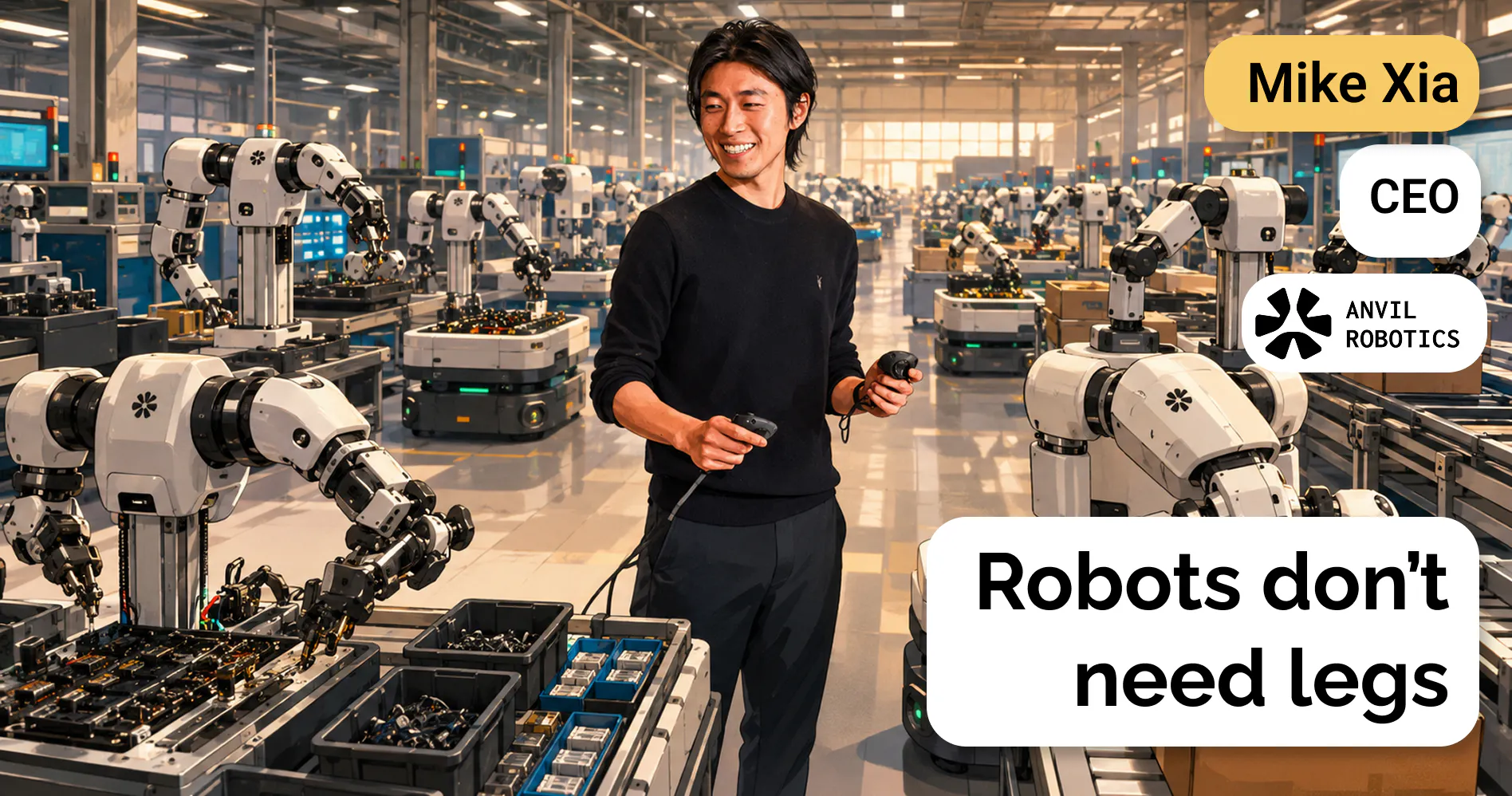
Mike Xia, CEO of Anvil Robotics, on humanoid vs. non-humanoid robots
 Jan-Erik Asplund
Background
With robotics foundation model companies like Physical Intelligence ($1B raised, Jeff Bezos, Thrive & Lux Capital) and Skild AI ($2B raised, Lightspeed Venture Partners & Coatue) racing to build the brain for physical AI, we reached out to Mike Xia, co-founder & CEO of Anvil Robotics ($6.5M raised, Matter Venture Partners), which sells robot arms & developer kits to hundreds of physical AI teams, to learn what the LLM playbook does and doesn't tell us about how robotics scales.
Key points via Sacra AI:
- Humanoids are overengineered for much of the near-term robotics market because food preparation, light manufacturing, packing, and logistics concentrate a disproportionate share of manual labor in structured workflows at fixed workstations, where legless robots can perform the job with lower costs and far less engineering complexity. “In a lot of these tasks, people are usually standing or sitting in one place to do them… So why do you need legs? You can't convince me it's efficient, in terms of both cost and engineering complexity, to invest in legs when a big portion of the task you're automating happens at a tabletop or a bench.”
- The focus on vision-led, pixel-to-action models from Google DeepMind, Physical Intelligence, and NVIDIA reflects the economics of data collection more than a settled belief that cameras are sufficient, with a complete camera costing roughly $12 while force-torque sensors cost thousands of dollars each and remain difficult for small robotics teams to integrate. “A lot of the reason today's most popular models are pixel to action models, VLAs and so on, is simply that it's easy. Cameras are everywhere and cheap. A Sony sensor is about $8 or $9, and an ISP with USB is about $3 or $4, and you've got a camera feed going into your model. Force torque sensing is a different category. A force torque sensor traditionally costs a couple thousand dollars.”
- Physical AI is approaching the point LLMs occupied around 2022, when basic outputs were already useful and emerging scaling laws suggested a much larger breakthrough ahead—with the industry now racing to determine which mix of egocentric video, force, tactile feedback, and dexterous-hand data can move robots from 80–95% task success toward production-grade reliability. “Right now we're in a try everything mode, people don't know if a given data type is best used for pretraining, post training, or somewhere in between… Once we figure out which one or two additional senses carry models from, say, 80 to 95% success rate up to 99.99% and high speed, the whole field will shift and focus around those… It looks a lot like the early OpenAI days, and I mean really early, like the copy.ai era of ‘Generate me five marketing taglines.’ I think it feels similar to that right now, like we're just around the corner from something mind blowingly better.”
Questions
- What was the moment that led you to start Anvil Robotics? What did you think was the problem that needed to be solved?
- Why is Anvil implicitly a bet on non-humanoid form factors making up half the market? What constrains you to the non-humanoid side?
- So, put simply, the Anvil kit, the hardware and the software, doesn't do legs?
- Can you walk us through the major recent phases in robotics, from industrial robots optimized for throughput in controlled factory settings to the current era of physical AI, where generalization is the key focus? What changed with physical AI?
- Can you walk us through a representative customer journey, from a team starting to build an application to where Anvil fits in?
- You've mentioned that this lower level part of the stack isn't core to your customers' product, and that you've open sourced some of the reference designs. If everyone builds on Anvil, where are your customers finding their differentiation?
- Is it fair to say Anvil is an implicit bet that generalization will only go so far? If a model and form factor genuinely generalize across 80% of the addressable market, you'd only need one company to rule them all rather than many solutions companies. Why isn't that the case?
- You mentioned that one way solutions companies differentiate is by training on the right data with specific customers. Everyone talks about the data flywheel as the key thing in robotics. What does a strong data flywheel actually look like, and how important is scale?
- You've said vision alone isn't enough. Cost seems to be one reason force and tactile data are under collected. What else, besides cost, is leading the industry to underweight this data?
- This might be a basic question, but can VLMs help solve this? You mentioned VLAs, pixel to action models, earlier. Do VLMs bring anything to this problem, and if not, what are they for?
- Looking at your customer base and what you've seen them build, does that give you clues about which verticals and applications physical AI will gain traction in first, or is it still too early to say?
- A lot of what you've mentioned still fits into a broader category of light industrials and logistics settings. Does that feel like a fair characterization?
- One area we haven't touched on is consumer. Those plays are very visible. What would it take for a consumer home vertical to gain traction, and are there major gaps in the technology or market that make that unlikely in the short term, setting humanoids aside and thinking more about single purpose devices?
- So your bet is that consumer robotics starts with single purpose applications rather than general purpose humanoids doing everything?
- We hear a lot about China dominating hardware manufacturing and manufacturing innovation. Is being able to source the best components while abstracting away exposure to China based supply chains actually core to your value proposition, or is that less central than people might assume?
- That presumably also helps your business model. You've mentioned elsewhere that gross margin on a $5,000 arm today is around 20 to 30%. Would that improve with scale?
- I'm curious about repeat purchase behavior. What percentage of customers make a repeat purchase, and what's driving that?
- If we end on a forward looking note, what do you think will be obvious three to five years from now about physical AI and robotics that isn't obvious today?
- Do you think we'll reach consensus that there are scaling laws in physical AI training analogous to LLMs, or are we already seeing hints of that if you look closely?
Interview
What was the moment that led you to start Anvil Robotics? What did you think was the problem that needed to be solved?
Anvil is one year old today, so it's kind of a birthday. We actually started talking about and thinking about Anvil about eighteen months ago. Before the company got started, I was an EIR at Matter Venture Partners, and we were exploring a few different areas. I spent a lot of time talking to robotics teams during that period to figure out what pain points they were going through. We talked to about 50 different companies, teams at both big and small companies, to get a spectrum.
There were three big things we saw that gave us conviction to go after this. The first was that teams go through a lot of pain to get something up and running. They have to buy robot arms, cameras, actuators, 3D printed parts to mount things, computer systems, cables, and capture cards, go through firmware installations, and tweak the OS. When I say cameras, I mean literally plural, different kinds of cameras, different SKUs, different vendors. It's not just "I need four cameras." It's "I don't know which one is going to work, so I'm going to buy four different companies and four different SKUs." It becomes a rabbit hole. Some of the teams we talked to spent five to six months and four or five engineers just to put together their initial system to be able to collect data and start training models. There was a ton of pain in that very first step, before we're even talking about deployment.
The second thing that was really exciting was that teams looked similar regardless of org size. Inside big companies that had raised something like $150 million, the team working on manipulation and physical AI was still maybe five to six people. Companies like Qualcomm, Intel, and NVIDIA had very tight teams working on the bleeding edge research, and that held true all the way down to seed stage companies or companies that had raised eight or nine figures. The market was fairly homogeneous in that the teams didn't look very different. Their specific pain points varied, but there was a lot of overlap between them.
The third big one was around humanoids. We think humanoids have a place in the future, but does it all have to be humanoid? There's got to be some other half of the market, maybe with one arm, two arms, three arms, or a mobile base. We don't know exactly what that looks like, but it didn't make sense to us for everything to be walking around on 14 joints in order to stay balanced. Our bet was that there's going to be this other half of the market that doesn't have to look like a human.
Why is Anvil implicitly a bet on non-humanoid form factors making up half the market? What constrains you to the non-humanoid side?
This is partially because I'm an engineer, so I come from a form fits function mindset. If you look at a lot of the automation tasks we're targeting, at least for our initial models, they fall into three big categories.
There’s food and beverage, like Chipotle, McDonald's, or industrial kitchens. There’s light manufacturing, like assembly and packing tasks, and then there’s logistics and materials handling.
In a lot of these tasks, people are usually standing or sitting in one place to do them. It's even more extreme if you look at mass manufacturing in Asia, where you have a station, you do a particular thing there, and you're sitting there the whole time. So why do you need legs? You can't convince me it's efficient, in terms of both cost and engineering complexity, to invest in legs when a big portion of the task you're automating happens at a tabletop or a bench.
So, put simply, the Anvil kit, the hardware and the software, doesn't do legs?
Right, we don't do legs. We're focused on the manipulation side.
Can you walk us through the major recent phases in robotics, from industrial robots optimized for throughput in controlled factory settings to the current era of physical AI, where generalization is the key focus? What changed with physical AI?
I'll try to keep this short because I have a lot of thoughts on it. The most interesting thing is that we're seeing a bit of a reset across the entire robotics stack, which is exciting. The reset is happening because the industry went down a long branch of technology, hardware, software, and solutions, that was built for the factory and industrial settings. In those settings you have laser fencing or physical cages. The robot is measured by how fast it can move without ever bumping into anything, because bumping into something in that setting usually means someone got hurt or something broke.
That's not just about programming a robot to move faster. It's baked into the drives and gearboxes chosen for that application. Harmonic drives, for example, have something like a 250 to one gear reduction ratio, which lets you lift a lot of weight and move very quickly if your motors are spinning fast. But they're not built to collide with anything, because all the force gets concentrated on tiny teeth inside the gearbox. If you bump into things, they break. That's fine for factories, because you're not supposed to bump into anything there. In these industrial settings you're also meant to lift superhuman weights, thirty, forty, fifty kilograms. Companies like KUKA and ABB build massive robots meant to handle a lot of payload at high speed and high throughput, because that's how your value is measured in a factory, how much you can lift, doing it over and over again with precision.
That looks very different from what we do as humans in a lot of bimanual manipulation tasks. I can't hold my arm out at five kilograms for more than a couple of minutes. Five kilograms is about ten pounds, and holding that out is basically a workout. We don't believe you need the same stack of technology that's been optimized over the last ten years of industrial automation covering the factory floor. The entire supply chain, hardware, software, and controls followed that path, including the underlying technology built around measuring precise locations and repeating the same motion over and over. That's what a factory looks like. Something comes down a conveyor belt, you pick it up, you move it, that's it.
Shift over to the manipulation tasks we're looking at today, like assembling a server or electrical components, or a power fixture. These are things people do today. If you ever come out to Taiwan, we could take you around to some of our deployment partners, including some of our investors in Asia. You'd see rows and rows of people plugging things in, kitting boxes, packing things, putting labels on. It's a very variable task. The box is never in exactly the same place. A bag doesn't always open the same way, sometimes you need to really pick at it with a fingernail to get the edges open. Historically, if you put a person there, you got much higher efficiency than trying to program a machine with the old industrial technology stack to do it. So for the last ten years, this category of work just wasn't automated, we had people do it.
What's exciting now is that the models, the actuation technology, and the perception technology are all getting reinvented, because for the first time we believe it's possible, in the next two to three years, to automate a lot of this work.
Can you walk us through a representative customer journey, from a team starting to build an application to where Anvil fits in?
Like I mentioned, it's fairly painful doing this solo. You're exposed to the whole supply chain. You're thinking about which camera to use, what specifications the camera needs, what specifications the lens needs, and that's just for perception. Then there's the question of what communication pipe to use, USB, GMSL, or Wi-Fi, God forbid. There are a lot of decisions in even a single component, and you have to multiply that across the entire system. It turns into a very multidisciplinary problem. If you're a solo engineer or solo founder, it becomes overwhelming. Even if you're a team of three, mechanical, software, and models, where does the camera perception stack fall? Is it software or mechanical? It's a very multidisciplinary problem, and you need to understand each piece deeply enough, and have accrued enough battle scars, to get the system running smoothly.
We've had to accrue those battle scars ourselves over the last year building this initial system and getting it into hundreds of customers' hands. There's so much we've learned that we've rolled back into the product. If you imagine each team doing this on their own in order to get a viable system to collect data, validate their models and policies, and get it into customers' hands for a proof of concept, you're setting yourselves back around half a year. This is also an area teams don't want to invest a lot of time in, because it's not core to their product. They're building a solution, trying to find a market, trying to get a policy trained and validated to prove a task can be automated. They don't want to invest in camera communication bandwidth and frame drops, or in smoother controls and better data collection or training infrastructure.
But that always bleeds back into a maintenance gap. When something goes wrong, you're stuck asking where it went wrong. You have this massive system to cover, a Linux build you've patched, a kernel you had to modify to support a particular camera, a capture card you bought off Amazon to get four streams of data, and you don't know which piece is causing the problem. If you're maintaining that yourself, you're responsible for debugging the entire stack, and as an individual company with low volume, it's hard to figure out where the problem is and even harder to get a vendor to listen to you. You've bought two cards from them, why would they go fix the problem for you?
There are a lot of things that are fundamentally challenging for teams building in this space, and that's what we're trying to solve. We've accrued a lot of fragmented volume from our customers, so vendors are much more willing to work with us. That turns into a healthy partnership where Anvil can help build out and improve this lower level stack, and everybody benefits.
You've mentioned that this lower level part of the stack isn't core to your customers' product, and that you've open sourced some of the reference designs. If everyone builds on Anvil, where are your customers finding their differentiation?
This is the fascinating part, because the market is so early. Things are shifting quickly, but you can already see the stack developing into roughly three parties.
There are the foundation model companies, who have a large pretrained model they need to prove and validate for certain capabilities, and a lot of that gets provided as core pieces for teams to build on. Physical Intelligence is an example, they've open sourced a lot of their work. Generalist is another, working with early teams through Y Combinator. They own the brain part of the stack and want to provide that brain to people.
Then there are hardware and systems providers, which is where we'd put ourselves. Similar to the foundation model companies, we're not very opinionated about the application. We want to find overlap across our customers and build a reusable platform that everybody can use, the physical equivalent of the brain.
The third category, which I wasn't expecting and where most of our customers actually sit, is go to market companies, product companies, or solutions companies, there isn't a settled term for this group yet. These companies take a brain, working with a Generalist or Physical Intelligence, take a body, either home grown or from Anvil, and go tackle a particular market. Their value and their moat is that they collect data with their customers. They own the customer relationship, understand the use case and the pain points, and have much better intuition for what will solve the customer's problem and what will get in the way. This group takes the technologies, brings them to market, gets them deployed, and builds out the full system to integrate with the customer. Take a 3PL as an example. You have to integrate with their systems, figure out what material is being moved or packed, how many people and stations are involved. That part has nothing to do with the foundation model or the hardware platform, it's purely about the solution, and that's true for any industry you'd tackle with physical AI.
Is it fair to say Anvil is an implicit bet that generalization will only go so far? If a model and form factor genuinely generalize across 80% of the addressable market, you'd only need one company to rule them all rather than many solutions companies. Why isn't that the case?
We're definitely betting on a lot of applications blooming, and I'm fairly confident in that bet because you can look at the LLM and agentic world as a good example. There are five, six, seven, eight frontier foundation models, some open source, some closed source, but how many agentic application companies are there with massive traction and penetration across accounting or customer support.
That market has gone through a very similar transformation, from an initial API to a of diaspora applications built on top of it, even though the underlying models are generalizable. At the end of the day, you can be generalizable & a little bit good at everything & very capable, but somebody wants to take that and build it into a solution, they're the ones who will win the market and benefit from being able to take that 80% or whatever to 99.99%.
You mentioned that one way solutions companies differentiate is by training on the right data with specific customers. Everyone talks about the data flywheel as the key thing in robotics. What does a strong data flywheel actually look like, and how important is scale?
This is an interesting, early part of the space, and honestly a bit of a wild west. I have my own opinions and hypotheses, but I'd call them strong beliefs loosely held. I do believe it's important to have a lot of data, there's no way around that. Going back to the LLM analogy, over the past decade our civilization has put an enormous amount of information, video, images, and text onto the internet and made it widely accessible. That data is what made VLMs and LLMs possible. Behind that data is the physical infrastructure that enabled it, smartphones, digital cameras, computers, built and optimized over a decade, and the supply chains behind them. Companies like Apple, Lenovo, and Samsung spent a decade optimizing that supply chain to make these devices ubiquitous. All of that made it possible to build the agentic models we have today.
If you map that back to robotics, we're at the very beginning. There are so many modalities of data we haven't collected yet. As a civilization, we've never needed to document the physical world as clearly as we've documented the digital world, because most of our time is spent communicating digitally. There's a big gap, and we have to solve it across data, hardware, and infrastructure to build the same kind of foundation for physical AI.
It starts from the supply chain. There's a lack of force data and tactile data because we've never had a need for massively affordable force or tactile sensing, so it just hasn't existed at scale. A lot of the reason today's most popular models are pixel to action models, VLAs and so on, is simply that it's easy. Cameras are everywhere and cheap. A Sony sensor is about $8 or $9, and an ISP with USB is about $3 or 4, and you've got a camera feed going into your model.
Force torque sensing is a different category. A force torque sensor traditionally costs a couple thousand dollars, and you usually buy one for the one robot you're deploying. If you're trying to collect data across hundreds of robots, that's hundreds of force torque sensors. These things haven't needed to be scaled or cost optimized, so they're less accessible, and researchers, who are the primary leaders in physical AI, can't easily access them. Very few research labs have a million dollars to deploy on twenty, let alone two hundred, robots. That alone is a big reason we don't see some of these data modalities yet.
You've said vision alone isn't enough. Cost seems to be one reason force and tactile data are under collected. What else, besides cost, is leading the industry to underweight this data?
Cost and timing, I think. We're early, these are the very first innings, so I don't expect it to stay this way forever. I'd bet that force torque becomes an important sense, how hard are you pushing, what are you bumping into. Some form of tactile, or even just binary force data at the manipulator, is going to matter. It's like screwing a lid onto a water bottle with your eyes closed, you can still figure it out because you can feel it. Compare that to when your arm falls asleep, it can still move, but you can't push yourself off the bed with it, because you've lost the sense of force even though motion is intact. That's the equivalent of pixel to action without force in human terms.
I think the reason we don't use it more is that it's inaccessible, because of cost or integration difficulty, or both. Getting a force torque sensor working today isn't trivial. The product is designed for a system integrator that a factory has paid half a million to a million dollars to integrate with a specific part of their manufacturing line. It's not something three founders out of YC usually buy and hook together.
You can already see this in the literature. Plenty of physical AI research has added force torque sensing to various methods, some affordable, some not. The CoinFT spawned robotics project is a good example, these projects have shown empirically that you get much better success rates, models understand tasks better, and you avoid certain failure modes that pixel to action models will fail on. But because we're so early, these are still research projects, they haven't turned into products, systems, or default parts of the platform people use when they conduct research & build applications.
This might be a basic question, but can VLMs help solve this? You mentioned VLAs, pixel to action models, earlier. Do VLMs bring anything to this problem, and if not, what are they for?
VLMs are a critical ingredient of VLAs and a lot of these models. The way to think about a VLM is that it's basically a VLA without the action part. You've already taught the model, in this latent space, about language and images or video, in this case multiple frames and the relationships between them. Picture a 300—to 700-dimensional space where inside the space, the word & the pixels that represent that word, and the action of the multiple frames of it are all in the same area. That's what people mean when they say the model understands what you're saying or what it’s seeing, because they're in the same area.
The extra step VLAs add is producing an action that results in the next frame appearing. It's almost like, “I'll tell the robot to do A, B, C, or move these joints this way,” and it expects that whatever it understands about its world will make this play out in the next frame. It's almost like a rudimentary graft onto a VLM, but just fine tuning it to be able to associate action with outcome.
In that sense, these are very complementary technologies. You could imagine VLAs extending to include force, something like vision force language action. Essentially you're adding these different senses as additional signals in the same latent space, so the model learns that action equals force equals some state change in the world it's observing. I think you'll see more and more of these senses added & integrated into these models, because there's a lot of literature showing that more information improves task performance.
Looking at your customer base and what you've seen them build, does that give you clues about which verticals and applications physical AI will gain traction in first, or is it still too early to say?
It's early to say where the first winners will be by industry, but you can see shapes forming. The fog of war is still there, but some patterns are emerging. Light manipulation is a huge area, that's where a lot of today's labor cost sits. We rarely have humans constantly lifting ten or twenty kilograms unless it's something like working at Chewy's lifting dog food, most people are handling something lighter. So light manipulation is going to be big.
The other area is more dangerous settings, where the consequences of failure are higher, like handling munitions or working in biohazardous environments. These are light but hazardous tasks, and there's a lot of pull to get humans out of that environment. In a lot of those settings, remote teleoperation is already a viable solution you can deploy today, and you can layer automation or guardrails on top in case the human operator makes a mistake.
For true mass scale physical AI, I think a lot of people are still watching the model companies to see who cracks the problem first, who's able to support a basic but high impact task at high reliability and high speed. The rest of us, both solution providers and platform providers like us, are racing to support that first breakthrough application or model by providing the best body and the best senses to help them go to market and scale faster.
A lot of what you've mentioned still fits into a broader category of light industrials and logistics settings. Does that feel like a fair characterization?
I think that's fair, and it's because of the shape of the market. That's where you get the most labor employment, and it's also where you find the most structured tasks, because these are large manual pipelines that already have to be structured. That fits the technology better. There’s a lot of people, a lot of it has already been structured, and there's a clear ROI, so I think we'll see it there first.
One area we haven't touched on is consumer. Those plays are very visible. What would it take for a consumer home vertical to gain traction, and are there major gaps in the technology or market that make that unlikely in the short term, setting humanoids aside and thinking more about single purpose devices?
I'm personally really excited about this. Not for Anvil, as we're very focused on light industrial, but as a consumer, I'm excited about whoever releases the laundry folding kit. It's a close to home problem, very few of us have someone folding our laundry for us, most of us do it ourselves. It's a huge market, billions of people, and there's going to be a big segment of us willing to pay premium prices for even a crappy laundry folding robot. If you asked me today, “Pay me $3,000 and I'll fold 50% of your laundry well,” I'd say take my money, especially if you tell me it'll improve over time.
There's been a constant trend of early adopters with new technologies, and I think that's partly because I've been in tech for ten years and I'm just pilled on it. But I think there are enough of us out there to absorb the initial wave & help fund a company targeting something as basic as laundry folding. I'm just surprised it doesn't exist already. The robots themselves are fairly affordable, and I know because we manufacture them. I'm just waiting for those two pieces to come together so I can buy one for my house. I'd guess within the next year there will be some kind of laundry folding setup available.
So your bet is that consumer robotics starts with single purpose applications rather than general purpose humanoids doing everything?
For consumer, for sure.
We hear a lot about China dominating hardware manufacturing and manufacturing innovation. Is being able to source the best components while abstracting away exposure to China based supply chains actually core to your value proposition, or is that less central than people might assume?
This is a really important problem, and it's a big reason we chose Taiwan as the base for our hardware supply chain operation. Nobody would argue that China isn’t currently leading in a lot of these technologies, from batteries to actuation to raw velocity in terms of how fast they're moving on sensors, cameras, and all of the above. It's basically impossible to avoid some dependence on China right now, but the goal is to be China plus one in as many critical areas as possible.
Even today, some of our actuators come from China. In the near future, we want to develop partners in Taiwan, Korea, and Japan who can get close to, if not match, the performance, pricing, and velocity of the Chinese components we currently rely on. The tricky part is that these partners can't build in a vacuum. If you're a manufacturing business, it's extremely risky to ramp in a particular direction without someone downstream to absorb that supply. It could be company ending move if you go to build something and don't have buyers lined up for the next twelve months.
This is a fundamental reason we've pursued a broad, developer first approach, by aggregating demand across the market, it becomes a much lower risk for our non-Chinese partners in Taiwan, Korea, and Japan to help build out some of these physical supply chain capabilities. If they know there's demand, it's a binary shift in how willing they are to invest and accelerate in a given direction, even for something as specific as actuators.
If you don't lower that risk for them, they can't take it on, and that's not because they're lazy, it's just business risk. If we can do this across multiple categories, sensors, actuation, and so on, we can help make that China plus one shift possible.
That presumably also helps your business model. You've mentioned elsewhere that gross margin on a $5,000 arm today is around 20 to 30%. Would that improve with scale?
Absolutely. We build, assemble, and work with a lot of Taiwanese vendors for CNC machining, sheet metal, FATP, and so on, and that adds cost. We're also still low volume, a couple hundred robots right now. Given that, there's no way to compete with the supply chain dominance of a company like Unitree in this current state. It's a bit like SaaS, where growth solves a lot of problems.
I'm curious about repeat purchase behavior. What percentage of customers make a repeat purchase, and what's driving that?
This is actually one of the most interesting stats for us, it's around 15 to 20%. Two things are driving it. One is the data collection need. In terms of revenue potential, the biggest driver of repeat purchases is data collectors, and it's not just a few companies in the US. Every region has its own players, because they each have different advantages. Southeast Asia has Vingroup doing a lot of humanoid robotics activity, they're not going to work with Scale, and Scale probably doesn't want to work with Vingroup either, but Vingroup has a couple billion dollars behind their physical AI and humanoid initiatives. Europe has similar players. Each region has these companies, and none of them want to develop the hardware or the low level controls and infrastructure themselves. They'd rather buy, amortize, or lease. That represents a big chunk of recurring revenue potential. Some of them already do recurring purchases with us, and even in the early days we've seen $50,000 to $80,000 in spend, which for a SaaS company would be considered fast.
The other driver is startups. Startups that raise money and grow their headcount can't all share one robot. They're either collecting data in house or need units for engineers to develop on, or to send to a partner for a proof of concept, and that also drives repeat purchases. I think this is more bottlenecked by deployment potential, the moment a startup turns into a meaningful, large repeat purchaser, scaling to hundreds of robots, that's going to be a function of how well their solution lands in the market. So far we haven't seen anyone with hundreds of robots, but we've seen repeat purchases of five or ten robots as a team grows and needs more for data collection or POCs.
If we end on a forward looking note, what do you think will be obvious three to five years from now about physical AI and robotics that isn't obvious today?
Three to five years is going to be a very exciting stretch, so everything I'm about to say could look very different by then. I'm extremely bullish that we'll see much larger deployments in three to five years. I think the data cocktail question, whether it's egocentric data, force data, dexterous hand data, gloves on people versus gloves on robots, is going to get much more resolved. Right now we're in a try everything mode, people don't know if a given data type is best used for pretraining, post training, or somewhere in between. I think that uncertainty will largely get resolved, because companies like us at Anvil, and other providers, will be able to supply these senses to researchers, and as those senses make their way into models, they'll show measurable improvements in capability. That will answer the question of what data actually matters.
Once we figure out which one or two additional senses carry models from, say, 80 to 95% success rate up to 99.99% and high speed, the whole field will shift and focus around those. We've already made our bet on force, we think force and some sense of tactile are going to be really important. I think those major senses for the brain will become clear, and that will quickly ramp up the amount and variety of data collected around those sensors. Right now we just haven't picked a lane to double down on, we're in a broad search mode. Once that search narrows to the ones that matter, the market will quickly collapse around them and focus on making sure they're well built, cost efficient, and scalable to produce data at scale.
Do you think we'll reach consensus that there are scaling laws in physical AI training analogous to LLMs, or are we already seeing hints of that if you look closely?
If you squint, you're already seeing it. I can't name the lab, but one of the bigger foundation model companies is doing very well with some of these scaling laws, and by their own account it looks a lot like the early OpenAI days, and I mean really early, like the copy.ai era of generate me five marketing taglines. I think it feels similar to that right now, like we're just around the corner from something mind blowingly better. We stayed in that copy.ai-like era for about a year and a half, and I'd guess we'll have another year and a half or so before we see something that's leagues apart from what these models can do today.
Disclaimers
This transcript is for information purposes only and does not constitute advice of any type or trade recommendation and should not form the basis of any investment decision. Sacra accepts no liability for the transcript or for any errors, omissions or inaccuracies in respect of it. The views of the experts expressed in the transcript are those of the experts and they are not endorsed by, nor do they represent the opinion of Sacra. Sacra reserves all copyright, intellectual property rights in the transcript. Any modification, copying, displaying, distributing, transmitting, publishing, licensing, creating derivative works from, or selling any transcript is strictly prohibited.