

Funding
$490.00M
2025
Valuation & Funding
CHAOS Industries raised $275 million in a Series C round led by New Enterprise Associates and Accel in May 2025, bringing total funding to $490 million. The company reached a $2 billion valuation with this latest round.
The funding history shows rapid scaling with a $70 million Series A led by 8VC in March 2023, followed by a $145 million Series B in November 2024. Key investors across rounds include StepStone Group, Overmatch Ventures, Tru Arrow Partners, Valor Equity Partners, and Lerner Enterprises. The appointment of George Tenet as Executive Chairman signals the company's focus on government and allied military markets.
Product
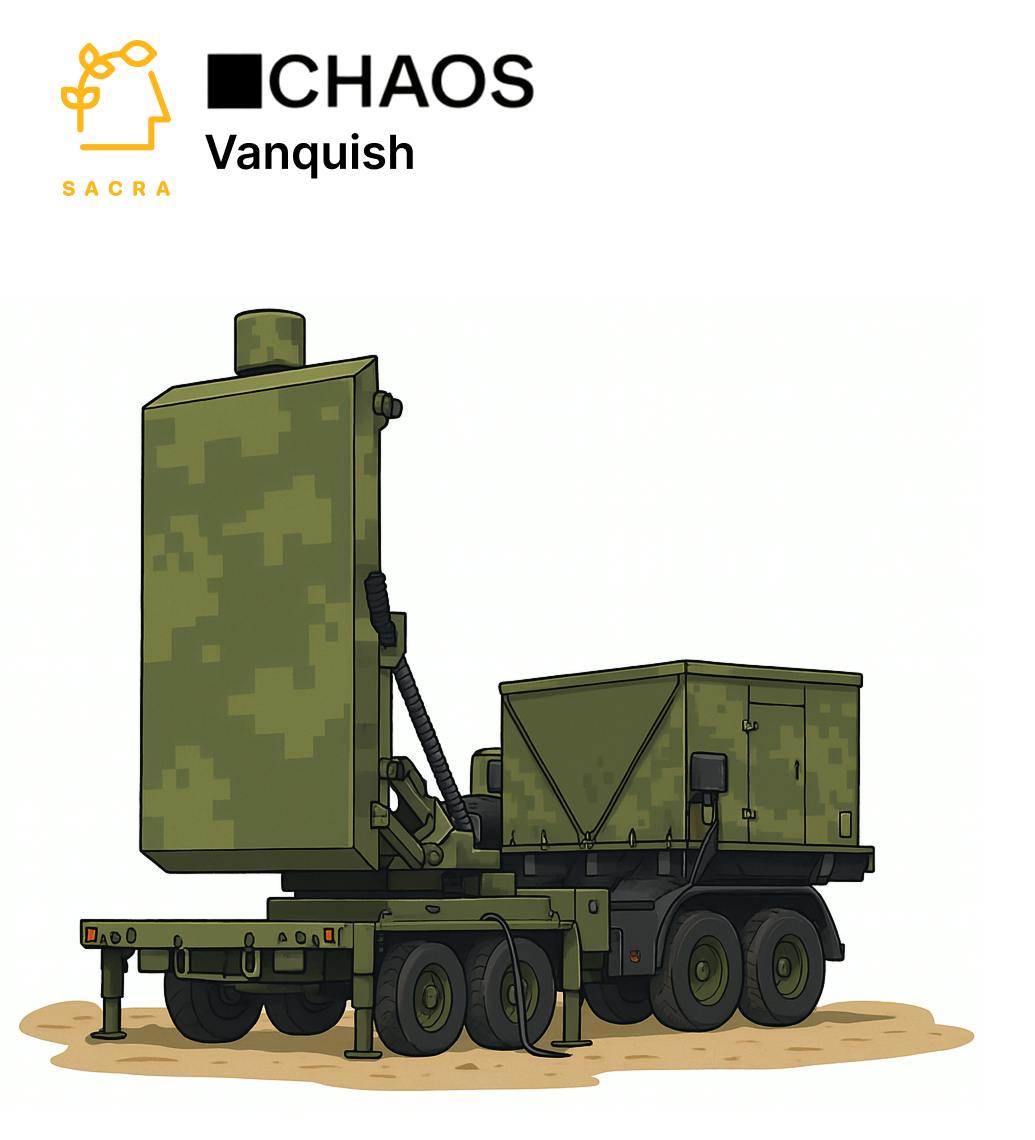
CHAOS Industries is building a distributed sensor network that synchronizes multiple small radar and communications nodes to act as one large, coherent system. Their core innovation is Coherent Distributed Networks technology that keeps dozens of devices synchronized to billionths of a second, enabling capabilities that individual sensors cannot achieve alone.
The HYDRA platform serves as the hardware foundation - rugged, shoebox-sized nodes that mount on trucks, ships, or drones and connect to vehicle power. Each node runs software-defined applications through an open API, allowing operators to switch between radar detection, mesh networking, electronic warfare, and communications functions with simple software updates. Users interact through a tablet dashboard where they select applications and the nodes automatically mesh with other HYDRA units in range.
The Vanquish radar represents their first commercial application, designed specifically for detecting cheap drones and missiles that traditional radar systems struggle to track cost-effectively. Multiple Vanquish nodes work together to create overlapping coverage areas, with each node contributing to a shared picture of the airspace. The system includes edge AI running on NVIDIA Jetson modules for real-time target classification and can receive new detection algorithms through remote software updates.
The distributed architecture provides resilience against jamming and physical attacks since losing individual nodes doesn't compromise the entire network. This approach transforms expensive, centralized radar installations into networks of lower-cost nodes that can be rapidly deployed and reconfigured based on mission requirements.
Business Model
CHAOS operates a B2B model selling both hardware platforms and software licenses to defense customers, with a focus on dual-use applications that can serve both military and civilian markets. The company manufactures the HYDRA hardware nodes in-house while developing the software stack that enables coherent networking across distributed sensors.
Revenue comes from three primary streams: hardware sales of HYDRA platform nodes, software licensing for applications like Vanquish radar and electronic warfare capabilities, and ongoing support contracts for deployed systems. The hardware pricing targets the low-six figures per node, dramatically undercutting traditional radar systems while the software licensing model allows customers to add new capabilities to existing hardware through updates.
The business model emphasizes rapid deployment and flexibility over the traditional defense approach of custom-built, single-purpose systems. Customers can purchase standalone products like Vanquish radar or adopt the full HYDRA platform ecosystem. The software-defined architecture creates recurring revenue opportunities as new applications can be deployed to existing hardware installations.
CHAOS is building manufacturing capabilities to support program-of-record contracts that require thousands of units, moving beyond prototype and pilot phases toward scaled production. The dual-use positioning allows them to serve both defense customers and critical infrastructure operators like airports and energy facilities, expanding the addressable market beyond purely military applications.
Competition
Vertically integrated defense platforms
Anduril Industries represents the most significant competitive threat with its $14 billion valuation and vertically integrated approach to autonomous defense systems. Anduril's Lattice operating system and massive Arsenal-1 manufacturing facility give them advantages in scale and integration that could undercut CHAOS's distributed approach. Their ability to bundle sensors, software, and autonomous platforms into comprehensive solutions, combined with superior capital resources, poses a risk to CHAOS's market positioning. Saronic follows a similar model in maritime autonomy, showing how vertical integration is becoming the preferred approach for well-funded defense startups.
Electronic warfare and counter-drone specialists
Epirus has raised $250 million for their Leonidas directed-energy systems and represents direct competition in the counter-drone market that CHAOS targets with Vanquish. Their software-defined microwave arrays could compete head-to-head if CHAOS extends their coherent timing technology into directed-energy applications. Shield AI and other counter-drone specialists are building focused solutions that may offer superior performance in specific use cases compared to CHAOS's more generalized platform approach.
AI-powered battle networks
Palantir dominates the data fusion and battle management market with established relationships across the Department of Defense and proven track record in fielded systems. Scale AI's Thunderforge contract and relationships with major defense contractors position them to potentially commoditize the networking layer that CHAOS depends on. International competitors like Helsing in Europe offer NATO buyers alternatives to U.S. suppliers, potentially limiting CHAOS's export opportunities. These software-focused competitors could make CHAOS's hardware-centric approach less relevant if battle networks shift toward AI-first architectures.
TAM Expansion
New products and capabilities
CHAOS is expanding beyond radar into electronic warfare, secure communications, and counter-drone effects that all leverage their core coherent networking technology. Each new capability adds incremental market opportunity across air defense, electronic warfare, and secure communications markets. The software-defined nature of their platform allows rapid deployment of new applications to existing hardware, creating recurring revenue streams. Their timing synchronization intellectual property has applications beyond defense in autonomous mining, energy grid management, and 5G infrastructure where precise distributed coordination is valuable.
Customer base expansion
The company is positioning for program-of-record penetration with U.S. military services that require thousands of units rather than small prototype contracts. European rearmament programs and Five Eyes alliance procurement create opportunities with allied militaries seeking rapidly deployable air defense systems. The dual-use positioning opens critical infrastructure markets including airports, refineries, and ports that need drone detection capabilities to comply with evolving regulations. George Tenet's appointment as Executive Chairman signals focus on expanding government and allied military relationships.
Geographic expansion
Indo-Pacific deployments represent a major opportunity as AUKUS Pillar 2 working groups seek distributed radar networks for island-hopping scenarios. The distributed architecture suits rapid deployment requirements better than traditional large radar installations. Middle Eastern markets facing drone threats from regional conflicts are funding layered counter-drone systems where CHAOS's non-lethal sensors could win export approvals faster than kinetic systems. The company's ITAR-controlled but non-lethal technology may face fewer export restrictions than weapons systems, enabling broader international sales.
Risks
Export controls: CHAOS's core timing and networking technologies likely fall under strict ITAR regulations that limit international sales and partnerships. As geopolitical tensions increase, export control restrictions could tighten further, limiting the company's ability to serve allied markets and compete against international alternatives like Helsing that offer NATO buyers non-U.S. options.
Chip supply constraints: The company's reliance on specialized timing chips and NVIDIA Jetson modules for edge AI creates vulnerability to semiconductor supply chain disruptions. Defense contractors typically require long-term supply guarantees that may be difficult to secure for commercial components, potentially forcing expensive custom chip development or limiting production scaling.
Program concentration: CHAOS's path to significant revenue depends on winning a small number of large program-of-record contracts with the U.S. military and allies. The defense procurement process is notoriously slow and political, with established primes having significant advantages in lobbying and relationship management. Failure to win major programs could leave the company with limited revenue despite substantial R&D investment.
DISCLAIMERS
This report is for information purposes only and is not to be used or considered as an offer or the solicitation of an offer to sell or to buy or subscribe for securities or other financial instruments. Nothing in this report constitutes investment, legal, accounting or tax advice or a representation that any investment or strategy is suitable or appropriate to your individual circumstances or otherwise constitutes a personal trade recommendation to you.
This research report has been prepared solely by Sacra and should not be considered a product of any person or entity that makes such report available, if any.
Information and opinions presented in the sections of the report were obtained or derived from sources Sacra believes are reliable, but Sacra makes no representation as to their accuracy or completeness. Past performance should not be taken as an indication or guarantee of future performance, and no representation or warranty, express or implied, is made regarding future performance. Information, opinions and estimates contained in this report reflect a determination at its original date of publication by Sacra and are subject to change without notice.
Sacra accepts no liability for loss arising from the use of the material presented in this report, except that this exclusion of liability does not apply to the extent that liability arises under specific statutes or regulations applicable to Sacra. Sacra may have issued, and may in the future issue, other reports that are inconsistent with, and reach different conclusions from, the information presented in this report. Those reports reflect different assumptions, views and analytical methods of the analysts who prepared them and Sacra is under no obligation to ensure that such other reports are brought to the attention of any recipient of this report.
All rights reserved. All material presented in this report, unless specifically indicated otherwise is under copyright to Sacra. Sacra reserves any and all intellectual property rights in the report. All trademarks, service marks and logos used in this report are trademarks or service marks or registered trademarks or service marks of Sacra. Any modification, copying, displaying, distributing, transmitting, publishing, licensing, creating derivative works from, or selling any report is strictly prohibited. None of the material, nor its content, nor any copy of it, may be altered in any way, transmitted to, copied or distributed to any other party, without the prior express written permission of Sacra. Any unauthorized duplication, redistribution or disclosure of this report will result in prosecution.