

Anthropic's S-1
 Jan-Erik Asplund
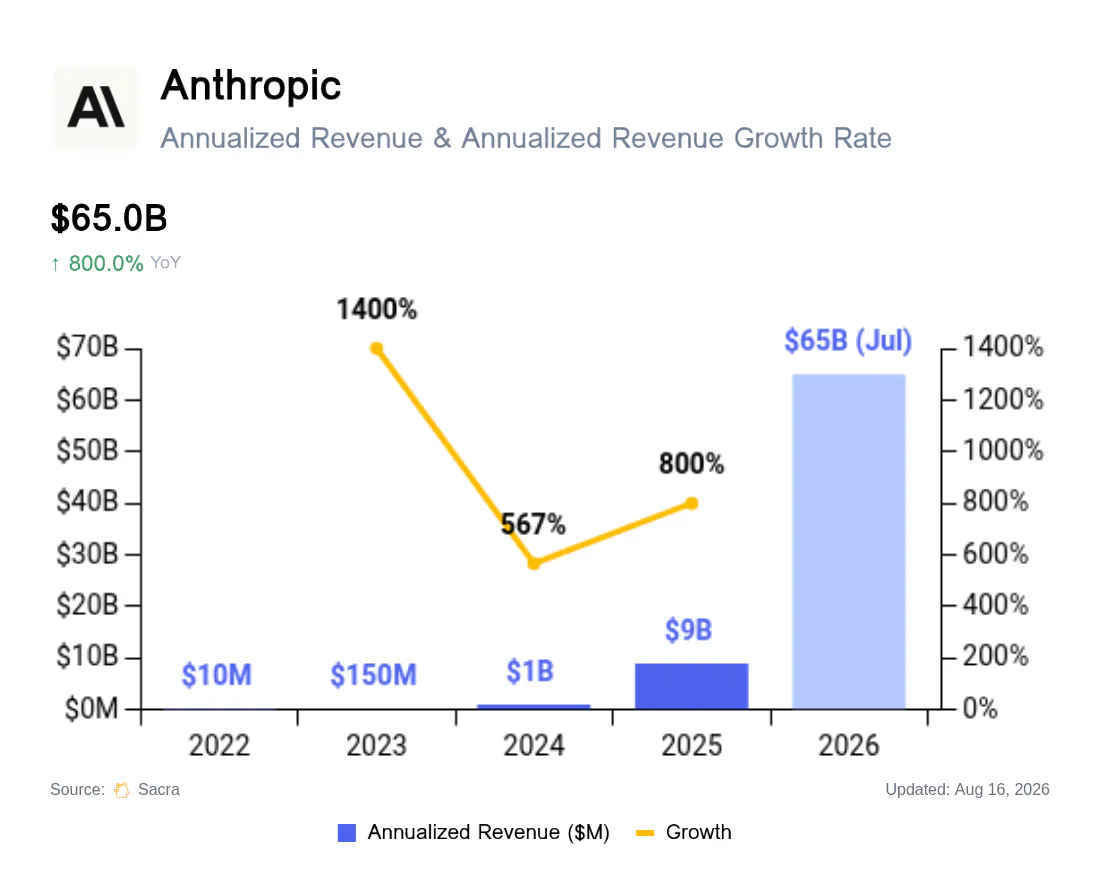
TL;DR: Anthropic overtook OpenAI as its annualized revenue surged from $9B at the end of 2025 to $65B by July 2026, delivering its first operating profit along the way, but reportedly reached only ~$70B by October as growth slowed & margins compressed. Ahead of its expected $1.5T IPO, investors must weigh whether demand can keep pace with $500B in planned compute & infrastructure spending. For more, check out our full report and dataset on Anthropic.
We’ve covered Anthropic (March 2024, October 2024, March 2025, August 2025) from its early enterprise API business through Claude Code’s emergence as a direct competitor to customers like Cursor, and followed up in April 2026 on its battle with OpenAI as new model releases, compute shortages & competing coding agents shifted developer demand between the two labs.
With its S-1 now public ahead of an expected November IPO, we’re revisiting how Anthropic went from insurgent upstart to neck-and-neck with OpenAI.
Key points via Sacra AI:
- Founded in 2021 by seven OpenAI defectors & effective altruists, led by Dario & Daniela Amodei, Anthropic found its initial wedge with businesses by focusing on large context windows, expanding its LLM chatbot Claude to 100,000 tokens in May 2023 (vs. 8,000 for GPT-4) so businesses could feed entire documents into a prompt, positioning Anthropic as the safety-focused lab for working with proprietary company data (vs. OpenAI going after mass-market adoption with ChatGPT).
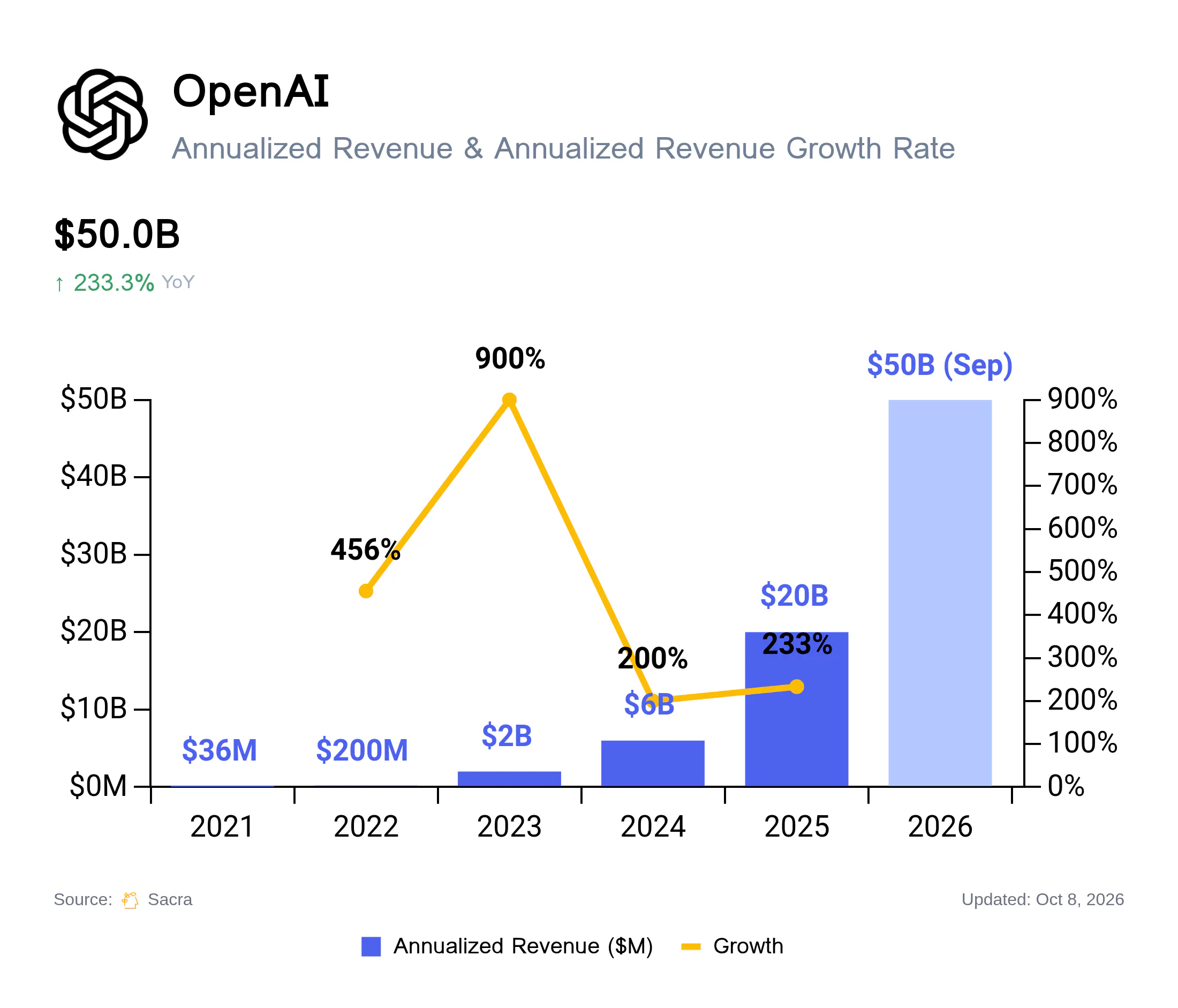
- Anthropic grew from from $150M in annualized revenue at the end of 2023 to $1B at the end of 2024, with the June 2024 launch of Claude 3.5 Sonnet proving a breakout moment for AI coding & driving a wave of migrations from OpenAI’s API as Anthropic came to power products like Vercel’s v0 and Replit Agent, though OpenAI’s huge advantage in mindshare & consumer (~300M MAUs vs. Claude at ~30M) ensured it kept its lead on revenue, growing from $2B annualized in 2023 to $6B in 2024.
- Five months after we covered Claude Code, Anthropic’s terminal-based coding agent & direct challenge to its own #1 customer Cursor (March 2025), we declared it “Anthropic’s ChatGPT” (August 2025) as it grew from $18M annualized in April to $400M in July (compared to the AI application breakout Cursor’s $500M in May), with OpenAI fast-following with its launch of Codex (May 2025) as Anthropic’s total annualized revenue exploded to $9B at the end of 2025.
- With Anthropic already capturing an outsized share of AI coding demand, the rise of agents in 2026 poured even more fuel on the fire, driving annualized revenue to $47B in May 2026, as Claude Code ($8B annualized revenue as of May 2026) became a platform for agents doing inference-time reasoning and writing & testing code, multiplying billable token consumption to 80% of Anthropic’s revenue and driving the company’s first GAAP operating profit ($974M), roughly 900% net dollar retention, and gross margin expansion to 85% (from 12%).
- Growth dropped off in Q3’26, with revenue rising just 45% (vs. 143% in Q2) to $16.8B amid 1) a move away from tokenmaxxing—with top-5 customers slashing their internal usage of Claude Code like Meta (reducing usage by 50%) & Microsoft (reducing by ~35%)—2) competition from a resurgent OpenAI & cheaper open-source Chinese models, and 3) consumer backlash over Anthropic removing Fable, its most powerful model ever, from its subscription product.
- Not just a coding assistant, Claude Code has proved to be Anthropic’s strongest wedge into the enterprise, as Claude Code deployments have led to sales of Cowork (now being adopted faster than Claude Code at the same stage after launch) for non-engineering “vibe doing”, Claude for chat over connected workplace SaaS apps, and the Claude API, with more than 50% of Anthropic customers that spend $100K/year now paying for more than one of these products, giving Anthropic more ways to expand within existing accounts.
- With its S-1 now public and a November IPO expected, Anthropic is reportedly pursuing a $1.5T valuation at roughly 21x its estimated ~$70B in annualized revenue as of October, up just ~8% from $65B at the end of July, marking a sharp slowdown from its 5x growth between December & May and raising the question of whether demand can keep growing fast enough to absorb its $500B in planned compute & infrastructure spending.
For more, check out this other research from our platform:


