
$5T/year human-shaped Roomba
 Jan-Erik Asplund
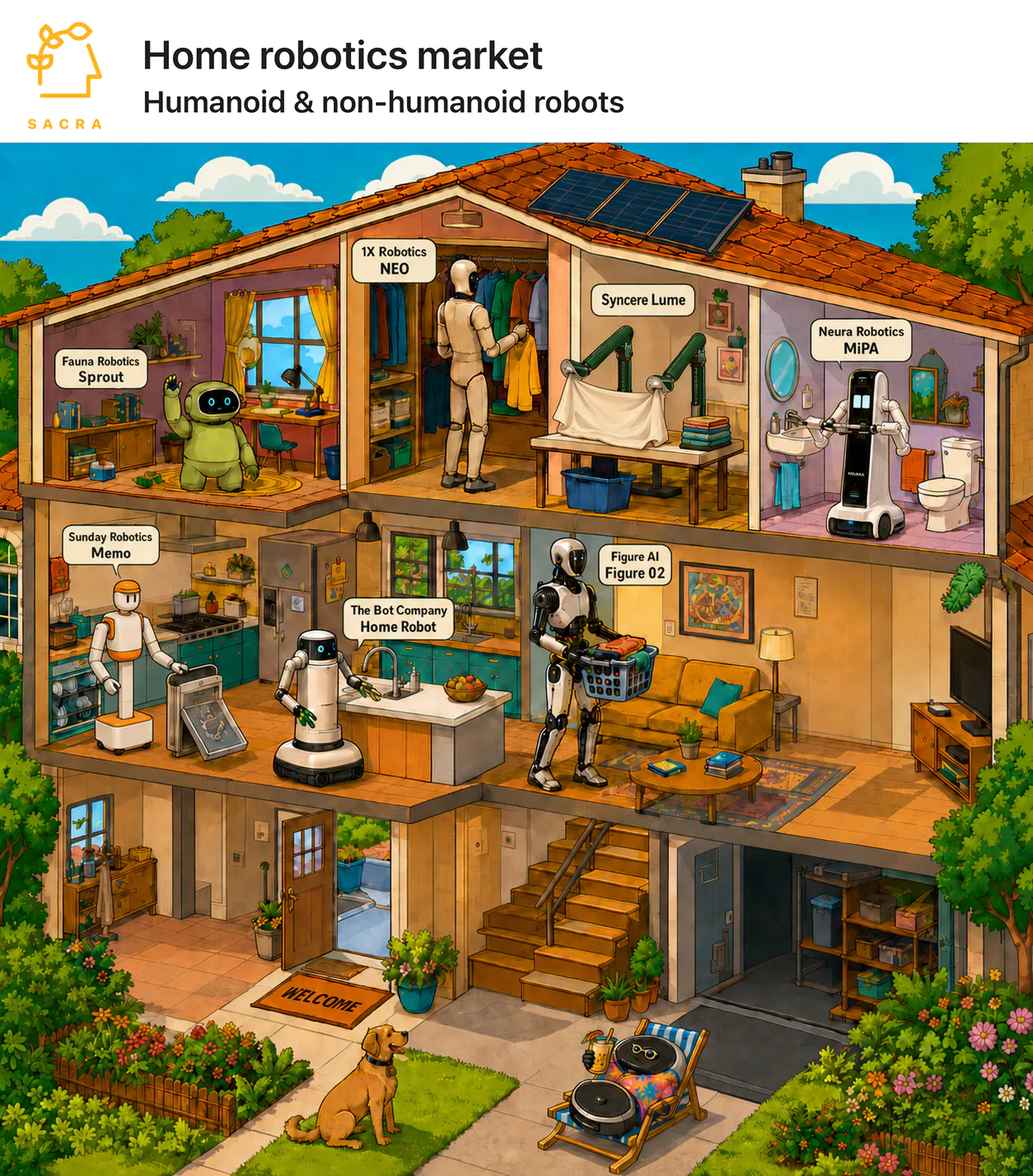
TL;DR: In three decades of consumer robotics, only the Roomba found real product-market fit — but cheap sensors, brushless motors & transformer-based AI are now unlocking a new wave of home robots from 1X, Sunday Robotics & The Bot Company, split between $20K humanoids that attempt full-spectrum housekeeping and sub-$10K non-humanoids. For more, check out our full reports on 1X, Sunday Robotics & The Bot Company.
Key points via Sacra AI:
- Since the first consumer robot hit the market three decades ago, only the robotic vacuum, led by Roomba (50M+ vacuums sold, $1.6B revenue in 2021) by iRobot (IPO in 2005, filed for Chapter 11 in December 2025 after failed Amazon buyout) as the most successful iteration, has found great product-market fit, benefiting from 1) the non-complex nature of vacuuming, 2) affordability, and 3) a form factor that requires minimal behavioral change. The new consumer robotics wave exists because cheap, reliable sensors, cameras, brushless DC motors, and microprocessors now meet transformer-based AI and imitation learning, making it plausible for robots to learn & adapt to messy, variable home environments rather than relying on hard-coded obstacle avoidance like the Roomba did, unlocking the possibility of a general-purpose home robot capable of multi-step tasks & recognizing novel objects and layouts in real time.
- 1X's NEO is a 5'7", soft-bodied, bipedal humanoid robot built to traverse the full built home environment of stairs, doorways, cabinets, countertops, and shelves and perform the broad range of domestic chores from loading dishes to folding laundry to picking up toys, meaning it can technically do everything a homeowner needs but at current speeds of roughly 2 minutes to fold a sweater or 5 minutes to load three dishes. At $20K upfront or $499/month (6-month minimum lease), NEO is priced at roughly 2x a Sub-Zero built-in refrigerator and 13x a Roomba, above mass consumer electronics and appliance price points, but within range of economic justification when compared to the $10-12K annual cost of a human housekeeper ($180-$240/week), a comparison that works as the robot's performance approaches human equivalence.
- Sunday Robotics and The Bot Company are going after the non-humanoid approach—Sunday with a 170 lb wheeled base, telescoping vertical spine that reaches from floor level to ~7 feet, and simplified 3-finger grippers, and The Bot Company with a roughly ~6-foot, treaded Roomba-like mobile base—both targeting a sub-$10K price point and betting that the first home robots to ship at scale will focus on a single, high-frequency task like toy pickup and do it well, rather than attempting full-spectrum housekeeping. Per Bot Company CEO Kyle Vogt (former Cruise CEO), home robots only need one nine of reliability (90–99% success) vs. the five to six nines (99.999–99.9999%) required for self-driving since failure is a toy left on the floor rather than a fatality, a gap of 4 orders of magnitude that suggests home robots could reach commercial viability on a dramatically shorter timeline than the 15+ years autonomous vehicles have taken.
- Teleoperation in the home presents privacy issues, but teleoperation is crucial to the B2B factory and warehouse deployments done by Tesla (1,000+ Optimus units in its own factories), Figure (40 Figure 03 robots at BMW Spartanburg), and Apptronik (Apollo piloting at Mercedes-Benz and GXO Logistics) because remote human operators guarantee uptime and keeps the assembly line moving 24/7, fulfilling the economic promise of robotics while gathering training data. Most of these companies have consumer ambitions but sequence B2B & government first where demand is stronger—see Foundation’s U.S. Army, Navy & Air Force contracts totalling $24M—building revenue, data flywheels, and manufacturing scale in controlled environments before attempting the harder consumer market where robots must survive unstructured homes without a human backstop.
- Training a robot that generalizes across the vast variety of home layouts requires a high diversity of data, necessitating the parallel approaches of teleoperation logs (1X, Figure), human demonstration capture without robots (Sunday's Skill Capture Gloves), internet-scale video of humans performing chores, and simulation—all feeding world models that let robots simulate possible futures, which standalone AI companies are building as transferable infrastructure across robot types (Physical Intelligence, Skild AI). The earliest deployments are less about selling robots at volume and more about kickstarting that continuous data collection, with 1X is taking pre-orders for NEO (deliveries expected in late 2026), Sunday distributing 1,000+ Skill Capture Gloves across 500+ households ahead of a late 2026 beta, and Figure has partnering with Brookfield to collect first-person human video from 100,000 residential units for training.
For more, check out this other research from our platform:
- Sankaet Pathak, CEO of Foundation, on why humanoids win in robotics
- 1X
- Sunday Robotics
- The Bot Company
- Apptronik
- Physical Intelligence
- Skild AI
- Figure AI
- Figure vs Apptronik vs Agility Robotics
- Bobby Healy, founder & CEO of Manna, on drone delivery for the suburbs
- Zach Rash & Daniel Singer, CEO & CBO of Coco Robotics, on why ground delivery beats drones
- Mike Bell, CEO of Miso Robotics, on automating across the value chain of fast casual food
- Scott Sanders, chief growth officer at Forterra, on the defense tech startup playbook
- Orest Pilskalns, CEO of Skyfish, on building autonomous drone infrastructure
- Voltage Park customer at robotics company on GPU pricing and robotics computing needs
- UAS product lead at Valmont Industries on scaling drone autonomy in industrial inspection
- Partnerships lead at Skydio on where value accrues in the drone stack
Read more from


$23M/year Legora for civil law
Free Report
Continue Reading
Lexroom revenue, growth, and valuation
Unlocked Report
Continue Reading