$400M/year GLP-1 wrapper
 Jan-Erik Asplund
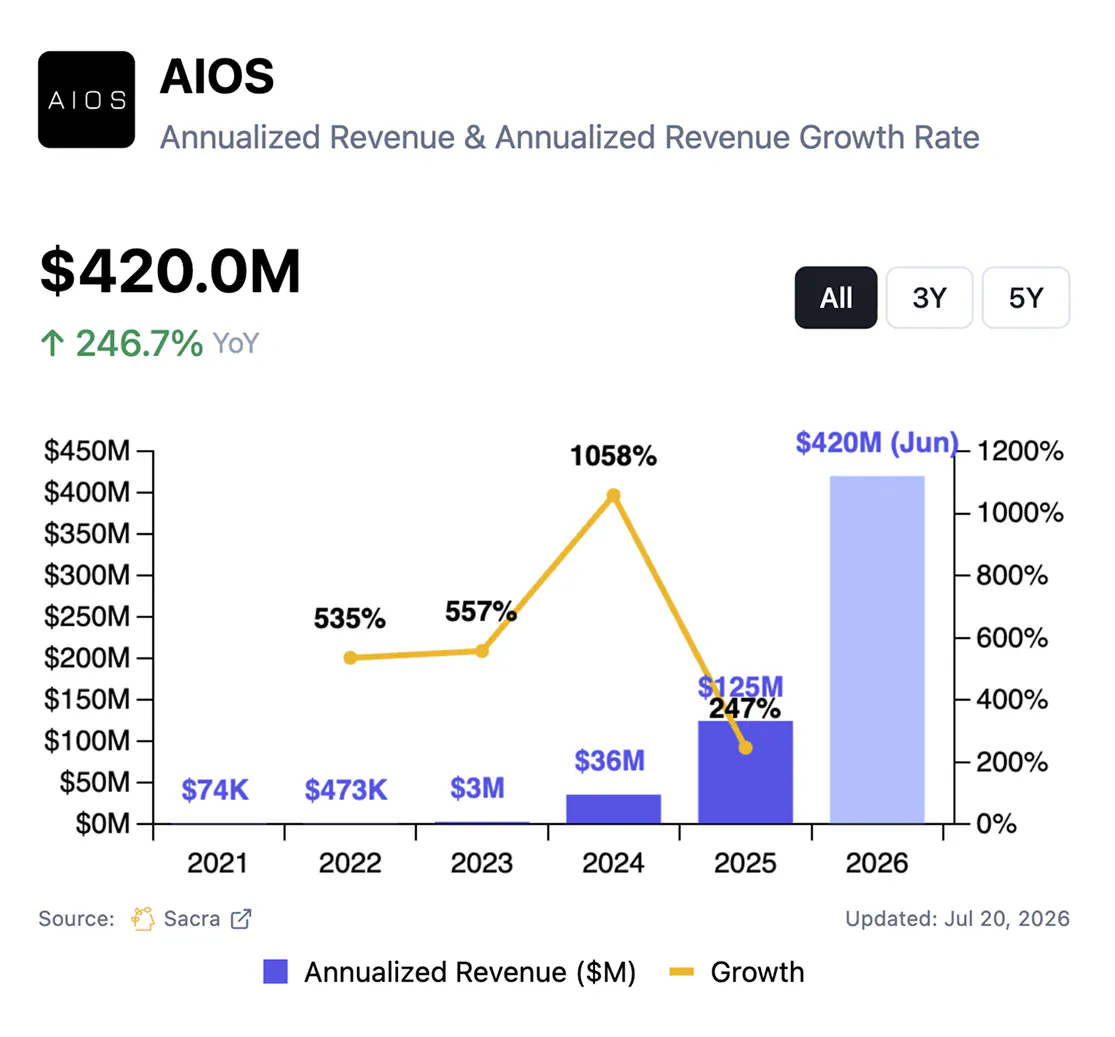
TL;DR: Launched as Fella Health in 2021 to prescribe GLP-1s to men via telehealth, AIOS survived a 2025 FDA crackdown on compounded drugs and lawsuits from Eli Lilly and Novo Nordisk by acquiring UK pharmacy Bolt and applying its paid-growth playbook to Britain's private-pay market, growing to ~150,000 patients. Sacra estimates AIOS hit $420M in annualized revenue in June 2026, up from $125M at the end of 2025. For more, check out our full report and dataset on AIOS.
Key points via Sacra AI:
- In July 2021, one month after the FDA first approved GLP-1s for obesity, AIOS (then Fella Health, YC W20) launched to prescribe GLP-1s to men (and later women via their Delilah brand) via telehealth, with growth taking off after the FDA approved compounding due to shortages (2022), allowing Fella to charge ~$300/month vs. Wegovy's ~$1,300 sticker price and helping the company grow from $74K in annualized revenue in 2021 to $36M at the end of 2024. The explosive demand for GLP-1s (15% of Americans have used one) has made the GLP-1 wrapper the fastest-growing business model in consumer health, with companies like Fella Health making money by running paid ads, converting visitors through a quick online intake form, getting a licensed clinician to review and prescribe, and shipping the medication to the patient's door on a monthly subscription, with revenue scaling with ad spend rather than headcount.
- When the FDA shut down GLP-1 compounding in early 2025, with Eli Lilly & Novo Nordisk suing Fella alongside other GLP-1 telehealth businesses like Mochi Health and Henry Meds, AIOS's revenue fell from $82M annualized (March 2025) to $54M (September 2025) before the company re-accelerated by acquiring UK-based Bolt Pharmacy (April 2025) and applying its paid-growth playbook to Britain's private-pay market for branded Wegovy & Mounjaro. With the NHS tightly rationing access to GLP-1s but legally anchoring name-brand list prices at £139-£249/month nationwide, Britain developed a large private cash-pay market that AIOS set to serving at cost, taking no markup on the medication itself, undercutting competing pharmacies like Numan & Boots (£179-£299/month).
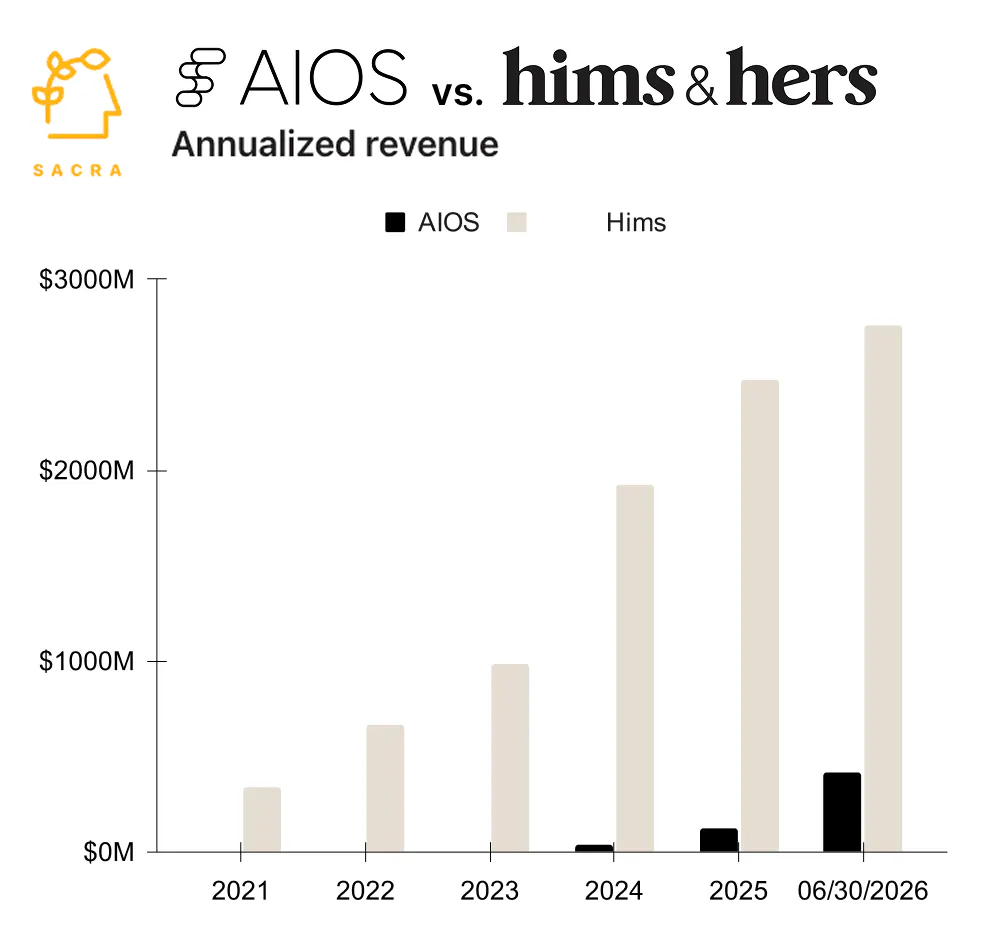
- As GLP-1 usage tripled across the UK to 6% of households in 2026 with Bolt as the cheapest source in-country, AIOS grew its total patient base by 40x to ~150,000 over 12 months, with Sacra estimating that AIOS hit $420M in annualized revenue in June 2026, up from $125M at the end of 2025, profitable since 2023 with no institutional capital raised beyond seed. Compare to UK rival pharmacy Numan at $225M in projected 2025 revenue, up 150% YoY, and major GLP-1 telehealth players Ro at $598M in annualized revenue in 2024, up 66% YoY, and Hims & Hers at $2.8B annualized revenue in June 2026, up from $2.5B at the end of 2025, though selling branded drugs at cost means most of Bolt's revenue passes through to Eli Lilly & Novo Nordisk for ~20% gross margins vs. the 65-80% Ro and Hims & Hers earn on fulfillment.
- Where Ro and Hims & Hers grew by stacking more conditions onto a single brand, from ED into hair loss, dermatology, and eventually weight loss, AIOS is doing the opposite, betting that GLP-1s alone are a big enough market to scale one molecule across segments (Fella for US men, Delilah for US women, Bolt in the UK) on a shared ops layer handling intake, clinical review, dose titration, side-effect monitoring, cold-chain shipping, and monthly refills. Every generation of D2C health has organized around a hero product, with Ro ($598M annualized revenue in 2024) & Hims ($2.8B annualized revenue in June 2026) built on generic Viagra & finasteride, Hone Health ($114M ARR in Sep 2025) on testosterone, and Function Health ($100M ARR in Feb 2025) on $499/year blood panels, and in each case the real business is the ops wrapped around the product, from at-home labs and async clinician review to pharmacy fulfillment, with GLP-1s now the biggest hero product consumer health has ever had.
- AIOS's plan is to repeat the Bolt playbook across Europe's 10 biggest markets, buying a licensed local pharmacy in each, plugging it into the shared ops platform, and undercutting incumbents on price, then manufacturing its own generic semaglutide when patents begin expiring in the early 2030s to finally capture the drug margin it currently passes through to pharma. The competition is arriving fast, with Hims & Hers acquiring London-based online doctor ZAVA (June 2025) to enter the UK, Ro locking in Wegovy supply at £410/month through Novo Nordisk's own NovoCare pharmacy, and the longer-term threat of Lilly & Novo selling direct-to-consumer (LillyDirect, NovoCare, TrumpRx) and cutting out the telehealth middlemen entirely.
For more, check out this other research from our platform:
- AIOS (dataset)
- Ro (dataset)
- Ro vs TrumpRx
- Ro and the telehealth capital cycle
- Legendary Foods (dataset)
- $180M/year protein poptart
- Chobani (dataset)
- $3.6B/year Atkins of yogurt
- Hone Health (dataset)
- Hone Health at $114M ARR growing 82% YoY
- Hone Health: the $55M/year D2C testosterone startup
- Function Health (dataset)
- Function Health at $100M/year
- Noom (dataset)
- Noom at $1B ARR
Read more from
AIOS revenue, growth, and valuation
Unlocked Report
Continue Reading
Read more from
Ro vs TrumpRx
Free Report
Continue Reading