

$340M/year Heroku for Claude Code
 Jan-Erik Asplund
TL;DR: While v0 has lost app-building share to Lovable & Replit, Vercel has emerged as a default deployment layer for agentic coding, with agents initiating more than 50% of deployments by June 2026. Sacra estimates Vercel hit $340M in annualized revenue in February 2026, up 112% YoY in 2025, as it expands into workflows, sandboxes & backend services for agent-built apps. For more, read our full report and dataset on Vercel.
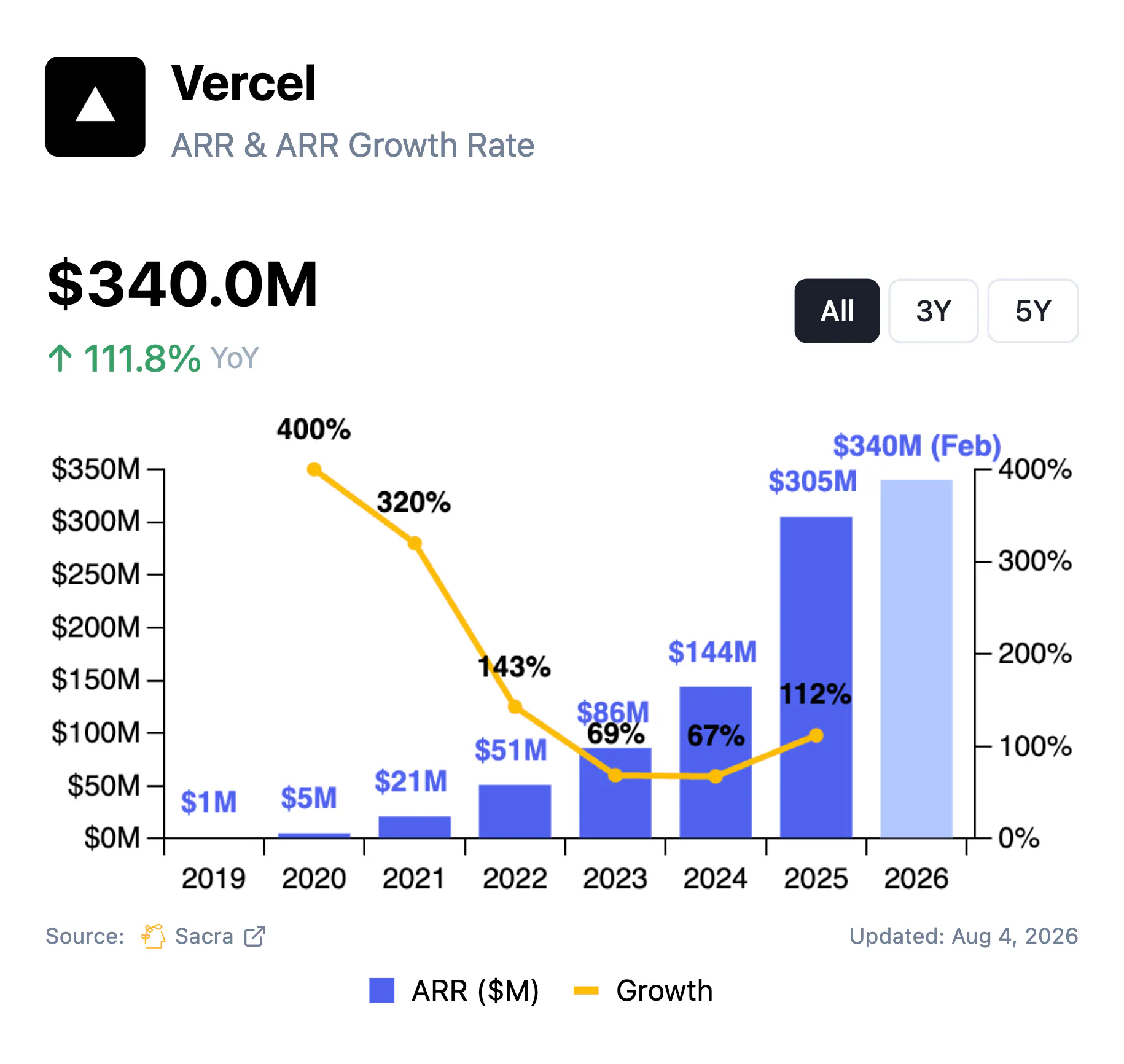
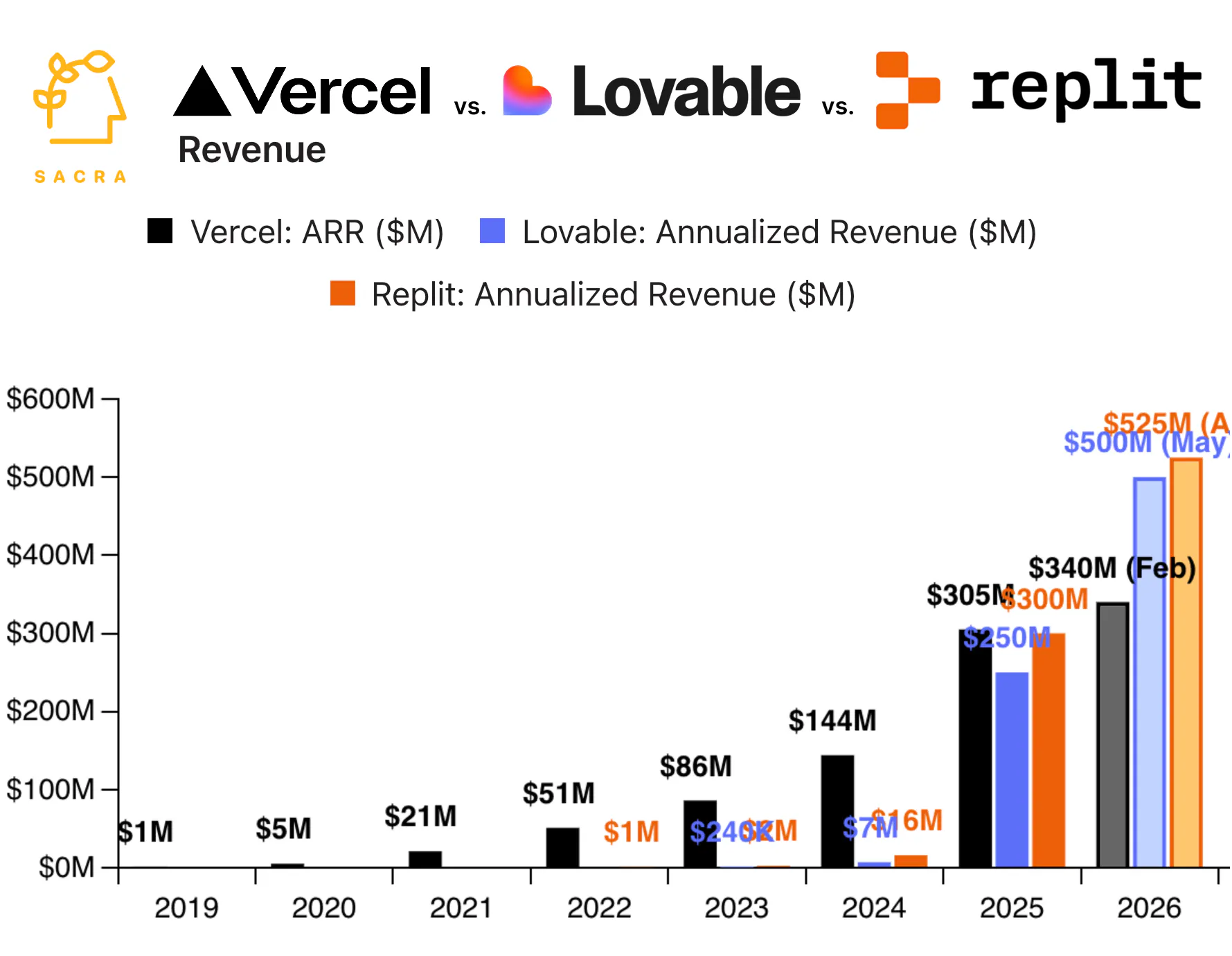
We’ve covered Vercel (January 2022, November 2024, March 2025, May 2025) from its roots as a core player in Jamstack through its rapid revenue acceleration with the rise of AI coding.
Key points via Sacra AI:
- While Vercel’s text-to-app builder v0 has lost out to Lovable & Replit, Vercel has become a platform-as-a-service (PaaS) of choice for agentic coding with agents initiating more than 50% of all deployments as of June 2026 vs. less than 3% in late 2025 and Claude Code in particular driving 75% of agent deployments in April (vs. 6% for v0 & Lovable combined).
- Capturing hosting spend for vibe coded projects by standalone agents, Sacra estimates Vercel hit $340M in annualized revenue in February 2026, +112% year-over-year in 2025, valued at $9.3B as of its September 2025 Series F for a roughly 35x multiple on $265M in September annualized revenue.
- In comparison, app building platforms have gone full stack to capture token spend at app creation and hosting spend with the database, auth, and payments infrastructure that runs the app afterward, with Replit at $525M in annualized revenue in April 2026, +1,775% YoY in 2025, valued at $9B as of its $400M Series D in March 2026 for a ~19x forward revenue multiple & Lovable at $500M in annualized revenue in May 2026, +3,471% YoY in 2025, valued at $6.6B as of its December Series B for a 26x multiple.
- Across four acquisitions in the past twelve months, Vercel has bolstered its ability to host agentic apps, extending its framework and server tooling from React and Next.js into Vue and Nuxt through NuxtLabs (July 2025), adding forms, content and data to v0 through new.website (March 2026), expanding into identity and delegated permissions for agents through Better Auth (July 2026), and adding DevOps agents that monitor, repair and operate production software through Stakpak (July 2026).
- As agent-built applications increasingly run asynchronously, execute untrusted code and maintain state across long-running tasks, Vercel is expanding into background jobs (Vercel Workflows) competing with workflow platforms (Temporal, Inngest), isolated code execution (Vercel Sandbox) competing with code sandboxes (E2B, Daytona), and backend services (Vercel Services) competing with full-stack application platforms (Railway, Render, Fly.io, Northflank).
For more, check out this other research from our platform:
- Vercel (dataset)
- OpenRouter (dataset)
- OpenRouter growing 29% MoM at $140M/year
- Mintlify (dataset)
- $21.4M/year Vercel of developer docs
- Arena (dataset)
- $100M/year Nielsen of LLMs
- $172M/year Heroku of vibe coding
- Vibe coding index
- Lovable vs Bolt.new vs Cursor
- Claude Code vs Cursor
- Cursor at $200M ARR
- Cursor (dataset)
- Lovable (dataset)
- Bolt.new (dataset)
- Anthropic (dataset)
- OpenAI (dataset)
Read more from

Read more from


Read more from




Read more from

OpenAI revenue, growth, and valuation
Unlocked Report
Continue Reading

