$2B/year premium Shein
 Jan-Erik Asplund
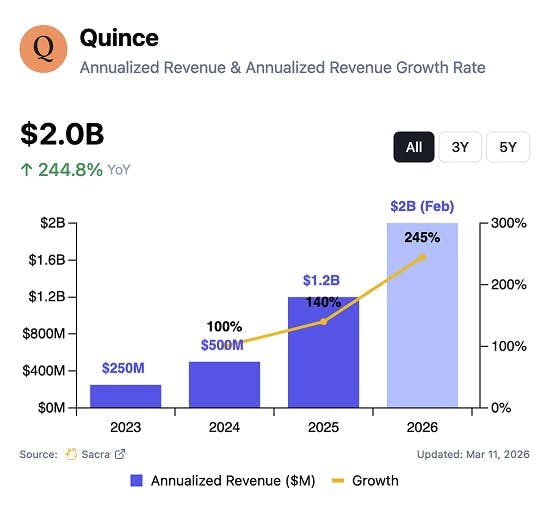
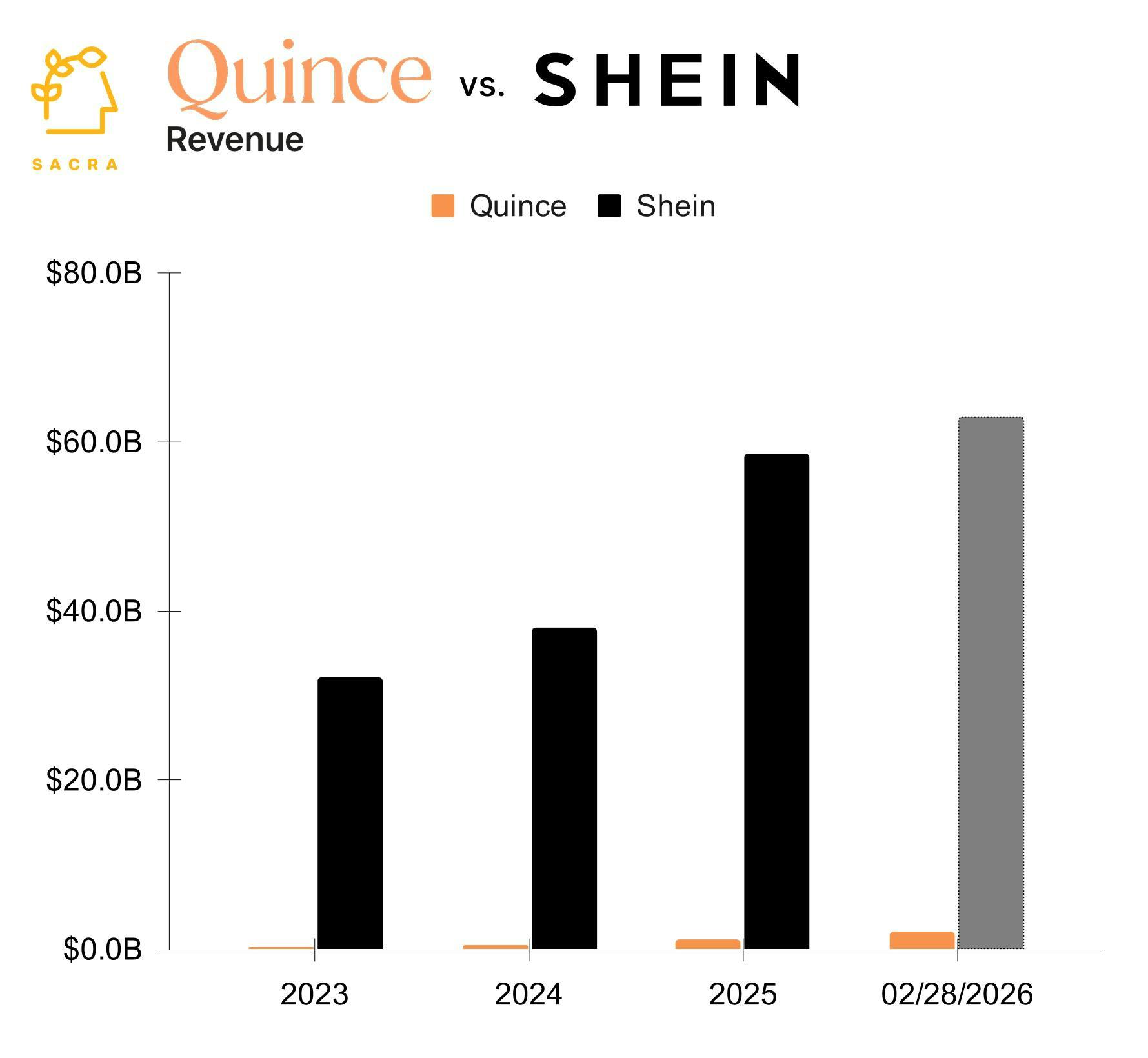
TL;DR: Where Shein used factory-direct fulfillment to build a $38B fast fashion empire selling de-minimis-exempt $5 polyester dresses to Gen Z, Quince (2018) has applied the same playbook to selling $150 dupes of $5,700 Bottega Veneta bags to millennial women. Sacra estimates Quince hit $2B in annualized revenue in February 2026, up ~245% year-over-year, in talks to raise at $10B for a 5x revenue multiple. For more, check out our full report and dataset on Quince.
Key points via Sacra AI:
- Shein (2008) pioneered the model of trawling social media to identify trending products, contracting Chinese factories to produce cheaper copies, and shipping them direct-to-consumer at scale, inspiring Quince (2018, ICONIQ Capital, $470M+ raised) to apply the same playbook to luxury goods, scraping best-selling products across brands like Loro Piana, Jenni Kayne, and Restoration Hardware & contracting with 100+ factory partners to produce $150 dupes of $5,700 Bottega Veneta bags and $50 Mongolian cashmere sweaters. While Shein is building domestic U.S. distribution infrastructure to get around the closure of the “de minimis loophole”, Quince’s diverse set of manufacturers across India, Italy, Turkey, Mongolia, and Portugal give it more flexibility to route around China-targeting tariffs while still exploiting factory-direct pricing.
- Where Everlane, Warby Parker & Bonobos were built primarily on social in the era of cheap Facebook ads, Quince has combined 1) flooding TikTok & Instagram with influencer haul and comparison content with 2) aggressively buying search ads on trendy, high-intent terms like "mongolian cashmere sweater" to intercept traffic to higher-priced competitors at the moment of purchase, scaling rapidly from ~$250M in 2023 to a Sacra-estimated $2B in annualized revenue in February 2026, up 245% year-over-year, in talks to raise at a $10B valuation for a 5x revenue multiple. Hitting $2B in revenue within 8 years of founding, Quince has vastly outpaced every major DTC brand of the prior generation like Warby Parker (founded 2010, NYSE: WRBY) at ~$870M in revenue in 2025 after 16 years, up 13% YoY, Everlane (founded 2011) at ~$200M after 15 years essentially flat, and Allbirds (founded 2015, NASDAQ: BIRD) at ~$163M after 11 years with revenue down ~14% YoY—with Quince’s dynamics more comparable to those of a Shein at $38B in revenue in 2024, up 23% YoY.
- Where first wave DTC companies like Allbirds, Glossier ($266M raised, Thrive Capital), Outdoor Voices ($66M raised, acquired by PE in 2024) & Casper ($340M raised, taken private by PE in 2021) bet on unseating mass-market incumbents with their own products and brands until the trends turned against them, Quince along with luxury dupe brand Italic ($87M raised, Index Ventures) and perfume dupe company Dossier (2018, $100M annualized revenue) are eliminating that risk by eschewing original products & focusing on shortening the turnaround time from trend to dupe. As a marketplace, Quince has expanded from apparel into sofas, ceramic cookware, fine jewelry, beauty, caviar, and lab-grown diamonds, adding ~200 new items and rapidly expanding its product surface area while also taking on more risk, with lawsuits coming from Williams-Sonoma, Coach, & Deckers for copying boot designs and advertising pans as “like Williams-Sonoma but half the price”.
For more, check out this other research from our platform:
- Quince (dataset)
- Shein (dataset)
- Shein vs Trump
- Dossier (dataset)
- Italic
- Shein vs H&M vs Zara
- Stuart Kearney, co-founder of Vetted, on AI agents in shopping
- Fanatics at $8.1B
- Weee! vs. Instacart
- $4.8B/yr Instagram of China
- Scott Sillcox, sports licensing consultant, on the economics of Fanatics' contracts
- Sean Frank, CEO of Ridge, on the state of ecommerce post-COVID
- Faire at $616M/year growing 74%
Read more from
Quince revenue, growth, and valuation
Unlocked Report
Continue Reading
Read more from

Fanatics vs. Kalshi
Free Report
Continue Reading

Dossier revenue, growth, and valuation
Unlocked Report
Continue Reading