

$180M/year protein poptart
 Jan-Erik Asplund
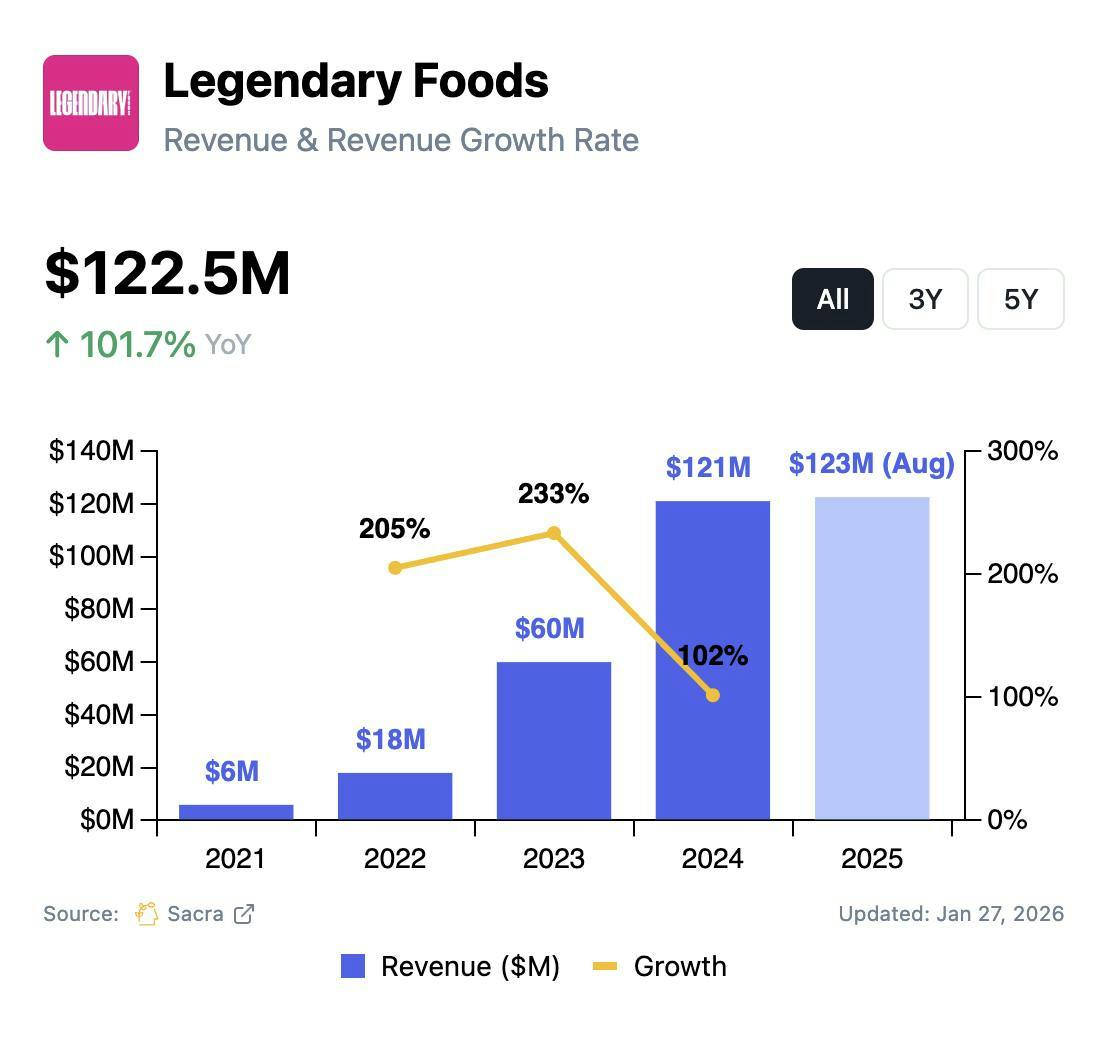
TL;DR: The protein food market is entering its biotech era as companies like Legendary Foods & David use proprietary fat substitutes to create bars, pop tarts & other products with 2x the calories from protein of last-generation brands like Quest and RXBAR. Sacra estimates Legendary Foods generated $123M of revenue through August 2025, on track for $180M for the year, up 63% year-over-year. For more, check out our full report and dataset on Legendary Foods.
Key points from our research via Sacra AI:
- From its origins in the chalky supplement drinks of the 1960s bodybuilder era (Tiger's Milk, MET-Rx), the protein market evolved through the sugar alcohol-laden protein “candy bars” of the 2000s (Quest, acquired by Simply Good Foods, NASDAQ: SMPL), saw a backlash and a turn towards “clean” diets (paleo & keto) & ingredients in the mid-2010s with brands like RXBar (egg whites for binder instead of soy) and Kodiak Cakes (whey protein instead of flour), and today is entering its biotech era with companies like David (founded by RXBAR's Peter Rahal) and Legendary Foods (founded by Quest's Ron Penna). The key ingredient is esterified propoxylated glycerol, or EPG—a fat substitute that delivers fat-like creaminess at 0.7 calories per gram versus fat's 9—which enables the creation of low-calorie, high-protein products with junk food mouthfeel that solve for protein’s dry, inherently chalky texture through chemistry rather than through sugar alcohols with gastric side effects (Quest) or natural but lower-protein ingredients like egg whites (RXBar).
- After co-founding Quest Nutrition and selling it for $1 billion in 2019, Ron Penna waited out his 3-year non-compete before launching Legendary Foods as a line of high-protein, low-carb versions of junk foods—Pop-Tart-style pastries first, then donuts and chips—targeting the snack shelf rather than the protein bar shelf. Legendary Foods sells direct-to-consumer ($32.49 for a 10-pack of pastries, ~300% premium over conventional Pop-Tarts) and through retail including Walmart, Target, Kroger, GNC, and Vitamin Shoppe, with vertical integration via its own Bell, California manufacturing facility enabling tight control over proprietary protein formulation chemistry.
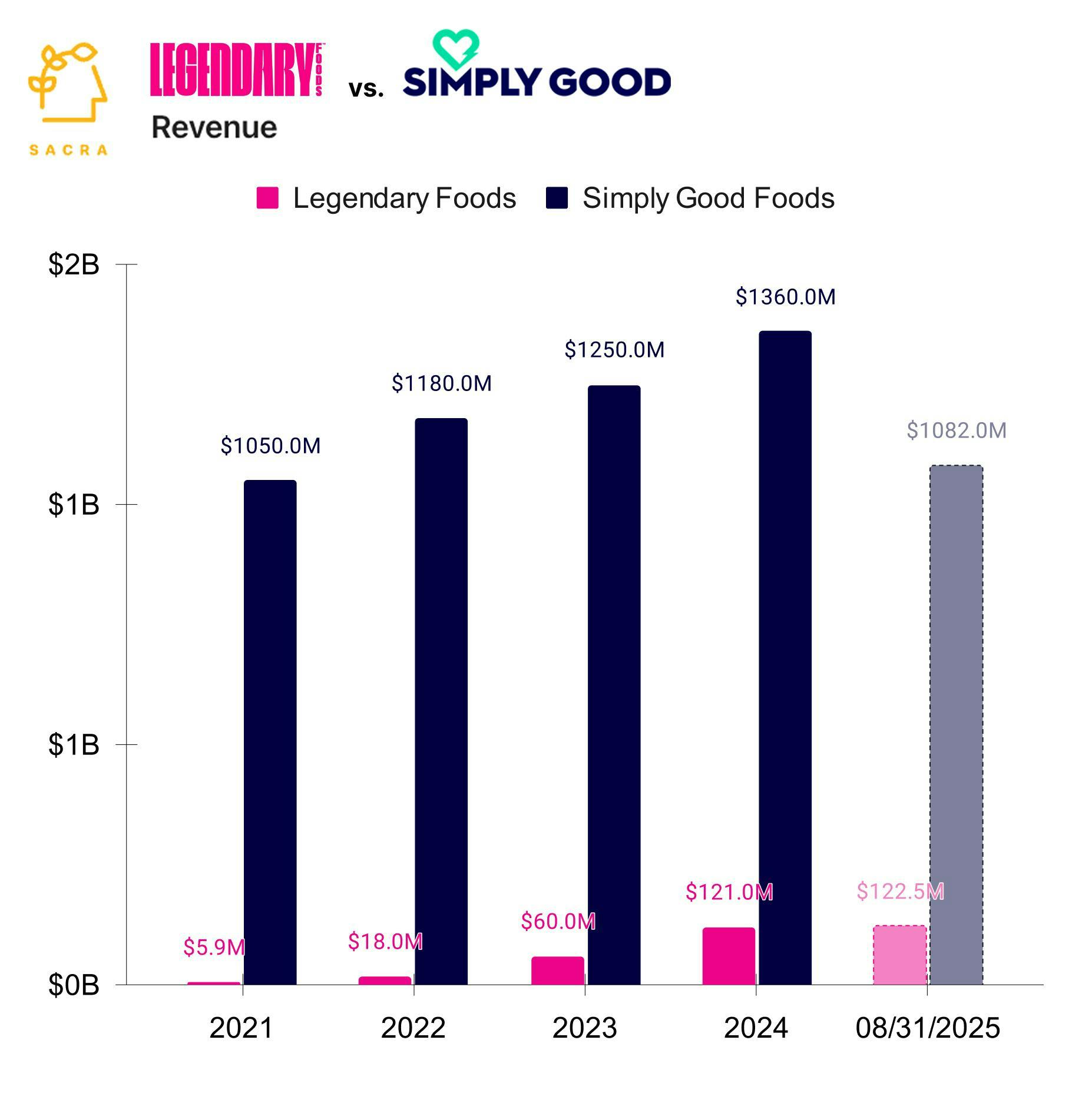
- Expanding from fitness-focused DTC into mass retail distribution across 100,000+ locations, Sacra estimates Legendary Foods generated $123M of revenue through August 2025, on track for $180M for the year, up 63% year-over-year, scaling from $6M in 2021 to $18M in 2022 to $60M in 2023—compare to protein food incumbent Simply Good Foods (NYSE: SMPL, Quest parent) at $1.4B revenue growing 3% YoY valued at $3.5B for a 2.5x multiple, and upstart David at ~$102M revenue as of June 2025, after raising a $75M Series A in May (Greenoaks), which acquired EPG supplier & patent holder Epogee in 2025. As GLP-1 medications like Ozempic drive demand for high-protein foods that preserve muscle during weight loss among the ~12% of Americans that use them, Legendary Foods launched Protein Mac & Cheese (47g protein, 7g net carbs) in January 2026, targeting the growing category of consumers looking for high protein density foods at mealtimes, not just in snacks.
For more, check out this other research from our platform:
- Legendary Foods (dataset)
- David (dataset)
- Liquid Death (dataset)
- Weee! vs. Instacart
- Sean Frank, CEO of Ridge, on the state of ecommerce post-COVID
- Pradeep Elankumaran, CEO of Farmstead, on the future of online grocery
- Sebastian Mejia, co-founder of Rappi, on building for multi-verticality in on-demand
- Instacart vs Amazon vs Uber
- Tyler Scriven, CEO of Saltbox, on co-warehousing and D2C ecommerce
- David Lin, CEO of Duffl, on the economics of hyperlocal ultrafast delivery
Read more from
Read more from

$315M/year Soylent for the UK
Free Report
Continue Reading