

$100B sovereign AI boom
 Jan-Erik Asplund
TL;DR: As Trump’s blacklisting of Anthropic and China’s distillation of US frontier models show how AI control is becoming a geopolitical weapon, governments worldwide have $100B+ committed towards building sovereign AI, setting off a global race between OpenAI & Anthropic, Chinese labs, Gulf state megaprojects, and US hyperscalers. For more, check out our full reports on Mistral (dataset), Cohere (dataset), and Anthropic (dataset).
Last month, the Pentagon demanded unrestricted military access to Anthropic’s Claude, and when refused, the administration directed federal agencies to drop Claude, with OpenAI stepping into the gap and signing its own deployment deal with the Department of War.
For non-US governments, the episode crystallized a risk that has been building since ChatGPT launched in 2022 and that has motivated the development of sovereign AI around the world.
Key points via Sacra AI:
- Starting with AWS in 2006, Azure in 2010, and Google Cloud in 2012, US hyperscalers built the cloud layer the rest of the world came to depend on (hosting 80% of the EU by 2024), and when OpenAI’s ChatGPT launched in November 2022, that dependence deepened from infrastructure to intelligence itself, with frontier reasoning models concentrated across 2-3 US-based labs. India shows how complete that dependence became, with critical government systems like CoWIN, DigiYatra, and DigiLocker still running on AWS even amid the launch of a $1.1B sovereign AI initiative, critical, a pattern repeated across dozens of countries trying to build independence on top of American cloud.
- As Nvidia CEO Jensen Huang toured world capitals pitching governments on buying GPUs to build their own sovereign AIs, DeepSeek released the open-source R1 (January 2025) and proved it was possible—but it was Trump’s reelection, and confrontational posture towards U.S. allies, that drove the acceleration of sovereign AI, with Mistral reporting that its business tripled in his first 100 days back in office. With Moonshot AI and MiniMax also shipping competitive models despite export controls, and Anthropic accusing all three Chinese labs of industrial-scale distillation campaigns involving 24,000 fraudulent accounts and 16M+ exchanges to extract Claude's reasoning capabilities, the combination of open-source proof-of-concept from China and political rupture from Washington created the conditions for governments worldwide to commit $100B+ in sovereign AI investment.
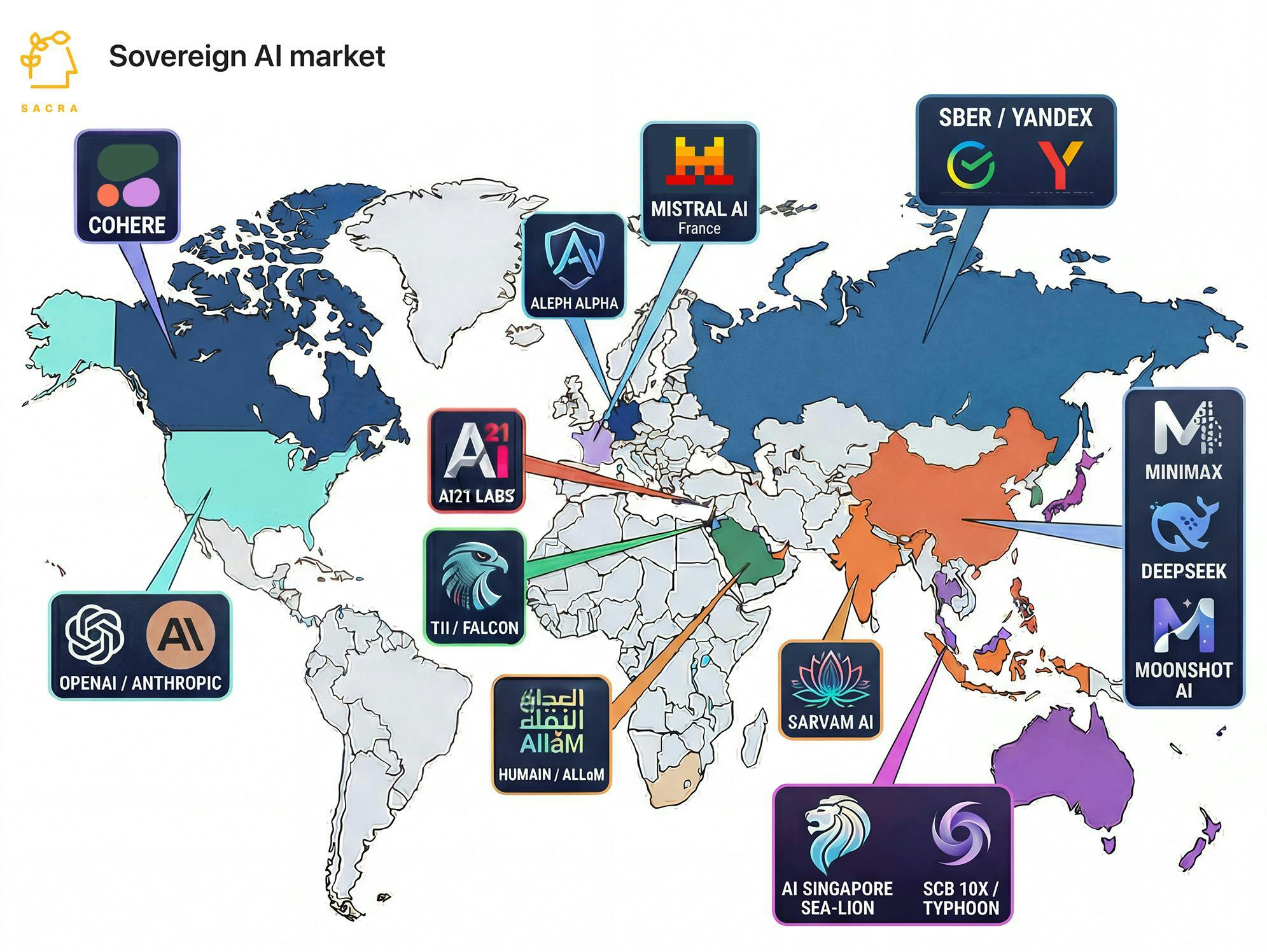
- Outside Europe, sovereign AI is splitting into three main models: (1) countries like India building their own sovereign models on top of US cloud providers, (2) Gulf states deploying capital to build AI infrastructure hubs for the region (G42 & Cerebras) and (3) countries like South Korea & Japan pushing for full-stack autonomy from chips to models on multi-billion-dollar state budgets. India’s $1.1B IndiaAI Mission backs Sarvam AI’s 105B-parameter Indic model even as government platforms stay on AWS, while Indonesia is taking a more pragmatic route by building Sahabat-AI with help from Google Cloud, NVIDIA, Alibaba’s Qwen, and Tsinghua, and Japan has gone the other way by investing $41B for an 11% stake in OpenAI rather than building its own frontier lab.
- The irony of sovereign AI is that US hyperscalers have become some of its biggest beneficiaries, with AWS launching its European Sovereign Cloud in January 2026, Microsoft shipping Azure Local Disconnected and Foundry Local for air-gapped government use, and Oracle promoting EU-aligned sovereign cloud protections. This localization strategy allows companies to fufill residency and jurisdiction requirements by “buying local” from the same American providers they were trying to reduce dependence on, preserving US control over the underlying technology, operations, and update cycle while also reinforcing Nvidia’s position as the GPU supplier behind almost every sovereign AI buildout.
- As sovereign AI spending surpasses $100B in global commitments, the forward tension is between countries that can compete on technological capability—like France with Mistral and Canada with Cohere, gaining traction because their models are genuinely competitive with US frontier labs on enterprise workloads—while companies like Aleph Alpha that are unable to keep pace on model quality will retreat to consulting and systems integration. Similar to how India's Unified Payments Interface (handles 50% of all global digital transactions) expanded from India into 25 countries across Asia, the Middle East, and now Europe (France) via reliable, near-instant payments in an open source package, the upside for the sovereign AI market's long-term winners is supranational and depends on whether they can genuinely compete with OpenAI, Anthropic, and the US hyperscalers on performance and cost.
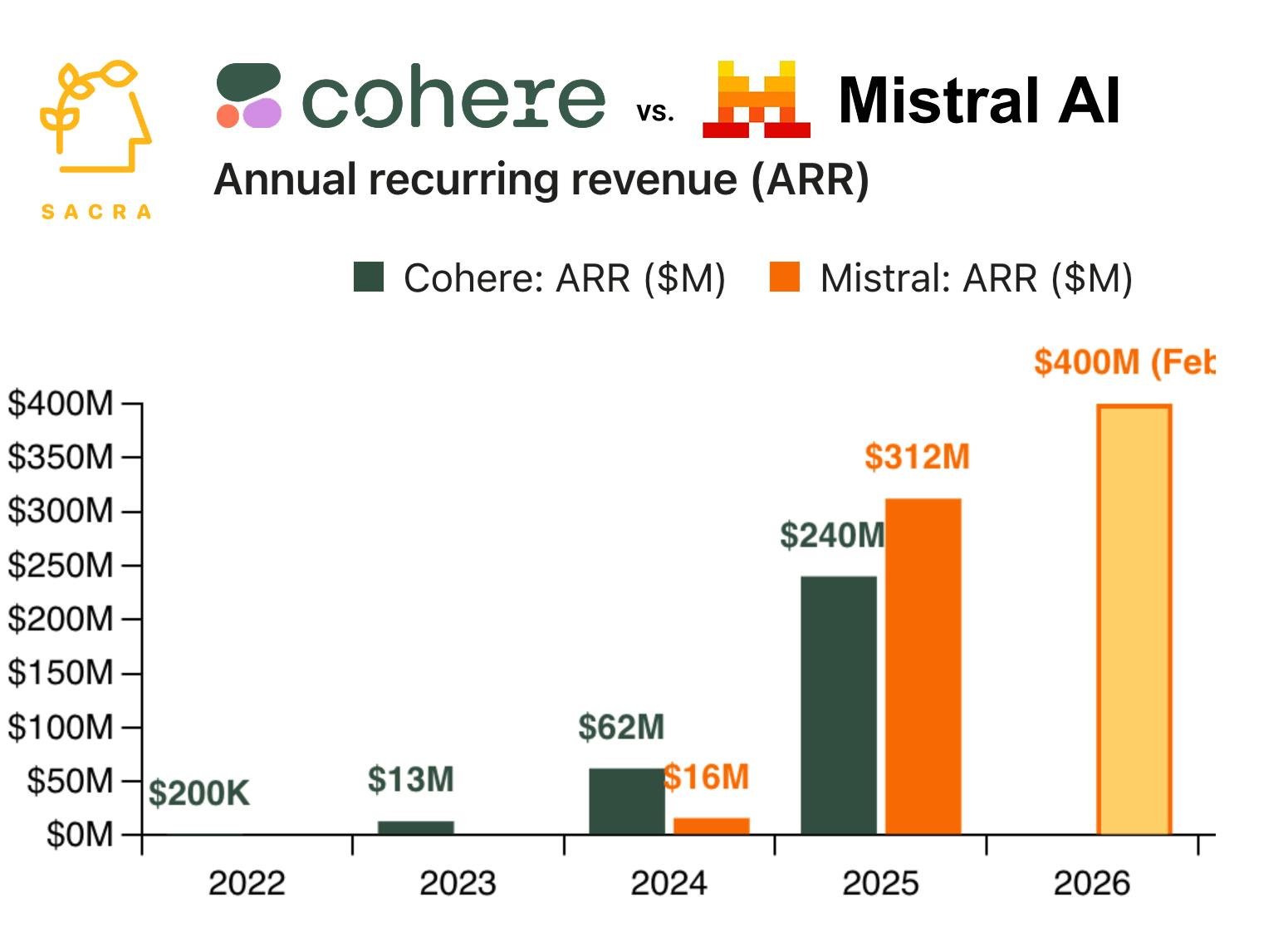
- Looking to develop its own AI infrastructure independent from both the US & China, Europe has moved furthest in building sovereign AI, with the French Mistral reaching $400M ARR in January 2026, up 20x YoY, pivoting from an open-source lab into an enterprise platform selling private deployments and implementation support on-premise for European industrial giants & governments. Cohere ($240M ARR, up 287% YoY) opened a Paris office to compete for European contracts, the EU is funding 15+ AI Factories, and infrastructure players like Nebius, Fluidstack ($180M ARR), and Mistral itself are building sovereign compute while Germany’s Aleph Alpha retreated from foundation models into consulting after failing to keep up.
For more, check out this other research from our platform:
- Mistral (dataset)
- Cohere (dataset)
- Cohere at $150M ARR
- Mike Knoop, co-founder of Zapier, on Zapier's LLM-powered future
- Danny Wheller, VP of Business & Strategy at Hebbia, on vertical vs horizontal enterprise AI
- Product manager at Cohere on enterprise AI search infrastructure and deep research agents
- Eric Simons, CEO of Bolt, on consumer vs. B2B vibe coding
- Harvey at $195M ARR
- Glean at $200M ARR
- Glean for law
- Cerebras vs Nvidia
- Anthropic (dataset)
- OpenAI (dataset)