

Revenue
$2.57B
2025
Valuation
$6.82B
2025
Funding
$2.40B
2025
Growth Rate (y/y)
17%
2025
Revenue
Sacra estimates that Bolt generated $2.57B in revenue in 2025, up 19% from $2.15B in 2024. Bolt grew while reaching full-year profitability for the first time, reflecting operating leverage across its ride-hailing, delivery, and micromobility network.
Bolt’s revenue comes primarily from ride-hailing commissions, with smaller contributions from micromobility rentals, food and grocery delivery, and fleet-related services. Ride-hailing accounted for about 82% of revenue in 2024, making Bolt still mostly a global Uber competitor despite its expansion into scooters, e-bikes, delivery, and grocery.
Growth in 2025 was driven by geographic expansion and increased monetization across existing markets, with Bolt launching ride-hailing in Canada, New Zealand, Taiwan, and Greece, expanding delivery into Bulgaria, entering UK and US micromobility, and acquiring Danish taxi operator Viggo.
Bolt generated about $1M in net profit, $22M in operating profit, and $87M in operating cash flow in 2025. The company had more than 200M customers and 4.5M partners across drivers, couriers, and restaurants.
Valuation & Funding
Bolt's most recent valuation stands at $6.82B (€6.3 billion) following a secondary share sale in 2025, a 14% decrease from its 2022 peak valuation.
The company has raised approximately €2.22 billion in total funding since inception. Its most recent primary funding was a €220 million revolving credit facility closed in May 2024, with participation from banks including Barclays, BNP Paribas, Citi, Deutsche Bank, Goldman Sachs, JPMorgan, LHV Pank, and Luminor.
Before the credit facility, Bolt raised a €628 million Series F round in January 2022 led by Sequoia Capital and Fidelity Management & Research Company, with participation from Whale Rock, Owl Rock, D1 Capital Partners, G Squared, and other investors.
Business Model
Bolt operates a B2C marketplace model connecting consumers with drivers, restaurants, and vehicle fleets through its platform. The company generates revenue primarily through commission fees charged to service providers, with ride-hailing representing the largest revenue stream at 82% of total revenue.
The platform employs a take-rate model where Bolt charges drivers and restaurants a percentage of each transaction. The company has historically maintained lower commission rates than competitors, advertising sub-20% rates compared to industry leaders that charge above 50% in some markets, though Bolt has begun selective increases in certain regions.
Bolt's cost structure includes technology development, customer acquisition, regulatory compliance, and fleet management for its car-sharing and micromobility services. The company leases vehicles for Bolt Drive rather than purchasing them outright, maintaining an asset-light approach while refreshing the fleet regularly to ensure quality and incorporate newer technologies like hybrid engines.
The business benefits from cross-platform utilization where drivers can toggle between ride-hailing and food delivery to maximize their earning potential, improving supply-side economics and reducing wait times for customers. This dual-service capability helps Bolt maintain competitive service levels while optimizing driver productivity across different demand patterns throughout the day.
Revenue expansion occurs through geographic growth, new service launches, and increased usage frequency as customers adopt multiple services within the ecosystem. The company has introduced subscription passes for micromobility services, with nearly half of scooter trips now using these passes to improve customer retention and revenue predictability.
Product
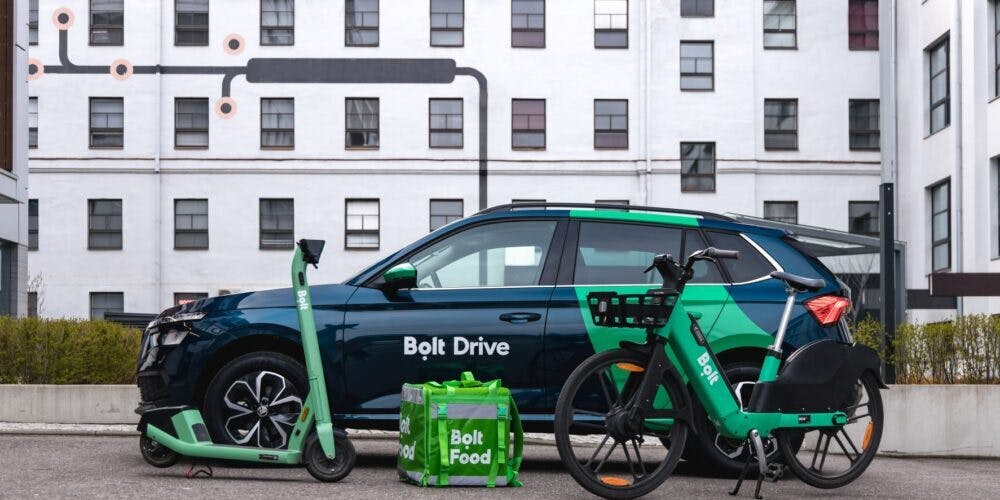
Bolt operates as a super-app offering six integrated services through a single mobile platform. Users download the app once, add payment information, and can access ride-hailing, micromobility, food delivery, grocery delivery, car-sharing, and business travel services from a unified home screen.
The ride-hailing service forms the core offering, allowing users to book rides in over 500 cities with options ranging from budget-friendly to premium vehicles, including zero-emission electric and hydrogen options. Users can pre-book rides up to 90 days in advance and track their driver in real-time.
Bolt's micromobility service provides dock-less e-scooters and e-bikes with proprietary hardware and firmware designed in-house. The app enforces speed limits, designated parking zones, and includes safety features like cognitive reaction tests for nighttime rides and tandem-riding detection that disables the motor if two people attempt to ride simultaneously.
Bolt Drive offers free-floating car-sharing where users can locate and unlock nearby vehicles through their phone, paying a combined per-minute and per-kilometer rate that automatically caps at hourly or daily maximums. The company refreshes its leased fleet every 24 months and has transitioned to hybrid vehicles in markets like Germany to reduce fuel consumption.
Food delivery through Bolt Food operates in 300+ cities, leveraging the same courier network that handles ride-hailing to optimize driver utilization and maintain delivery times under 30 minutes. Bolt Market provides 15-30 minute grocery delivery from approximately 200 micro-warehouses across 10 European countries, with some deliveries handled by autonomous sidewalk robots in Tallinn.
Bolt has entered a strategic partnership with Stellantis to jointly explore the development and large-scale deployment of Level 4 (driverless) autonomous vehicles for commercial operations across Europe. The collaboration will utilize Stellantis’ AV-Ready Platforms and Bolt’s extensive mobility network, with the goal of having 100,000 autonomous vehicles on the Bolt platform by 2035. Trials are planned to begin in European countries starting in 2026, marking a significant step in Bolt's long-term product strategy to integrate driverless technology into its core ride-hailing service.
Competition
Full-stack mobility platforms
Uber dominates the European ride-hailing market with approximately 60% market share and operates Uber Eats for food delivery alongside Jump micromobility services. Uber's aggressive dynamic pricing strategy has pushed take-rates above 50% in some markets, generating higher per-transaction revenue but creating driver retention challenges and regulatory scrutiny.
Lyft's €175 million acquisition of Free Now brings the American company into 150 European cities, combining traditional taxis, e-scooters, and car-sharing services. This gives Lyft immediate cross-border scale and an asset-light taxi supply that competes directly with Bolt in Germany, Spain, and Italy.
The DoorDash acquisition of Wolt and potential Deliveroo consolidation creates a pan-European food delivery giant with logistics density that challenges Bolt Food's market position. These larger players possess deeper war chests for market expansion and can leverage advertising revenue and subscription bundles to lock in customer demand.
Micromobility specialists
The pending merger between Tier and Dott would create a combined entity with €250 million in revenue and 125 million rides across 20+ countries, directly challenging Bolt's scooter and e-bike operations. These specialized players focus exclusively on micromobility optimization and regulatory relationships with city governments.
Lime maintains a strong presence in major European cities and has developed sophisticated fleet management technology and city partnership strategies. Bird and Voi represent additional competition in the shared micromobility space, each with distinct approaches to vehicle design and market expansion.
The micromobility sector faces ongoing consolidation pressure as cities limit the number of operators through licensing processes, making regulatory compliance and municipal relationships critical competitive advantages.
Regional and vertical specialists
Local players like Cabify in Spain and Latin America, Gett in Eastern Europe, and various city-specific taxi apps maintain strong positions through regulatory relationships and localized service offerings. These companies often have deeper integration with traditional taxi fleets and local payment systems.
Traditional taxi companies are increasingly digitizing their operations through apps and dispatch systems, creating competition particularly in regulated markets where ride-hailing faces restrictions. Car rental companies like Sixt and Europcar are expanding into car-sharing services that compete with Bolt Drive.
TAM expansion
Growth of headless commerce
Boltʼs indexed on a world where ecommerce brands build their modular stacks of point solutions instead of relying on a single platform as an end-to-end ecommerce solution, whether it is Shopify or Stripe. Boltʼs partnerships with BigCommerce, WooCommerce, and Magneto point to this focus. Bolt envisions a future where the extensibility and freedom of headless commerce win out over the convenience of building your entire ecommerce stack on Shopify. Headless technologies startups are showing momentum, with over $1.65B invested by VCs in 2020-21.
Value-added services to retailers
The bullish bet on Bolt is that it can move upwards from the checkout layer and leverage the data from its shoppers network to sell marketing, analytics, conversion, and engagement software into its enterprise customer base to build the Salesforce of headless commerce. Bolt is counting on two-sided network effects across its shopper base and retailers to scale its shopper base quickly and build new retailer tools on top of it.
Shopper portal
Shoppers are increasingly seeking personalized experiences integrating checkout, reward points, gift cards, and return/replacement. With 14M shopper accounts, Bolt has a place to build a portal where shoppers can track purchases, loyalty points, discounts, and offers across different retailers. Bolt can then use the behavioral data to build personalized checkout flows when they land on ecommerce websites.
TAM Expansion
New products and services
Bolt is expanding into autonomous logistics through partnerships with robotics companies, beginning with grocery deliveries via sidewalk robots in Tallinn. This low-capital approach to testing autonomous delivery could scale to other European cities and reduce last-mile delivery costs.
The company has launched flight-tracking capabilities for scheduled rides, automatically adjusting pickup times for delayed flights to capture higher-value business travelers. This premium service targets the corporate travel segment where customers are less price-sensitive and generate higher transaction values.
Electric vehicle financing represents another expansion opportunity, with Bolt partnering with companies like M-KOPA to provide battery-swappable e-motorbikes to drivers in Kenya. This hardware-as-a-service model creates additional revenue streams while improving driver economics and environmental impact.
Customer base expansion
Bolt Business has grown 25% year-over-year and now serves over 50,000 companies across 50+ countries, providing corporate travel management with unified billing across ride-hailing, car-sharing, food delivery, and micromobility services. This B2B segment offers higher customer lifetime values and more predictable revenue streams.
The company is targeting safety-conscious users through a €100 million three-year safety upgrade program that includes PIN verification, trip audio recording, and real-time monitoring. These features have already reduced cash-based rides in Nigeria by 42%, helping Bolt win back risk-averse customers and improve regulatory relationships.
Subscription services are gaining traction, with micromobility passes now used for nearly half of all scooter trips. This model improves customer retention, provides revenue predictability, and reduces the friction of individual trip payments.
Geographic expansion
Bolt's first acquisition of Danish electric taxi app Viggo instantly added 300 electric vehicles, 500+ drivers, and 450,000 users while establishing a foothold in Scandinavia. Additional partnerships with existing taxi operators provide rapid market entry without the need to build driver networks from scratch.
The company is winning regulated tenders in major European cities, securing licenses for 2,500 e-bikes and 4,000 scooters in Brussels while competitors like Lime were forced to exit. This demonstrates Bolt's ability to navigate restrictive regulatory environments and maintain market access.
African markets present significant expansion opportunities, particularly for electric two-wheeler services where Bolt can provide financing and charging infrastructure to drivers transitioning from petrol-powered vehicles. The company's safety investments are helping establish trust and regulatory approval in these emerging markets.
Risks
Regulatory pressure: The EU Platform Work Directive creates a rebuttable presumption of employment for gig workers by 2026, which may require Bolt to reclassify drivers as employees rather than independent contractors. That shift would increase labor costs via benefits, social security contributions, and minimum wage requirements, altering the unit economics of the platform model.
Market consolidation: Ongoing consolidation among competitors, including the DoorDash-Wolt merger and Tier-Dott combination, creates larger rivals with higher logistics density and greater bargaining power with restaurants and city governments. These consolidated players can sustain longer periods of subsidized pricing to gain market share and may achieve economies of scale that Bolt may not match as a smaller independent platform.
Profitability timeline: Bolt generated €1.99 billion in revenue but reported an €87.7 million operating loss in 2024 while preparing for a 2026 IPO with pressure to demonstrate profitability. The company faces pressure to increase take-rates to reach profitability, yet higher commissions could push drivers and restaurants to competing platforms, creating a difficult balance between growth and unit economics ahead of going public.
News
DISCLAIMERS
This report is for information purposes only and is not to be used or considered as an offer or the solicitation of an offer to sell or to buy or subscribe for securities or other financial instruments. Nothing in this report constitutes investment, legal, accounting or tax advice or a representation that any investment or strategy is suitable or appropriate to your individual circumstances or otherwise constitutes a personal trade recommendation to you.
This research report has been prepared solely by Sacra and should not be considered a product of any person or entity that makes such report available, if any.
Information and opinions presented in the sections of the report were obtained or derived from sources Sacra believes are reliable, but Sacra makes no representation as to their accuracy or completeness. Past performance should not be taken as an indication or guarantee of future performance, and no representation or warranty, express or implied, is made regarding future performance. Information, opinions and estimates contained in this report reflect a determination at its original date of publication by Sacra and are subject to change without notice.
Sacra accepts no liability for loss arising from the use of the material presented in this report, except that this exclusion of liability does not apply to the extent that liability arises under specific statutes or regulations applicable to Sacra. Sacra may have issued, and may in the future issue, other reports that are inconsistent with, and reach different conclusions from, the information presented in this report. Those reports reflect different assumptions, views and analytical methods of the analysts who prepared them and Sacra is under no obligation to ensure that such other reports are brought to the attention of any recipient of this report.
All rights reserved. All material presented in this report, unless specifically indicated otherwise is under copyright to Sacra. Sacra reserves any and all intellectual property rights in the report. All trademarks, service marks and logos used in this report are trademarks or service marks or registered trademarks or service marks of Sacra. Any modification, copying, displaying, distributing, transmitting, publishing, licensing, creating derivative works from, or selling any report is strictly prohibited. None of the material, nor its content, nor any copy of it, may be altered in any way, transmitted to, copied or distributed to any other party, without the prior express written permission of Sacra. Any unauthorized duplication, redistribution or disclosure of this report will result in prosecution.