

$1.1B/year Under Armour of health wearables
 Jan-Erik Asplund
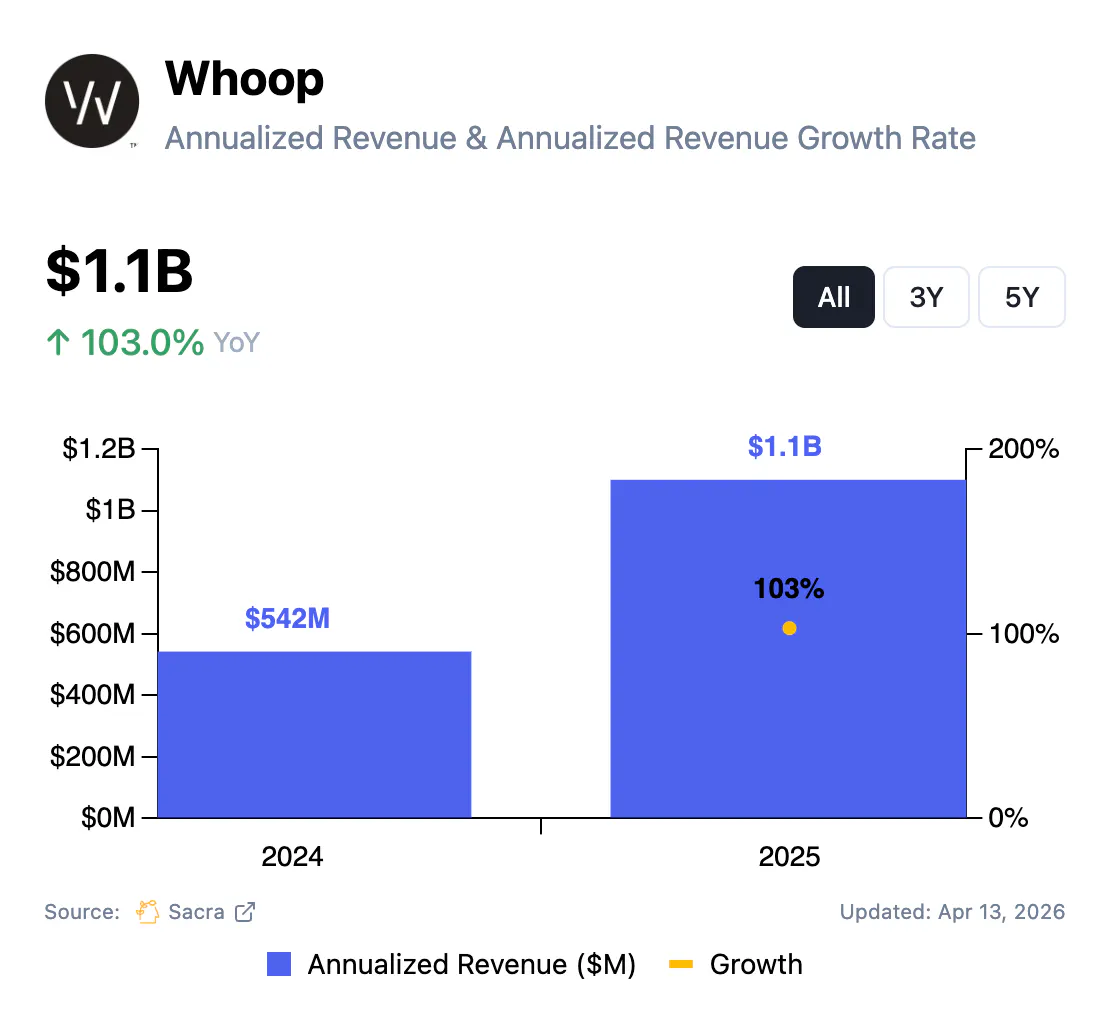
TL;DR: Whoop flipped the Apple Watch model, monetizing on subscriptions vs. hardware sales, using a screenless form factor that could be worn 24/7 vs. a wrist computer, and focusing on athletic performance vs. general health monitoring. Sacra estimates Whoop hit $1.1B in annualized revenue exiting 2025, up 103% YoY. For more, check out our full report and dataset on Whoop.
Key points via Sacra AI:
- Where Fitbit (2007) built a $1.6B/year business measuring health outputs like steps and calories, Whoop (2011) flipped to continuous physiological inputs—HRV, respiratory rate, skin temperature, up to 100x per second—through a screenless, notification-free wristband that, without a display to power, achieves a 14-day battery life and is unobtrusive enough to wear 24/7 in the shower, during sleep, and at the gym via an on-wrist battery pack that charges without removal. Whoop bundles hardware and gives it away "for free" as part of annual subscription-based memberships—One ($199, performance, sleep, strain tracking), Peak ($239, Stress Monitor, Healthspan), and Life ($359, ECG, blood pressure, AFib detection)—with ~85% of revenue from subscriptions, ~10% from accessories and Whoop Body apparel, and ~5% from Whoop Unite enterprise contracts.
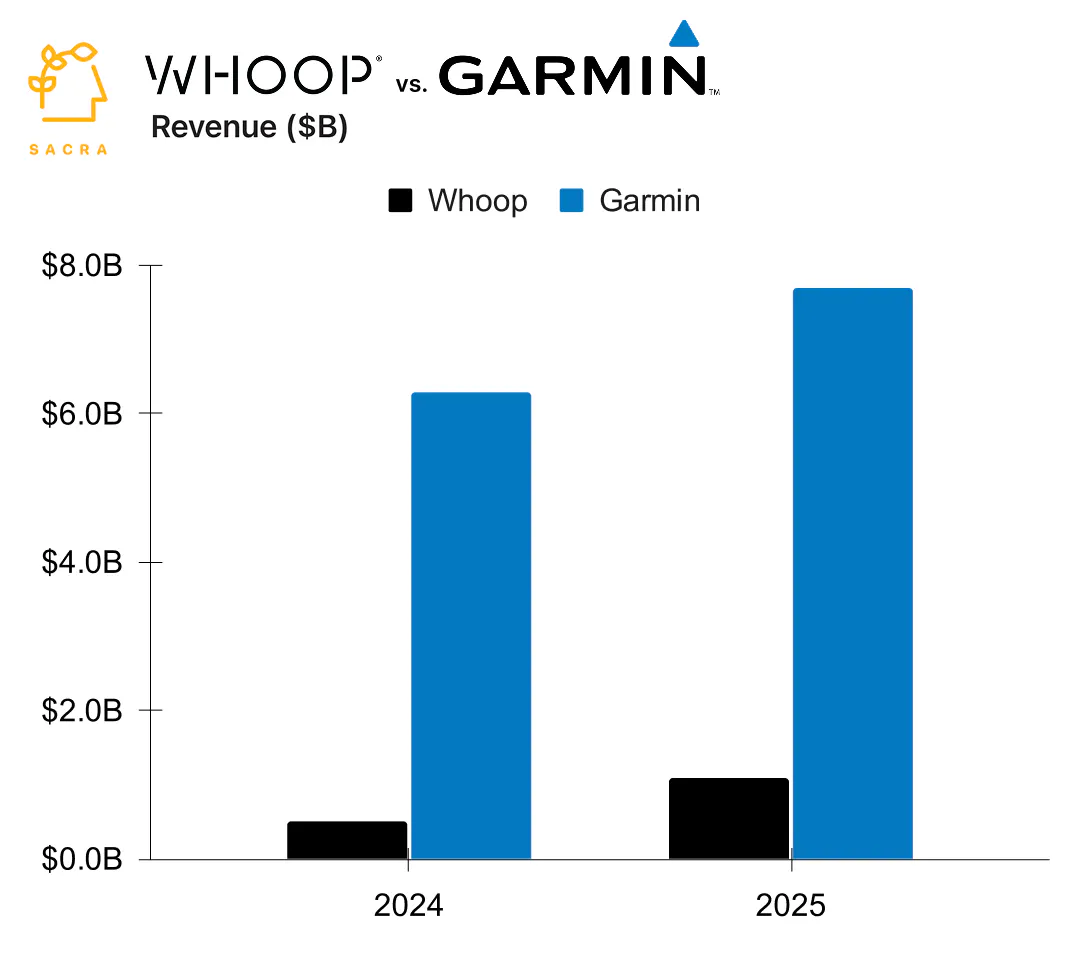
- From having 70% of its members in the United States just 4 years ago, Whoop has gone after aggressive geographical expansion to grow revenue, now operating in 60 countries with 60% of its sales coming from outside the U.S as Sacra estimates Whoop reached $1.1B in annualized revenue exiting 2025, up 103% YoY and valued at $10.1B for a ~9x multiple. Compared to Oura at $1B TTM revenue in 2025, up 100% YoY, valued at $5.2B for a ~5x multiple and to the hardware-focused wearable incumbent Garmin at $7.3B in 2025 revenue, growing 15% YoY, valued at $50B for 6.8x revenue multiple.
- Where Oura started with sleep and Whoop with athlete recovery, both are now converging on the same medical device territory, adding AFib detection, cycle tracking, and blood pressure monitoring, both backed by healthcare strategics (Abbott & Mayo Clinic), and each competing to own the longitudinal health record that insurers & drug companies will pay billions to access. While Apple Watch sells a $400+ general-purpose wrist computer with basic health tracking & data for a mass audience, Whoop is selling a $199 to $359/year subscription to a 14-day battery wristband for an audience willing to pay recurring fees to optimize their athletic performance rather than casually monitor their wellness.
For more, check out this other research from our platform:
- Whoop (dataset)
- Oura (dataset)
- $1B/year Finnish MAHA wearable
- Oura at $500M/year growing 120% YoY
- Oura at $225M
- Andy Hoang, CEO of Aviron, on the unit economics of connected fitness
- Strava: the $265M/year Whole Foods of social networks
- Aviron and the Xbox of connected fitness
- Apple vs. Limitless vs. Gong
- Freed at $13M ARR
- OpenEvidence (dataset)
- Brendan Keeler, interoperability lead at HTD Health, on GTM for AI medical scribes
- Strava (dataset)
- RunSignup (dataset)
- Function Health (dataset)
- Maven Clinic at $268M ARR
- BillionToOne at $153M/yr
- Commure at $105M ARR
- Virta Health at $175M revenue
- Noom at $1B ARR
- Hone Health: the $55M/year D2C testosterone startup
- Sweden’s $215M/year telehealth giant
- Johannes Schildt & Claes Ruth, CEO and CFO of Kry, on the AI future of telehealth
Read more from
Read more from


Dave revenue, growth, and valuation
Unlocked Report
Continue Reading


