

Revenue
$123.00M
2025
Valuation
$1.30B
2023
Funding
$464.10M
2023
Growth Rate (y/y)
-4.5%
2024
Revenue
Sacra estimates that SingleStore hit $123M in annual recurring revenue (ARR) in September 2025, up 17% from $105M at the end of 2024. ARR had declined 5% in 2024 from $110M at the end of 2023, making the 2025 increase a recovery rather than uninterrupted growth.
SingleStore passed the $40M ARR point in October 2020. By the end of 2022, they were at roughly $85M ARR with about 320 customers—including Comcast, Hulu and Uber, Fiverr, Heap, and Siemens—for an ARPC (average revenue per customer) of $266K.
Valuation & Funding
SingleStore completed a growth buyout led by Vector Capital in October 2025, giving Vector majority ownership. Raj Verma and the management team continued to lead the company, while GV, Dell Technologies Capital, IBM, and REV remained investors. The transaction’s financial terms were not disclosed in the company announcements.
SingleStore announced $116M in financing led by Goldman Sachs Asset Management in July 2022, with participation from Sanabil Investments and existing investors including Dell Technologies Capital, GV, HPE, IBM Ventures, and Insight Partners. CEO Raj Verma told Axios the July 2022 round valued SingleStore at $1.3B.
The company has raised $464.12M across 12 funding rounds, with backing from prominent investors including Dell Technologies Capital, Google Ventures, and IBM Ventures.
Product
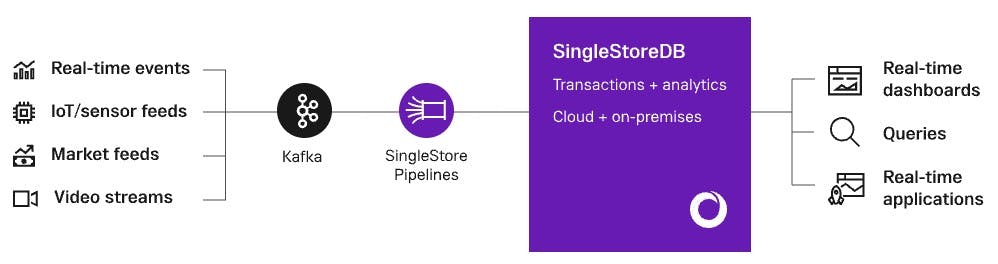
Founded in 2011 as MemSQL by Eric Frenkiel, Adam Prout, and Nikita Shamgunov, SingleStore is a cloud-native, distributed SQL database that aims to be an all-in-one database solution combining both transactional and analytical workloads.
These two use cases have traditionally been handled by different databases.
Transactional use cases are handled by OLTP (online transaction processing) systems, and they usually involve large numbers of database transactions demanding extremely fast response times—for example, ecommerce or online banking.
Analytical use cases are handled by OLAP (online analytical processing) systems, and involve complex queries run over large numbers of records, with relatively slow response times appropriate for data analysis rather than real-time business applications.
SingleStore’s aim was to build a database that could do both—a HTAP (hybrid transactional & analytical processing) database—so that companies can simply use SingleStore instead of stitching together a series of multiple databases via ETL in order to run their business and answer data questions.
Instead of an ecommerce brand needing to run a Postgres database with Snowflake, MongoDB and Redis, they could just use SingleStore.
SingleStore supports vector and full-text search alongside SQL queries, allowing developers to retrieve data for AI applications within the same database. AI Functions let developers call models from SQL, while Aura Analyst provides a conversational interface for exploring data. Embedding Aura Analyst directly inside customers’ applications was described as a future capability at the October 2025 launch.
Business Model
SingleStore sells a managed cloud database, Helios, and self-managed software deployments. Helios bills compute through credits and charges separately for storage, with customers choosing on-demand usage or discounted annual commitments. Revenue can expand as customers add workloads, use larger compute resources, or retain more data.
Cloud delivery shifts database operation to SingleStore, but infrastructure consumption remains a cost driver. Its consolidation pitch depends on replacing enough separate databases and data movement to justify the bill; customers that use SingleStore only for an analytics layer leave a smaller share of their data infrastructure spending addressable.
Competition
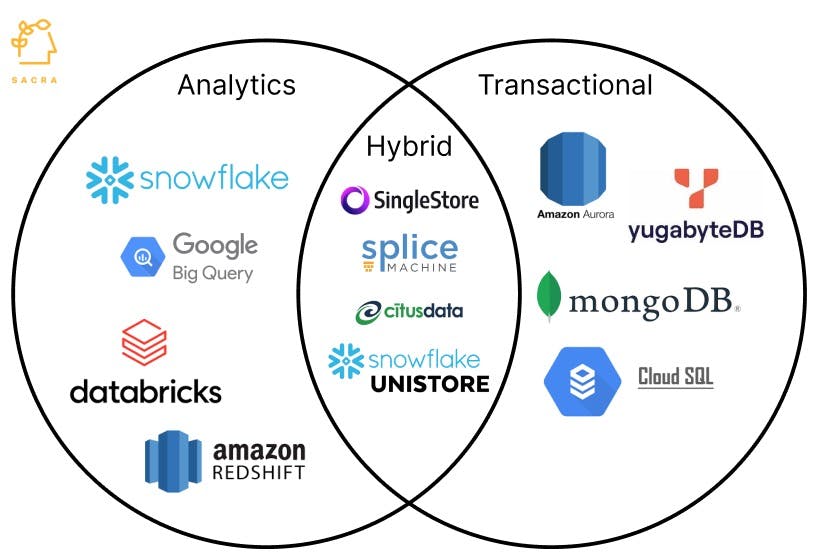
SingleStore’s hybrid approach means that it’s competing with a litany of other companies when it comes to winning both transactional and analytical workloads.
On the analytical side, SingleStore is competing with heavyweights like Snowflake, Redshift, Databricks, and BigQuery.
Among transactional databases, SingleStore faces competition from CockroachDB, Yugabyte, Postgres, and MySQL, as well as competitive offerings from major cloud services providers like Aurora from AWS and Cloud SQL from Google.
SingleStore has outgrown most of their competition on the hybrid database end—companies like Splice Machine and Citus. However, the most common way that SingleStore is implemented is not as an end-to-end hybrid database—instead, it’s as an analytics layer on top of a company’s existing data warehouse, where it functions mainly as an OLAP for analytics use cases.
HTAP remains a small percentage of SingleStore’s existing use cases across its customer base, and mostly at the lower end of customer size—larger enterprises are using more specialized databases.
This reflects a prevailing sentiment which is an overall skepticism across the industry towards the idea of a "one-size-fits-all" approach for databases, the emerging consensus being that enterprises‚ especially those handling large-scale databases—prefer to have solutions specifically tailored for distinct workload types, like Neo4j for graph databases.
TAM Expansion
The upside for SingleStore is that despite all the competition and challenges they face, the database market is the largest category in enterprise software as a whole at around $60B and growing—meaning that there’s room for many large winners in the space.
Real-time analytics
A few years ago, the hype cycle for the idea of ‘real-time analytics’ hit a peak—since then, the wave has receded as big players in the space have gone stagnant (Omnisci, Rockset, Druid, Kinetica) and companies have recognized that they lack the organizational infrastructure to truly react to and use real-time data.
SingleStore, right now, is a bet on the idea that this will shift in the future—and that more organizations (outside of a few customers that can fully utilize this capability today, like Comcast and Uber) will develop the capacity and the desire to do real-time, low-latency analytics on their various applications.
Even here, however, SingleStore will face challenges—recent benchmarks have indicated that Snowflake is outperforming SingleStore on real-time analytics, eroding SingleStore’s claims of being the fastest (though they remain less expensive than Snowflake).
Rise of cloud
50% of enterprise IT spend is expected to move to the cloud by 2025 as organizations look to reduce their spend on commodified computing infrastructure and instead invest more in the differentiated parts of their business.
SingleStore is positioned to benefit from this migration into the cloud. Another related area where SingleStore is well-positioned is consolidation: by bringing multiple database functionalities together into one unified platform, organizations using SingleStore can potentially reduce the overheads associated with managing, licensing, and operating multiple disparate database systems.
Risks
Limited consolidation: SingleStore’s report indicates that larger customers often use it as an analytics layer rather than replace their entire transactional and analytical stack. If that deployment pattern persists, the company must win individual workloads without capturing the broader consolidation budget on which its all-in-one pitch depends.
Consumption and cloud costs: Helios revenue grows with compute and storage usage, making customer optimization a potential drag on expansion. Supporting demanding low-latency applications also exposes SingleStore to infrastructure costs that need to be recovered through pricing. A customer can remain on the product while reducing its bill by shrinking or consolidating workloads.
DISCLAIMERS
This report is for information purposes only and is not to be used or considered as an offer or the solicitation of an offer to sell or to buy or subscribe for securities or other financial instruments. Nothing in this report constitutes investment, legal, accounting or tax advice or a representation that any investment or strategy is suitable or appropriate to your individual circumstances or otherwise constitutes a personal trade recommendation to you.
This research report has been prepared solely by Sacra and should not be considered a product of any person or entity that makes such report available, if any.
Information and opinions presented in the sections of the report were obtained or derived from sources Sacra believes are reliable, but Sacra makes no representation as to their accuracy or completeness. Past performance should not be taken as an indication or guarantee of future performance, and no representation or warranty, express or implied, is made regarding future performance. Information, opinions and estimates contained in this report reflect a determination at its original date of publication by Sacra and are subject to change without notice.
Sacra accepts no liability for loss arising from the use of the material presented in this report, except that this exclusion of liability does not apply to the extent that liability arises under specific statutes or regulations applicable to Sacra. Sacra may have issued, and may in the future issue, other reports that are inconsistent with, and reach different conclusions from, the information presented in this report. Those reports reflect different assumptions, views and analytical methods of the analysts who prepared them and Sacra is under no obligation to ensure that such other reports are brought to the attention of any recipient of this report.
All rights reserved. All material presented in this report, unless specifically indicated otherwise is under copyright to Sacra. Sacra reserves any and all intellectual property rights in the report. All trademarks, service marks and logos used in this report are trademarks or service marks or registered trademarks or service marks of Sacra. Any modification, copying, displaying, distributing, transmitting, publishing, licensing, creating derivative works from, or selling any report is strictly prohibited. None of the material, nor its content, nor any copy of it, may be altered in any way, transmitted to, copied or distributed to any other party, without the prior express written permission of Sacra. Any unauthorized duplication, redistribution or disclosure of this report will result in prosecution.