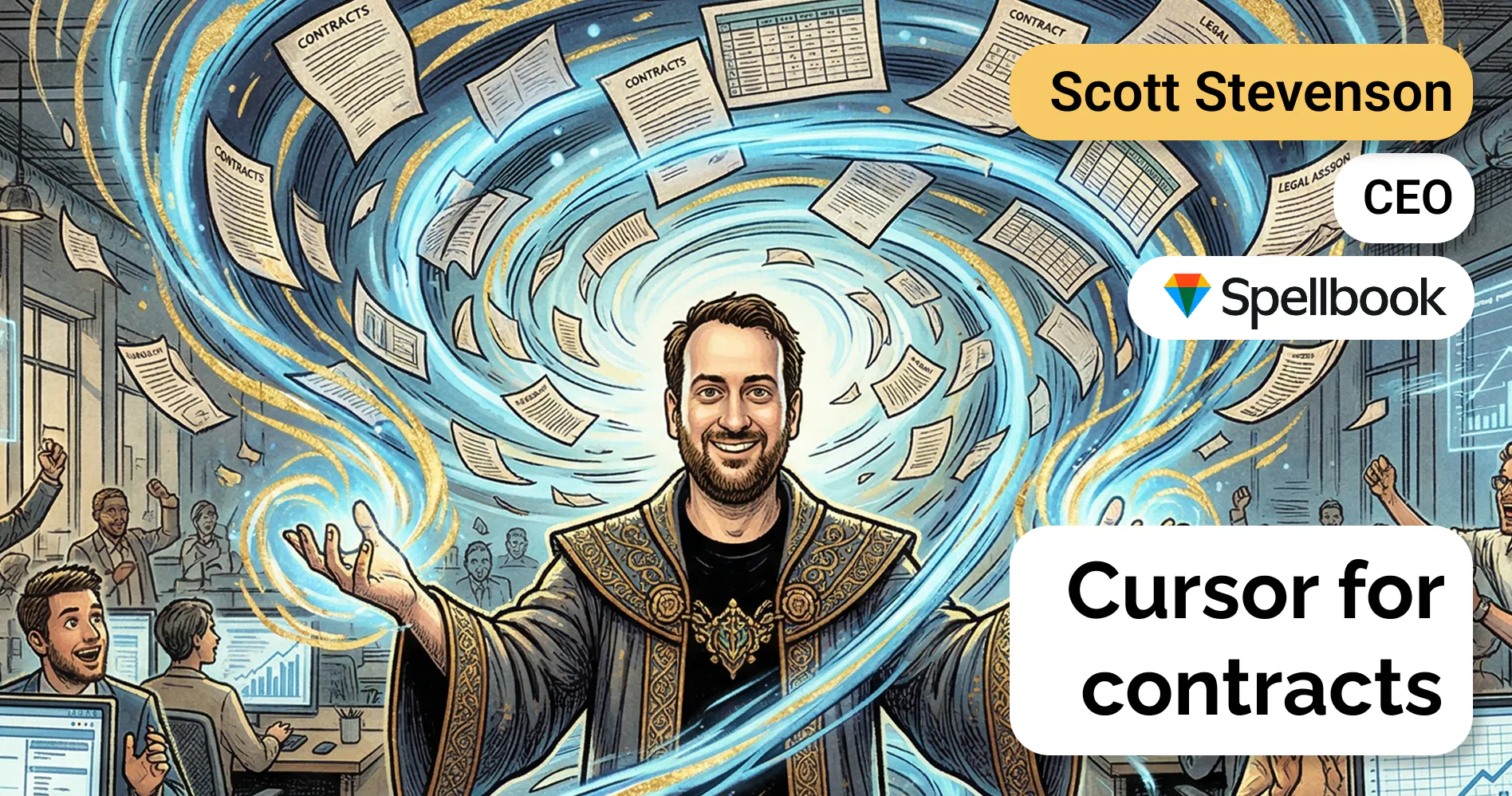
Scott Stevenson, CEO of Spellbook, on building Cursor for contracts
 Jan-Erik Asplund
Background
We last covered the convergence of AI & legal software with our interview with Shubham Datta, VP of Corporate Development at Clio, following its $1B acquisition of vLex. To learn more, we reached out to Scott Stevenson, co-founder and CEO of Spellbook ($50M raised, Inovia Capital).
Key points from our conversation via Sacra AI:
- Contracts have emerged as the breakout use case for LLMs in legal because, unlike litigation where every case demands creative, subjective reasoning, contracts are valued for being as standardized and unoriginal as possible, with in-house legal teams aligned with speed & efficiency in contract turnaround & revenue acceleration adopting legal AI 3x faster than law firms. "The nice thing about contracts is that no one wants a contract to be creative. Nobody says 'you generated that with GPT-3 therefore it's not a good contract.' Everyone wants a contract to be as unoriginal as possible. Whereas if you submit a really unoriginal argument in a lawsuit, that's a problem: every case is so deeply unique that you want creativity. It's similar to journalism: you can use AI in your writing, but people start to recognize it, and judges don't like it."
- Rather than killing vertical legal AI tools, foundation model products like Claude Cowork (+ its legal plugin) are serving as top of funnel for vertical legal AI adoption, showcasing the power of applying LLMs to law at the same time as they leave the last-mile gap of solving boring, habitual jobs-to-be-done, integrating with the long tail of law firm systems and designing specific interfaces & product experiences for legal niches. "When the Claude-for-legal headlines came out, massive global headlines, everyone asked what that meant for Spellbook. The answer is it spiked our top of funnel to all-time highs.... These tools act like gateway drugs for lawyers. They're easy to get started with, but lawyers end up looking for more specialized things. As long as we continue to deliver a ton of value beyond what you get in a Claude chat box, it will actually be a source of leads for us."
- The legal AI market is splitting along two axes: broad-based, chat-shaped legal AI platforms like Harvey ($190M ARR, $1B raised, Sequoia) and Legora ($800M raised, Redpoint Ventures) which tend to sell top-down into large law firms & the 20 million lawyers who work at them, versus specific, workflow-embedded tools like Spellbook that go bottom-up through individual lawyers as an AI plugin for Microsoft Word, with the upside of expanding into procurement, sales, and the broader market of everyone who touches contracts. "Harvey and Legora sell specifically to lawyers, and we sell based on the contract problem. Those are actually very different markets. There are about 20 million lawyers in the world that Harvey and Legora can sell to. We sell to lawyers too, but we also sell to procurement teams and sales teams: there are actually billions of people who touch contracts... One of our first users was a single lawyer at a Fortune 10 company who put Spellbook on his personal credit card and used it on his own to improve his work. We made a lot of these bottom-up sales."
Questions
- Can you explain what Spellbook is, what the initial product-market fit was, and who was using it?
- Can you talk about Microsoft Word and why it was essential to build it that way, versus trying to get lawyers to use a separate tool?
- Who is using Spellbook and who is paying for it? There's a lot of conflation across legal AI companies and it's hard to get a sense of who's actually using them. They're often marketed one way and real usage ends up somewhere else. Is it primarily corporate in-house?
- Can you expand on why not big law?
- What's the use case so urgent that a lawyer puts Spellbook on their personal credit card? What does that look like?
- Legal seems like a field designed for AI, the way coding was. But coding and healthcare have both seen more explosive take-off. Do you agree with that read, and what do you attribute legal's relative slowness to?
- We've done some coverage of Ironclad, Icertis, and other contract software that seems to be launching AI features around contract review and drafting. Do you see people using tools like that alongside Spellbook? How do you see those co-opetition dynamics?
- Any hints there toward Spellbook's future plans?
- Do you see research or litigation as interesting, or is that Harvey and Legora's domain? Will Spellbook stay focused on contracts?
- On litigation specifically, what's the fundamental problem with legal AI in that space? In healthcare there's an analog issue where a lot of good data is locked up behind paywalls. Is it a data problem with Westlaw, LexisNexis? Or something else?
- How do you feel about the frontier model threat? Anthropic has Claude Code and promotes contract review as one of its use cases. Where do you think that will gain ground and where will it fall short?
- On the billable hour, do you see AI having fundamental ramifications for that business model? Is it going to go away?
- Thinking about the previous generation of legal tech like LegalZoom, how important is the democratization thesis to how you think about Spellbook?
- Besides contract management features, are there other adjacent areas you're excited about going after with Spellbook?
- Is there anything we didn't cover that you think is important?
- Is it an advantage to be in Canada?
Interview
Can you explain what Spellbook is, what the initial product-market fit was, and who was using it?
Spellbook is the most used AI contract review tool in the world. We launched in the summer of 2022, making us the very first generative AI product launched for lawyers, a little before ChatGPT and a little before Harvey. I started the company because I had a small business and was extremely frustrated by the legal fees I was paying, especially around commercial transactions. The friction and expense of contracts just drove me crazy. I wanted to shake hands with people and get to work, not deal with all that expense and slowness.
We originally started the company in 2018 with a doc automation product. We would use templates to automate the output of contracts and sold that to about 100 law firms. Then we were really early to jump on the generative AI train. We were inspired by GitHub Copilot originally, and based on patterns from our users: what they liked and didn't like about our product, we saw an opportunity to build the first GitHub Copilot-style experience for lawyers.
What Spellbook does is surface issues in agreements, ensure they're compliant with your standards, and actually alter or redline agreements, as lawyers would say. If a company is reviewing a thousand NDAs a year, they can set up a playbook in Spellbook that will alter every contract based on their standards, editing it with track changes in Microsoft Word. We also have a co-pilot inside Microsoft Word, very much like Cursor or GitHub Copilot.
The way we hyperfocus on contracts and fit into a lawyer's existing workflow is what makes us special. Sometimes I describe us as an electric bicycle for lawyers. Rather than being a separate app that lawyers go to, we give them an electric bicycle, our Word add-in, that enables them, very much like what Cursor is to engineers, to stay entirely within their existing workflow. We help them pedal up the hills faster on these complex drafting and review problems.
To give you a sense of the scope of the problem: what lawyers have been doing before large language models is looking at a 60-page commercial lease and reviewing it by hand, with their eyes. Reading through 60 pages and finding every mistake or issue is basically an impossible task. Literally every public contract we look at, we almost always find a mistake or issue. There's never a case where there are no issues. AI enables lawyers to go from this basically impossible task of reviewing 60-page agreements to having threads to pull on, spotting issues, and fixing them.
Can you talk about Microsoft Word and why it was essential to build it that way, versus trying to get lawyers to use a separate tool?
One thing we learned working with lawyers is that getting them to go to any new app is very difficult. Coming from an engineering background, I really like the Cursor experience because you're basically in the same environment you were already in. Even with Claude Code, it works with the tools you already use. You don't have to completely change how you do things. We saw time and time again that even getting a lawyer to go to a web app and enter their password was very difficult.
We also had a thesis that there are way too many apps shaped like a chat box. ChatGPT already exists, Claude already exists. If all you build is a chat box, that's not going to be very differentiated. By putting ourselves on top of a lawyer's existing workflow, it creates a really differentiated experience that drives habit formation in a way that's very difficult to achieve with a separate app.
Who is using Spellbook and who is paying for it? There's a lot of conflation across legal AI companies and it's hard to get a sense of who's actually using them. They're often marketed one way and real usage ends up somewhere else. Is it primarily corporate in-house?
We have about 4,000 customers. About 60% of our revenue today comes from corporate in-house, from large enterprise teams with significant contract flows running through Spellbook. That's our sweet spot right now. But we also have mid-size and large law firms using us, with mid-size firms being more typical for us. We don't go heavily into big law, and that's one way we differ from Harvey and Legora.
Can you expand on why not big law?
Some of our first customers were big law, and what we realized was that purchase decisions at these firms were made by innovation committees, very top-down. They would give us a long laundry list of required features and then force their users to use the product. We also learned that those innovation committees cared heavily about how big the press release was going to be. At a big law firm, everything is based on the billable hour. Cutting your billable hours in half is not actually exciting for a large law firm. What is exciting is doing a big press release to your clients and showing them how innovative you are. We saw this pattern across a lot of large firms: they were overfocused on client optics and using AI as a marketing moment rather than actually driving internal adoption, which would mean decreasing their billable hours.
So we made the decision early on not to sell top-down to large firms unless they were authentically committed to improving how they work. Instead, we sold bottom-up. One of our first users was a single lawyer at a Fortune 10 company who put Spellbook on his personal credit card and used it on his own to improve his work. We made a lot of these bottom-up sales. This is harder because we're closing smaller deal sizes: we'll close a single lawyer if they want to come on board, and then it expands from there. Our NRR in December was 130%, so we are expanding into these organizations, often starting with a single seat.
The thesis is that this builds a better, more usable product long term because you're actually selling to the user, not to a committee or to executives at the top. That's been very special about Spellbook. We're focused on the end user of the app, not the innovation committees at large law firms, and we believe that just builds a better product.
What's the use case so urgent that a lawyer puts Spellbook on their personal credit card? What does that look like?
It's mainly contract review. The challenge is you have this constant flow of people asking for contracts to be signed, reviewed, or revised. You need to find the problems, suggest negotiation positions, modify the contracts, and ultimately get them signed. The reason we saw the opportunity is that, as an engineer, when I write code I have all these tools telling me if something is wrong, tests to catch bugs, linters to surface potential issues. Lawyers have none of that. They're just writing and copying and pasting these 60-page documents with nothing to help them. It's a hair-on-fire problem.
The other area we've gotten into, beyond one-off reviews, is multi-document drafting. If you're an investor working on a venture financing, you'll often start with a term sheet and then need to draft 10 documents—a share purchase agreement, a voting agreement—to make that transaction happen. When we did our $50 million Series B last year, we had to sign 10 different documents to close it. Spellbook has a Claude Code-for-legal element where you can handle these complex multi-document drafting tasks as well. That's not what pulled in that original lawyer, but it's pulling in more users now.
Legal seems like a field designed for AI, the way coding was. But coding and healthcare have both seen more explosive take-off. Do you agree with that read, and what do you attribute legal's relative slowness to?
We think about this all the time. We didn't start this company because we saw an opportunity for AI in legal. We started it because legal was one of the only industries that had not adopted software to improve its workflows. Before generative AI, there was massive pent-up demand: 70% of people can't afford legal services, and 70% of businesses won't go to a lawyer because it's too expensive. A lot of lawyers hate their job because they're just copying and pasting in Word all day.
What happened in law, and also in healthcare, is that software up until 2022 basically couldn't do anything useful with unstructured text. The ML we had was very primitive before that. Contrast that with accounting and finance, which have been massively automated since the 80s. Spreadsheets and databases meant one person could run a financial model that used to take a building full of people. Computers were very good at quantitative and structured data, so finance has seen 40 years of software adoption.
In law, up until 2022, it was still running on an army of humans with almost nothing automated. That is the fundamental force that people don't understand & that is why you're hearing about legal AI all the time. Software did not help lawyers until 2022. When we first went to raise money, we got 80 nos from investors because every investor said they didn't think lawyers wanted to buy software. But as soon as the generative AI moment happened in 2022, lawyers started adopting this stuff really fast because it actually helped them. Whereas all the previous software wasn't helpful because lawyers work with unstructured text in Microsoft Word, and nothing truly helped them except Word itself and email.
Now law is one of the biggest verticals in the world, and we're seeing this Cambrian explosion of apps for lawyers. It's like a dam breaking: there's so much pent-up demand for innovation and you're seeing these massive growth stories. Legal was one of the last bastions that software never really got to, and the same is true of healthcare.
Now law is one of the biggest verticals in the world, and we're seeing this Cambrian explosion of apps for lawyers. It's like a dam breaking, where there's so much pent-up demand for innovation and you're seeing these massive growth stories. Legal was one of the last bastions that software never really got to, and the same is true of healthcare.
We've done some coverage of Ironclad, Icertis, and other contract software that seems to be launching AI features around contract review and drafting. Do you see people using tools like that alongside Spellbook? How do you see those co-opetition dynamics?
We do see them using contract lifecycle management tools. The CLM category did not take off as people expected: it didn't have the level of success people wanted because it was a pre-AI paradigm that relied on a huge amount of manual data entry and manual workflow configuration. That category is being reinvented from the ground up. Even when we sell to very large enterprise teams, a lot of them still aren't using a CLM like Ironclad. Our view is that category is going to be rebuilt entirely with AI.
Any hints there toward Spellbook's future plans?
We will be launching features that I'd describe as CLM. Although we won't call it that, because our customers don't like the name and see the category as having underdelivered. Where Spellbook is going, and what really differentiates us from Harvey, Legora, ChatGPT, and Claude, is building infrastructure and rails for contracts. Many of the customers we sell to are processing sometimes 100,000 contracts a year and they want to send those through our pipes and rails.
We need features to service those customers: automated intake and triage, workflows, plugging into Slack and email, and being proactive. The vision is that Spellbook is pulling in information from email and Slack, building context for the AI, and the AI is actually doing the first step of your work for you. A lawyer should open up Spellbook and see that, based on their inbox, Spellbook has already done a first pass on every contract they need to look at and written recommendations, without them doing anything. That's where we're headed.
Do you see research or litigation as interesting, or is that Harvey and Legora's domain? Will Spellbook stay focused on contracts?
We're focused purely on contracts. Contracts at the speed of commerce. Litigation is not where we play.
One thing that might be interesting in terms of positioning: Harvey and Legora sell specifically to lawyers, and we sell based on the contract problem. Those are actually very different markets. There are about 20 million lawyers in the world that Harvey and Legora can sell to. We sell to lawyers too, but we also sell to procurement teams and sales teams: there are actually billions of people who touch contracts. If you focus on contracts, that's actually a bigger market in terms of the number of people you touch versus selling exclusively to lawyers. Contracts are pervasive in everything we do in the world. If you get married, you might have a prenup.
So yes, we service a lot of lawyers and legal teams and that's our primary customer base, but we also touch everyone else who touches a contract.
On litigation specifically, what's the fundamental problem with legal AI in that space? In healthcare there's an analog issue where a lot of good data is locked up behind paywalls. Is it a data problem with Westlaw, LexisNexis? Or something else?
We have seen success in litigation with eDiscovery: you're looking at thousands of records to find evidence for your case. AI has been good there, though that actually started before generative AI. Companies like Reveal are doing that.
Beyond eDiscovery, the challenge is that a lot of litigation work requires more creativity and is more subjective. The nice thing about contracts is that no one wants a contract to be creative. Nobody says "you generated that with GPT-3 therefore it's not a good contract." Everyone wants a contract to be as unoriginal as possible. Whereas if you submit a really unoriginal argument in a lawsuit, that's a problem: every case is so deeply unique that you want creativity. It's similar to journalism: you can use AI in your writing, but people start to recognize it, and judges don't like it. There's a subjective taste aspect to legal writing that these models aren't very good at right now. I can tell when something was written by ChatGPT almost immediately, and that can really hurt the litigation use case if you're using it to draft an argument.
How do you feel about the frontier model threat? Anthropic has Claude Code and promotes contract review as one of its use cases. Where do you think that will gain ground and where will it fall short?
Everyone always asks about this. When we first launched and ChatGPT came out, all our investors asked what ChatGPT was going to do to Spellbook. We were pretty scared at first, and then our funnel just exploded. When ChatGPT came out, we saw more leads than ever because the broad awareness of what AI could do increased so dramatically.
The same thing is actually happening with Claude. When the Claude-for-legal headlines came out, massive global headlines, everyone asked what that meant for Spellbook. The answer is it spiked our top of funnel to all-time highs. The broad awareness and urgency, with everyone talking about legal AI, caused more people to come to us than ever. In December we were booking about 200 demos a week with lawyers. After those Claude-for-law headlines, we were booking 450 meetings a week: more than doubling our weekly demo volume in two months. I'd largely attribute that to the hype from Claude for Law.
These tools act like gateway drugs for lawyers. They're easy to get started with, but lawyers end up looking for more specialized things. As long as we continue to deliver a ton of value beyond what you get in a Claude chat box, it will actually be a source of leads for us because lawyers try it and then want more.
Harvey and Legora's products are very shaped like Claude or ChatGPT, so they face more of a challenge there: it's hard to compete with Claude if you're just building a chat box. But when you go beyond a chat box, there's so much you can build that will never make sense for Claude to build. For instance, in Spellbook we have something called market comparison. If you're signing a commercial lease in New York City, you get charts showing exactly how your commercial lease compares to the market norm. There's no chat component at all. It uses AI and our proprietary data to compare your contract data and produce visual graphs. That would just never make sense for Claude to build. As long as you're building things that aren't just a chat box, there's a lot of defensibility there.
On the billable hour, do you see AI having fundamental ramifications for that business model? Is it going to go away?
It's a massive threat to the business model. People will dance around it because no one wants to say it, especially a company like Harvey selling into big law. But in the backroom conversations we see these lawyers and law firms having, they are quite concerned. AI does not align with the billable hour incentive structure: it can reduce how much time you spend on something by 95%. Large firms are genuinely struggling to adapt right now, which is why you see so many press releases and marketing campaigns about how innovative they are, but usage metrics that aren't that great. Even as an individual lawyer, if you could bill eight hours today rather than two, you're going to bill eight hours.
That's one reason we focus so deeply on in-house, and also sell to a lot of small and mid-size law firms: many of them are already billing on a flat fee or alternative fee arrangement basis, so we find more adaptability there. In-house, the incentives are completely aligned. Everyone wants to get the work done faster and everyone wants the business to move faster.
Right now, in-house is growing three times faster than our law firm segments, and honestly we did not expect that. We actually started selling to law firms and said we were never going to sell in-house. Then in-house just kept coming to us, again and again. We only started selling in-house at the beginning of last year, and it's now the dominant part of our customer base because the urgency to adopt is just so much higher there.
Thinking about the previous generation of legal tech like LegalZoom, how important is the democratization thesis to how you think about Spellbook?
It's the reason I started the company. I was a small business owner who couldn't afford legal help, and that really frustrated me. Anyone should be able to start a company. Anyone should be able to get a sales agreement made. People shouldn't be prevented from entrepreneurship because they can't afford legal fees.
The first product we launched actually cut lawyers out of the equation entirely and automated everything. Before AI, we would automate the production of contracts. People didn't like the product that much because even if we could automate the production, they still couldn't understand what the contracts meant, and they still had to just trust that this robot was doing everything correctly. We called it "DIY anxiety." There are online will creators out there, but a lot of people still want a lawyer to rubber stamp something and say "yeah, this is reasonable." People really struggle to trust these outputs without a human in the loop.
Our view currently is that the best way to help everyone is to empower legal teams to do better. When we deploy to a large enterprise, we might roll out to a sales team and a procurement team, but there's a legal team overseeing it and putting guardrails in place to make sure things are operating within the right parameters. AI isn't good enough to completely disintermediate lawyers right now: it's actually pretty far from that. Maybe in 10 years you'll have a lot more DIY law tools, but we're not there yet.
Besides contract management features, are there other adjacent areas you're excited about going after with Spellbook?
The next pillars are intake, workflows, storage, and becoming a system of record: the full scope of the contract flow. After that, what we think about is what we'd call artificial employees: agents that are basically always working and surfacing risk for you. For instance, every company has a portfolio of employment agreements they've signed, and on any given month, legislation could change in a jurisdiction that makes some of those agreements invalid. We see proactive agents working in the background to surface risk and move your goals forward as the next big thing we're building toward.
One reason people are underestimating AI is that right now it's basically a poor employee: you ask it to do something, it'll work for five minutes, and the moment you walk away it stops doing anything. It just sits there for 48 hours, for seven days, until you ask it to do something again. We're going to get to a point where AI acts more like a good employee, proactively moving things forward even when you're not there. That's the next big thing after the CLM features.
Is there anything we didn't cover that you think is important?
A couple of things. We've been told we're the fastest growing AI company in Canada, based on what investors with a broad view of the market have shared with us. Harvey and Legora each have about 1,000 customers. We have more than both combined. We're operating in over 80 countries and selling in many different languages, which gives a sense of the scale of what we're doing.
Is it an advantage to be in Canada?
There are great things in Canada and not so great things: we try to mix the best of both US and Canadian culture. There's amazing talent here: humble, smart people who really want what's best for customers. The people are pretty incredible and often underrated. At the same time, we have to import some of the Silicon Valley ambition. Canada isn't necessarily known for that level of ambition. We try to bring as much of that into our culture as we can to build something really big.
Disclaimers
This transcript is for information purposes only and does not constitute advice of any type or trade recommendation and should not form the basis of any investment decision. Sacra accepts no liability for the transcript or for any errors, omissions or inaccuracies in respect of it. The views of the experts expressed in the transcript are those of the experts and they are not endorsed by, nor do they represent the opinion of Sacra. Sacra reserves all copyright, intellectual property rights in the transcript. Any modification, copying, displaying, distributing, transmitting, publishing, licensing, creating derivative works from, or selling any transcript is strictly prohibited.