

Valuation
$11.00B
2026
Funding
$2.50B
2026
Valuation & Funding
SambaNova Systems was valued at $11B following its $1B Series F round led by General Atlantic in July 2026. This was up from $5.1B at its Series D in 2021, its last previously disclosed valuation. The Series F was announced as a first close, with additional investors expected to join, five months after SambaNova raised a $350M Series E in February 2026.
Since its 2017 founding, SambaNova has raised approximately $2.49B in total funding, with notable investors including General Atlantic, Vista Equity Partners, SoftBank Vision Fund, Intel, and BlackRock. Other Series F participants included T. Rowe Price Associates, Capital Group, Qatar Investment Authority, Battery Ventures, and Seligman Ventures.
Product
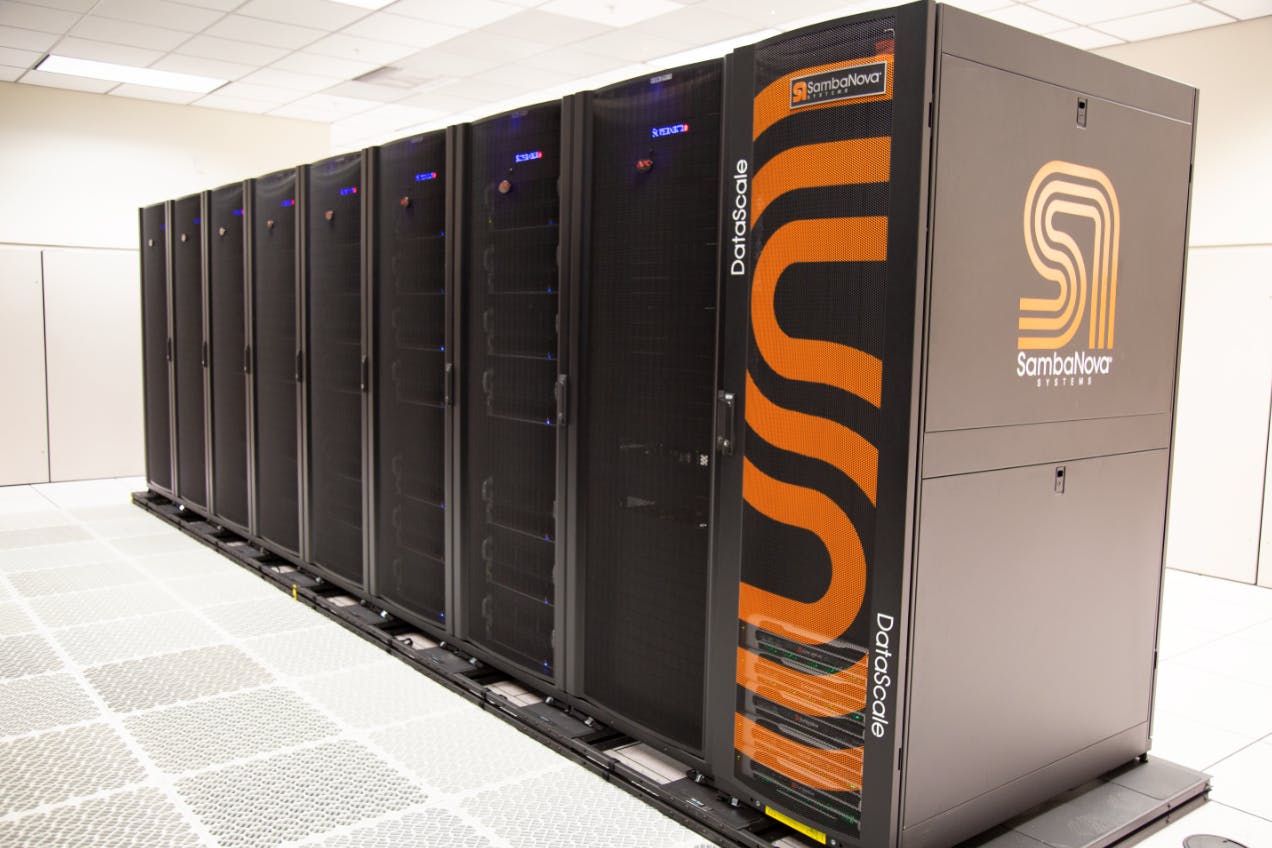
SambaNova Systems was founded in 2017 by Stanford professors Kunle Olukotun and Christopher Ré, along with former Oracle executive Rodrigo Liang. The founders set out to create a new type of AI chip architecture that could handle increasingly complex AI workloads more efficiently than traditional GPUs.
Over 2025 and 2026, SambaNova sharpened its focus around high-speed AI inference and reorganized its product portfolio into SambaCloud, SambaStack, and SambaManaged.
The three products run on the same underlying chips, SambaRack systems, and orchestration software, giving customers several ways to access the platform.
SambaCloud provides API-based access to open-source models including DeepSeek, Llama, and MiniMax from SambaNova-operated data centers.
SambaStack gives enterprises and governments dedicated systems hosted in the cloud or installed on-premise.
SambaManaged is a turnkey service through which cloud and data center operators can launch their own inference offerings using SambaNova hardware and software, with the company targeting deployment in approximately 90 days.
At the hardware layer, SambaNova’s Reconfigurable Dataflow Units use a three-tier memory architecture that can keep hundreds of models available on a single node and switch between them in microseconds.
This allows agentic applications to route requests across reasoning, coding, voice, and other specialized models without repeatedly loading each model from external memory.
In February 2026, SambaNova introduced SN50, its fifth-generation RDU. The chip provides five times more compute per accelerator and four times more network bandwidth than the prior generation, while supporting clusters of up to 256 accelerators. SN50 is scheduled to begin shipping to customers in 2026, with SoftBank as its first announced customer.
Business Model
SambaNova Systems generates revenue through three delivery models built on the same underlying RDU infrastructure.
SambaCloud sells usage-based access to models through an API, SambaStack provides dedicated hosted or on-premise systems, and SambaManaged enables data center operators to launch managed inference clouds using SambaNova hardware and software.
This structure creates a progression from developer adoption to larger infrastructure contracts. Customers can begin running workloads through SambaCloud before moving sensitive or high-volume applications onto a dedicated SambaStack deployment.
Cloud providers, telecom companies, and sovereign AI operators can use SambaManaged to sell inference capacity to their own customers, turning organizations such as SoftBank, OVHcloud, SCX, Infercom, and Argyll into both customers and distribution partners.
SambaNova's sales motion now spans large enterprises and the infrastructure providers that serve them. JPMorganChase is deploying SN40 and SN50 systems for on-premise inference, while OVHcloud selected SambaNova to power premium versions of its AI Endpoints service.
In Australia, Germany, and the UK, local operators are using SambaManaged to launch domestic inference clouds, allowing SambaNova to reach downstream enterprise and government customers through regional partners.
Competition
SambaNova Systems operates in the AI accelerator hardware and services market, competing across several distinct segments that have emerged as AI computing demands grow.
Traditional AI hardware manufacturers
NVIDIA dominates this space with roughly 85% market share through their H100 GPUs and CUDA software ecosystem. AMD and Intel represent the other major players, with AMD's MI300 series and Intel's Gaudi2 chips gaining traction. These companies focus on general-purpose AI acceleration through traditional chip architectures that can be clustered together.
Intel's competitive position relative to SambaNova has evolved into a strategic hardware and distribution partnership. The companies are developing an inference architecture that combines GPUs for prompt processing, SambaNova RDUs for token generation, and Intel Xeon 6 CPUs for agent orchestration. Intel is also investing in SambaNova, supplying host CPUs and other data center components, and supporting joint distribution through its enterprise and cloud channels.
Cloud AI infrastructure providers
Major cloud providers have developed proprietary AI chips to reduce NVIDIA dependence. Google's TPUs, Amazon's Trainium/Inferentia, and Microsoft's Maia target different aspects of AI workloads. These providers typically offer their chips as part of broader cloud services rather than selling hardware directly.
Regional cloud providers can also function as a channel for SambaNova. OVHcloud is integrating SambaNova RDUs into its AI Endpoints platform, while SoftBank already hosts SambaCloud in Japan and plans to anchor its next-generation inference infrastructure on SN50. These partnerships allow cloud providers to add differentiated inference capacity without developing a proprietary accelerator, while giving SambaNova access to their existing enterprise customers.
AI chip startups
by pairing specialized inference chips with cloud APIs and dedicated infrastructure. Cerebras uses wafer-scale processors to deliver high-speed inference through its cloud, dedicated systems, and on-premise deployments, making it the closest full-stack competitor to SambaNova. Cerebras completed its IPO in May 2026 and has since partnered with AMD on a disaggregated architecture that uses AMD infrastructure for prompt processing and Cerebras systems for token generation.
Groq similarly focuses on low-latency inference through its Language Processing Units and GroqCloud service. NVIDIA licensed Groq's inference technology in December 2025 and hired founder Jonathan Ross, president Sunny Madra, and other members of its team, although Groq remains an independent company and continues operating GroqCloud.
Etched has emerged as another well-funded inference competitor, developing rack-scale systems optimized for both prompt processing and token generation. The company raised $300M at a $10.3B valuation in July 2026 and says it is validating its first systems with customers against more than $1B in contracted demand. Its architecture combines low-voltage compute with a shared memory layer intended to deliver high throughput and low-latency inference on large mixture-of-experts models.
TAM Expansion
SambaNova Systems has tailwinds from the explosive growth in enterprise AI adoption and has the opportunity to expand into adjacent markets through inference optimization, industry-specific solutions, and cloud services delivery.
Enterprise AI infrastructure
The AI hardware market is projected to reach $250B by 2030, with enterprises increasingly seeking alternatives to NVIDIA's dominance.
SambaNova's unique architecture, which enables 10x performance improvements at one-tenth the power consumption, positions them to capture share in this expanding market. Their full-stack approach, combining chips, software, and services, addresses the acute shortage of AI talent while simplifying deployment for enterprises.
Inference and agentic AI
SambaNova has repositioned around high-speed inference for reasoning models, coding agents, voice applications, and other interactive workloads.
Agentic applications can generate substantially more inference demand than traditional chatbots because a single user request may trigger repeated model calls, tool use, and long-running workflows. SambaNova’s opportunity is to provide the low-latency token generation layer for these applications through both its own cloud and dedicated customer infrastructure.
The company’s work with Intel expands this opportunity into heterogeneous data centers.
GPUs can process large prompts, RDUs can handle the memory-intensive decode stage, and CPUs can execute code and other agent actions. This architecture allows SambaNova to sell specialized inference capacity into broader AI clusters rather than depending entirely on customers replacing their existing infrastructure.
Sovereign AI and infrastructure providers
SambaNova has expanded beyond direct enterprise deployments by supplying infrastructure to cloud, telecom, and sovereign AI operators. SCX in Australia, Infercom in Germany, and Argyll in the UK are building domestic inference clouds on SambaNova systems, while OVHcloud is incorporating its RDUs into a European cloud inference service.
These deployments exploit a practical constraint facing regional data centers: many lack the power and liquid-cooling infrastructure required for dense GPU clusters. SambaNova’s air-cooled systems are designed to operate within existing facilities, allowing regional providers to add AI capacity without rebuilding the data center around the accelerator. Its April 2026 agreement with TEPCO Systems extends this model into Japan, where TEPCO plans both to deploy the platform internally and distribute SambaNova systems to other enterprises.
Risks
Dependency on open source models: SambaNova's Samba-1 platform relies heavily on integrating open source models like Llama and Mistral. If these models' performance or licensing terms change significantly, or if proprietary models become the clear industry standard, SambaNova's value proposition of bundling and optimizing open source models could be undermined. The company would need to either develop its own foundational models or negotiate costly licensing agreements.
Hardware commoditization risk: SambaNova's competitive advantage stems partly from its specialized AI chips that enable efficient multi-tenant model hosting. As NVIDIA and other chip makers advance their architectures to better handle multiple concurrent models, SambaNova's hardware differentiation could erode. This would pressure margins and force greater reliance on their software and services offerings.
Enterprise adoption complexity: SambaNova's full-stack approach requires enterprises to adopt both their hardware and software ecosystem. This creates a higher barrier to adoption compared to solutions that can integrate with existing infrastructure. While this strategy enables better performance, it may limit growth to only the largest enterprises willing to commit to a complete platform switch.
DISCLAIMERS
This report is for information purposes only and is not to be used or considered as an offer or the solicitation of an offer to sell or to buy or subscribe for securities or other financial instruments. Nothing in this report constitutes investment, legal, accounting or tax advice or a representation that any investment or strategy is suitable or appropriate to your individual circumstances or otherwise constitutes a personal trade recommendation to you.
This research report has been prepared solely by Sacra and should not be considered a product of any person or entity that makes such report available, if any.
Information and opinions presented in the sections of the report were obtained or derived from sources Sacra believes are reliable, but Sacra makes no representation as to their accuracy or completeness. Past performance should not be taken as an indication or guarantee of future performance, and no representation or warranty, express or implied, is made regarding future performance. Information, opinions and estimates contained in this report reflect a determination at its original date of publication by Sacra and are subject to change without notice.
Sacra accepts no liability for loss arising from the use of the material presented in this report, except that this exclusion of liability does not apply to the extent that liability arises under specific statutes or regulations applicable to Sacra. Sacra may have issued, and may in the future issue, other reports that are inconsistent with, and reach different conclusions from, the information presented in this report. Those reports reflect different assumptions, views and analytical methods of the analysts who prepared them and Sacra is under no obligation to ensure that such other reports are brought to the attention of any recipient of this report.
All rights reserved. All material presented in this report, unless specifically indicated otherwise is under copyright to Sacra. Sacra reserves any and all intellectual property rights in the report. All trademarks, service marks and logos used in this report are trademarks or service marks or registered trademarks or service marks of Sacra. Any modification, copying, displaying, distributing, transmitting, publishing, licensing, creating derivative works from, or selling any report is strictly prohibited. None of the material, nor its content, nor any copy of it, may be altered in any way, transmitted to, copied or distributed to any other party, without the prior express written permission of Sacra. Any unauthorized duplication, redistribution or disclosure of this report will result in prosecution.