

Funding
$2.00B
2025
Valuation & Funding
In May 2026, PsiQuantum closed a $1.5 billion funding round, bringing its valuation to $10.5 billion.
Prior to this, in September 2025, PsiQuantum closed a $1 billion round led by BlackRock, Temasek, and Baillie Gifford at a $7 billion valuation. Major backers include BlackRock, Temasek, Baillie Gifford, and Nvidia's venture arm, alongside earlier investors like Microsoft.
Product
PsiQuantum was founded in 2015 by Jeremy O'Brien, Pete Shadbolt, Terry Rudolph, and Mark Thompson, a team of quantum physicists and photonics experts from the University of Bristol and Imperial College London.
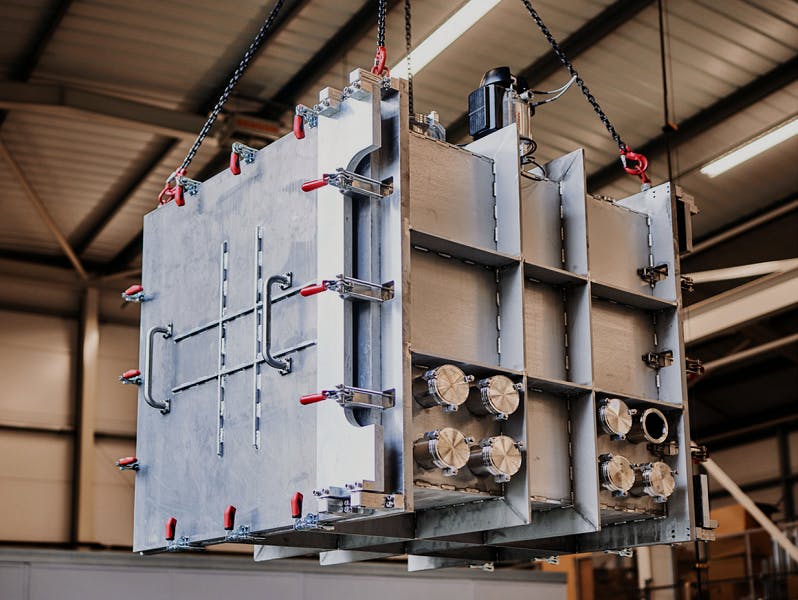
The company is developing a fault-tolerant quantum computer using silicon photonics technology, which manipulates individual particles of light as quantum bits (qubits). Their approach leverages existing semiconductor manufacturing processes through a partnership with GlobalFoundries to produce quantum chips at scale.
The core system integrates specialized components including single-photon sources, detectors, and optical switches on silicon chips that can be manufactured using standard 300mm wafer processes. These components work together to create, manipulate, and measure quantum states necessary for quantum computation.
PsiQuantum's quantum computer is designed to eventually scale to over one million qubits, enabling practical applications in drug discovery, materials science, and financial modeling. The system operates at higher temperatures than competing superconducting quantum computers and can be networked together using optical fiber connections, making it more practical for real-world deployment.
Business Model
Rather than pursuing incremental improvements with small numbers of qubits, PsiQuantum is focused on building utility-scale quantum computers with millions of qubits capable of running error-corrected quantum algorithms. Their approach leverages established silicon manufacturing expertise and infrastructure while developing proprietary optical switching technology crucial for connecting multiple quantum processing units.
The company's go-to-market strategy targets high-value enterprise and government customers who require massive computational power for chemistry simulation, materials science, and optimization problems that classical computers cannot solve effectively.
Their strategic partnership with GlobalFoundries provides access to advanced 300mm wafer fabrication capabilities, enabling the production of thousands of quantum components on a single wafer. This approach positions PsiQuantum to potentially achieve the scale required for practical quantum computing applications ahead of competitors still focused on laboratory-scale devices.
Competition
PsiQuantum operates in the quantum computing hardware market alongside established tech giants, quantum-focused startups, and specialized photonic quantum companies.
Large tech incumbents
IBM, Google, and Microsoft represent the dominant force in quantum computing development. IBM has demonstrated working processors with over 1000 superconducting qubits, while Google achieved quantum supremacy with its 53-qubit Sycamore processor. Microsoft has invested heavily in topological quantum computing research and maintains a strategic investment in PsiQuantum.
Pure-play quantum startups
IonQ and Rigetti lead the pure-play quantum computing companies, with market caps of $1.8B and $200M respectively. IonQ uses trapped ion technology, while Rigetti focuses on superconducting circuits. Both companies have gone public via SPAC mergers. Quantinuum (formerly Honeywell Quantum) represents another major player using trapped ion technology. The pure-play segment has experienced significant valuation volatility, with Rigetti and D-Wave Quantum each falling more than 34% from recent highs after a 12-month run exceeding 1,900% — erasing roughly $12 billion in combined market value — reflecting broader investor uncertainty about near-term commercialization timelines.
Photonic quantum competitors
In the photonic quantum computing space, Xanadu stands as PsiQuantum's most direct competitor. While both companies leverage silicon photonics, their approaches differ — Xanadu focuses on continuous variable quantum computing using squeezed states of light, while PsiQuantum uses single photon qubits. Both companies partner with major semiconductor foundries (GlobalFoundries for PsiQuantum, TSMC for Xanadu) to manufacture their chips.
The competitive dynamics are shifting as companies race to achieve fault-tolerant quantum computing at scale. While most competitors focus on incrementally increasing qubit counts, PsiQuantum's strategy centers on building manufacturing capabilities for millions of qubits through established semiconductor processes.
TAM Expansion
PsiQuantum has tailwinds from the rapid advancement of semiconductor manufacturing capabilities and growing demand for quantum computing solutions, with opportunities to expand into adjacent markets beyond pure quantum computing.
Manufacturing and infrastructure
PsiQuantum's partnership with GlobalFoundries enables them to leverage existing semiconductor manufacturing infrastructure to produce quantum components at scale. This approach could reduce the typically astronomical costs associated with quantum computing development. Their ability to produce quantum components using standard 300mm wafer processes positions them to potentially serve the broader quantum sensing and quantum communications markets, estimated to reach $35B by 2030.
Enterprise quantum solutions
The company's focus on achieving fault-tolerant quantum computing with millions of qubits opens opportunities in high-value enterprise applications. Financial services firms alone spend over $4B annually on high-performance computing that could be disrupted by quantum solutions. Materials science and drug discovery represent an additional $50B opportunity, as quantum computers could dramatically accelerate molecular simulation and optimization processes.
Quantum infrastructure services
PsiQuantum's development of specialized optical switches and photonic control systems creates opportunities in the quantum infrastructure layer. As quantum computing scales, there will be growing demand for the specialized components and control systems needed to build and operate large-scale quantum systems. The quantum computing infrastructure market is projected to reach $15B by 2025.
Their recent expansion into quantum testing facilities and partnerships with national laboratories positions them to potentially offer quantum computing as a utility-scale service, similar to how cloud providers offer classical computing resources today. The quantum-as-a-service market is expected to grow to $26B by 2030.
Risks
Single technology bet: PsiQuantum has committed entirely to silicon photonics as their path to quantum computing at scale. While this approach leverages existing semiconductor manufacturing expertise, it creates significant vulnerability if fundamental technical barriers emerge that are specific to photonic qubits. The company's deep integration with GlobalFoundries and specialized manufacturing processes means pivoting to an alternative quantum computing architecture would be extremely costly and potentially fatal.
Timing risk in a fast-moving field: PsiQuantum's strategy of bypassing intermediate milestones to focus directly on million-qubit machines creates exposure to being leapfrogged by competitors. While others are demonstrating incremental progress with smaller systems, PsiQuantum may find their ambitious timeline to utility-scale quantum computing extending beyond 2025, potentially allowing competitors using different architectures to capture early market position and talent.
Manufacturing complexity: The company's approach requires precise integration of multiple novel components - single photon sources, detectors, and ultra-high performance optical switches - all at massive scale. Any yield issues or integration challenges in manufacturing these components could significantly impact costs and timeline, particularly given the unprecedented requirements for optical switch performance that exceed anything currently available.
DISCLAIMERS
This report is for information purposes only and is not to be used or considered as an offer or the solicitation of an offer to sell or to buy or subscribe for securities or other financial instruments. Nothing in this report constitutes investment, legal, accounting or tax advice or a representation that any investment or strategy is suitable or appropriate to your individual circumstances or otherwise constitutes a personal trade recommendation to you.
This research report has been prepared solely by Sacra and should not be considered a product of any person or entity that makes such report available, if any.
Information and opinions presented in the sections of the report were obtained or derived from sources Sacra believes are reliable, but Sacra makes no representation as to their accuracy or completeness. Past performance should not be taken as an indication or guarantee of future performance, and no representation or warranty, express or implied, is made regarding future performance. Information, opinions and estimates contained in this report reflect a determination at its original date of publication by Sacra and are subject to change without notice.
Sacra accepts no liability for loss arising from the use of the material presented in this report, except that this exclusion of liability does not apply to the extent that liability arises under specific statutes or regulations applicable to Sacra. Sacra may have issued, and may in the future issue, other reports that are inconsistent with, and reach different conclusions from, the information presented in this report. Those reports reflect different assumptions, views and analytical methods of the analysts who prepared them and Sacra is under no obligation to ensure that such other reports are brought to the attention of any recipient of this report.
All rights reserved. All material presented in this report, unless specifically indicated otherwise is under copyright to Sacra. Sacra reserves any and all intellectual property rights in the report. All trademarks, service marks and logos used in this report are trademarks or service marks or registered trademarks or service marks of Sacra. Any modification, copying, displaying, distributing, transmitting, publishing, licensing, creating derivative works from, or selling any report is strictly prohibited. None of the material, nor its content, nor any copy of it, may be altered in any way, transmitted to, copied or distributed to any other party, without the prior express written permission of Sacra. Any unauthorized duplication, redistribution or disclosure of this report will result in prosecution.