

Funding
$34.20M
2024
Product
Prismatic, founded in 2019 by Michael Zuercher, Beth Harwood, and Justin Hipple, emerged from Zuercher's experience with integration challenges at his previous public safety software company. The startup aimed to simplify product integrations for B2B SaaS businesses, addressing a growing need in the market.
Prismatic found product-market fit by targeting B2B SaaS companies struggling with customer-specific integrations. Their embedded Integration-Platform-as-a-Service (iPaaS) significantly reduced integration development time, enabling customers like Sisu Software to complete integrations in 2 weeks instead of 6-8 months. This efficiency gain resonated strongly with the market, leading to a tripling of Prismatic's customer base in 2023.
The platform's key features include:
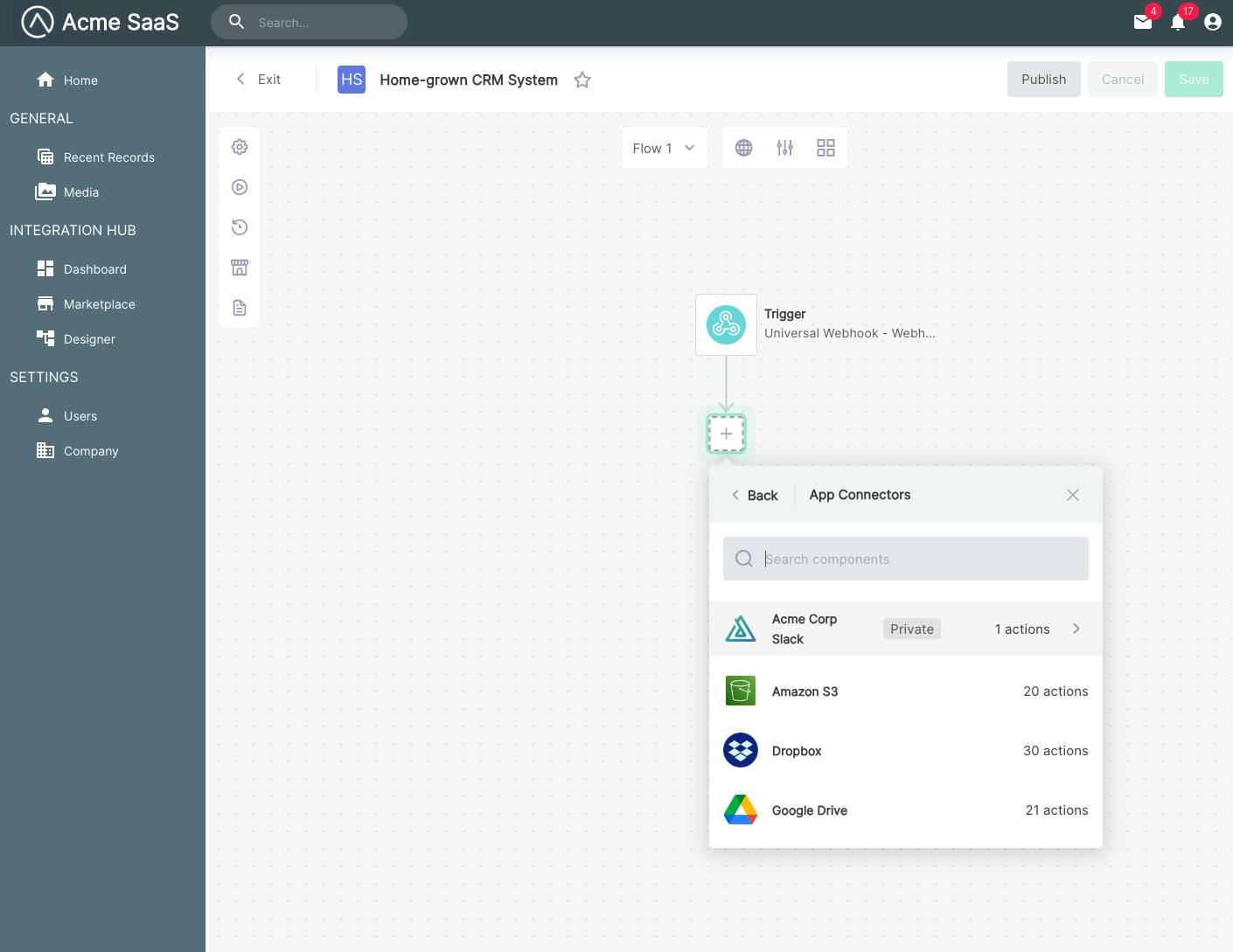
1. Flexible building options: Both low-code and code-native approaches, appealing to developers and non-developers alike.
2. End-to-end tooling: Comprehensive support for building, deploying, and managing integrations throughout their lifecycle.
3. Embedded integration marketplace: Allows SaaS companies to offer a seamless integration experience to their customers.
4. Cloud infrastructure: Purpose-built for scalability and performance.
5. Integration designer: Intuitive interface for creating and customizing integrations.
Prismatic's approach filled a gap left by existing solutions that were either low-code-only or code-only, providing a more versatile solution for SaaS teams dealing with complex integration needs.
Business Model
Prismatic is a subscription SaaS company that provides an embedded integration platform (iPaaS) for B2B software companies. Their core offering enables these companies to efficiently build, deploy, and manage integrations between their products and their customers' other software systems.
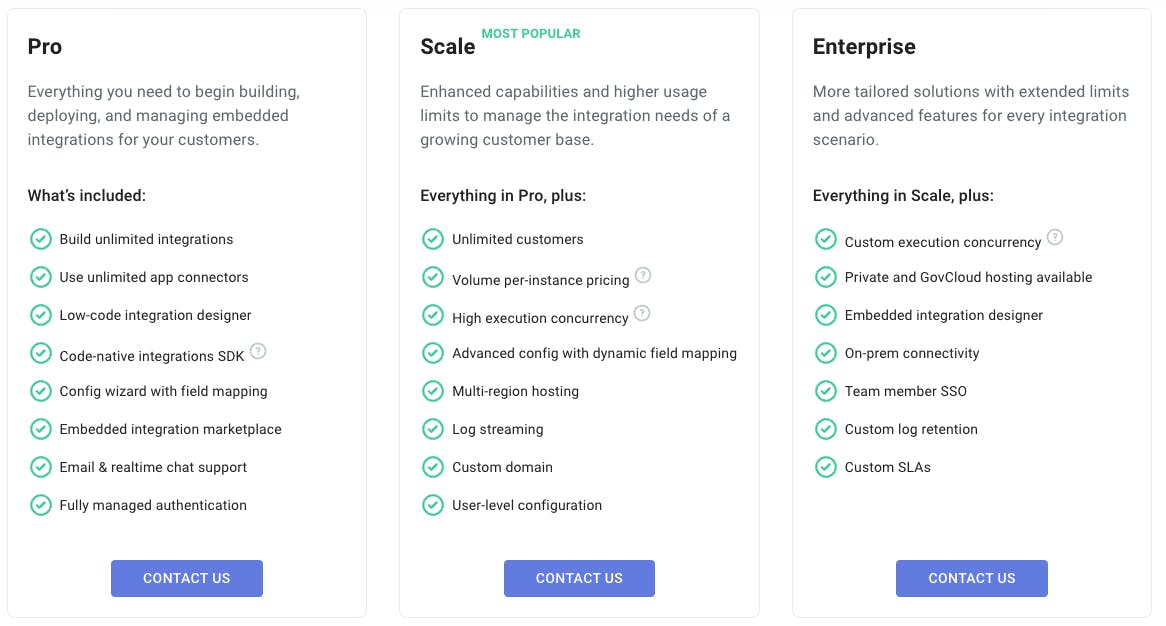
Prismatic's pricing model combines a subscription fee with usage-based pricing. The subscription provides access to the platform and its features, with different tiers based on functionality. The usage component is tied to "instances," which represent each deployment of an integration to a specific customer. This model allows clients to scale their usage and costs as they grow, reducing the initial barrier to entry.
The company's revenue is relatively balanced between subscription and usage fees, indicating a healthy mix of committed recurring revenue and growth potential tied to customer success. This structure incentivizes Prismatic to ensure their clients are deriving value from the platform, as increased usage directly correlates with increased revenue.
Prismatic's key competitive advantage lies in its focus on serving B2B SaaS companies specifically, rather than offering a general-purpose integration platform. This specialization allows them to provide tailored solutions that address the unique challenges faced by B2B software providers. Their platform offers both low-code and full-code integration building experiences, catering to a wide range of technical expertise within client organizations.
Competition
Prismatic competes in the embedded integration platform as a service (iPaaS) market, primarily serving B2B SaaS companies. The competitive landscape can be divided into two main categories: traditional iPaaS solutions and emerging embedded iPaaS providers.
iPaaS
Established players like MuleSoft, Dell Boomi, and Zapier dominate this space. These platforms focus on enabling businesses to integrate their internal systems and automate workflows.
While powerful, they are often not optimized for B2B SaaS companies looking to provide native integrations to their customers. Prismatic differentiates itself by offering a purpose-built solution for B2B SaaS, including features like white-labeling and customer-specific configurations that traditional iPaaS platforms typically lack.
Embedded iPaaS
This category includes newer entrants like Cyclr, Paragon, and Embedded.io. These companies, like Prismatic, focus on helping B2B SaaS providers offer integrations as part of their core product. Prismatic stands out in this group by providing both low-code and code-native integration building experiences.
This flexibility allows both developers and non-developers to contribute to integration projects, addressing a wider range of integration complexity than competitors who offer only low-code or full-code solutions.
Prismatic's approach to the market is unique in several ways. First, its focus on the full integration lifecycle - from building to deploying and managing integrations - provides a more comprehensive solution than many competitors.
Second, Prismatic's platform is designed to integrate seamlessly with existing development workflows, including support for version control and CI/CD pipelines. This feature is particularly attractive to engineering teams who want to maintain their established processes.
TAM Expansion
Prismatic has tailwinds from the growing demand for SaaS integrations and has the opportunity to expand into adjacent markets like AI-powered integration assistance and enterprise-wide integration platforms.
SaaS Integration Demand
The proliferation of SaaS applications across industries has created a significant need for efficient integration solutions.
As businesses increasingly rely on multiple specialized software tools, the complexity and importance of seamless data flow between these systems have grown exponentially. Prismatic is well-positioned to capitalize on this trend by providing a platform that simplifies the integration process for B2B SaaS companies.
As the SaaS market continues to expand, projected to reach $720 billion by 2028, the demand for integration solutions is likely to grow in tandem. This presents a substantial opportunity for Prismatic to scale its customer base and increase market share.
AI-Powered Integration Assistance
The rapid advancements in artificial intelligence present an exciting avenue for Prismatic to enhance its offering.
By incorporating AI capabilities into its platform, Prismatic could develop intelligent integration assistants that can predict integration patterns, offer real-time support during the integration building process, and even automate certain aspects of integration development.
This AI-driven approach could significantly reduce the time and expertise required to create complex integrations, making Prismatic's platform even more attractive to a broader range of SaaS companies.
Moreover, as AI continues to evolve, Prismatic could position itself at the forefront of "smart" integration solutions, potentially opening up new revenue streams and solidifying its market position.
Enterprise-Wide Integration Platforms
While Prismatic currently focuses on B2B SaaS companies, there's potential to expand its offering to serve larger enterprises with complex, multi-faceted integration needs.
By developing a more comprehensive, enterprise-grade solution, Prismatic could tap into the growing market for organization-wide integration platforms that connect not just customer-facing SaaS applications, but also internal systems, legacy software, and emerging technologies.
This expansion would allow Prismatic to compete in the broader iPaaS market, which is expected to reach $23.7 billion by 2028.
By leveraging its expertise in embedded integrations and expanding its capabilities to handle more diverse and complex integration scenarios, Prismatic could position itself as a one-stop solution for enterprises looking to streamline their entire software ecosystem.
Risks
1. Market Education Challenge: As an embedded iPaaS provider in an emerging category, Prismatic faces the ongoing challenge of educating the market about the value of their solution.
While this presents growth opportunities, it also means a potentially longer sales cycle and higher customer acquisition costs. The company must continually invest in content marketing and thought leadership to drive adoption, which could impact short-term profitability.
2. Developer Resistance: Prismatic's value proposition relies on convincing B2B SaaS companies to outsource a core technical function (integrations) that many developers might prefer to build in-house.
There's a risk that technical teams could resist adopting an external platform, viewing it as a threat to their expertise or control. To mitigate this, Prismatic needs to demonstrate clear efficiency gains and offer flexible, code-native options that don't constrain developers.
3. Platform Lock-in Concerns: As B2B SaaS companies build more integrations on Prismatic, they may become increasingly dependent on the platform. This could lead to concerns about vendor lock-in, potentially slowing adoption or increasing churn as companies seek to maintain control over their integration strategy.
Prismatic may need to offer robust data portability and migration options to address these concerns and build trust with potential enterprise customers.
DISCLAIMERS
This report is for information purposes only and is not to be used or considered as an offer or the solicitation of an offer to sell or to buy or subscribe for securities or other financial instruments. Nothing in this report constitutes investment, legal, accounting or tax advice or a representation that any investment or strategy is suitable or appropriate to your individual circumstances or otherwise constitutes a personal trade recommendation to you.
This research report has been prepared solely by Sacra and should not be considered a product of any person or entity that makes such report available, if any.
Information and opinions presented in the sections of the report were obtained or derived from sources Sacra believes are reliable, but Sacra makes no representation as to their accuracy or completeness. Past performance should not be taken as an indication or guarantee of future performance, and no representation or warranty, express or implied, is made regarding future performance. Information, opinions and estimates contained in this report reflect a determination at its original date of publication by Sacra and are subject to change without notice.
Sacra accepts no liability for loss arising from the use of the material presented in this report, except that this exclusion of liability does not apply to the extent that liability arises under specific statutes or regulations applicable to Sacra. Sacra may have issued, and may in the future issue, other reports that are inconsistent with, and reach different conclusions from, the information presented in this report. Those reports reflect different assumptions, views and analytical methods of the analysts who prepared them and Sacra is under no obligation to ensure that such other reports are brought to the attention of any recipient of this report.
All rights reserved. All material presented in this report, unless specifically indicated otherwise is under copyright to Sacra. Sacra reserves any and all intellectual property rights in the report. All trademarks, service marks and logos used in this report are trademarks or service marks or registered trademarks or service marks of Sacra. Any modification, copying, displaying, distributing, transmitting, publishing, licensing, creating derivative works from, or selling any report is strictly prohibited. None of the material, nor its content, nor any copy of it, may be altered in any way, transmitted to, copied or distributed to any other party, without the prior express written permission of Sacra. Any unauthorized duplication, redistribution or disclosure of this report will result in prosecution.