Why Sora failed
 Jan-Erik Asplund
TL;DR: Retreating from AI video, OpenAI is shutting down Sora and reallocating GPUs towards coding & enterprise to compete with Anthropic’s Claude Code. AI video is being left to cash-generating giants ByteDance (Seeddance) & Google (Veo) for consumer and workflow tools like Higgsfield, Runway & Synthesia for creators, filmmakers, and B2B. Sacra estimates OpenAI hit $25B in annualized revenue in February 2026, up 100% year-over-year. For more, check out our full report & dataset.
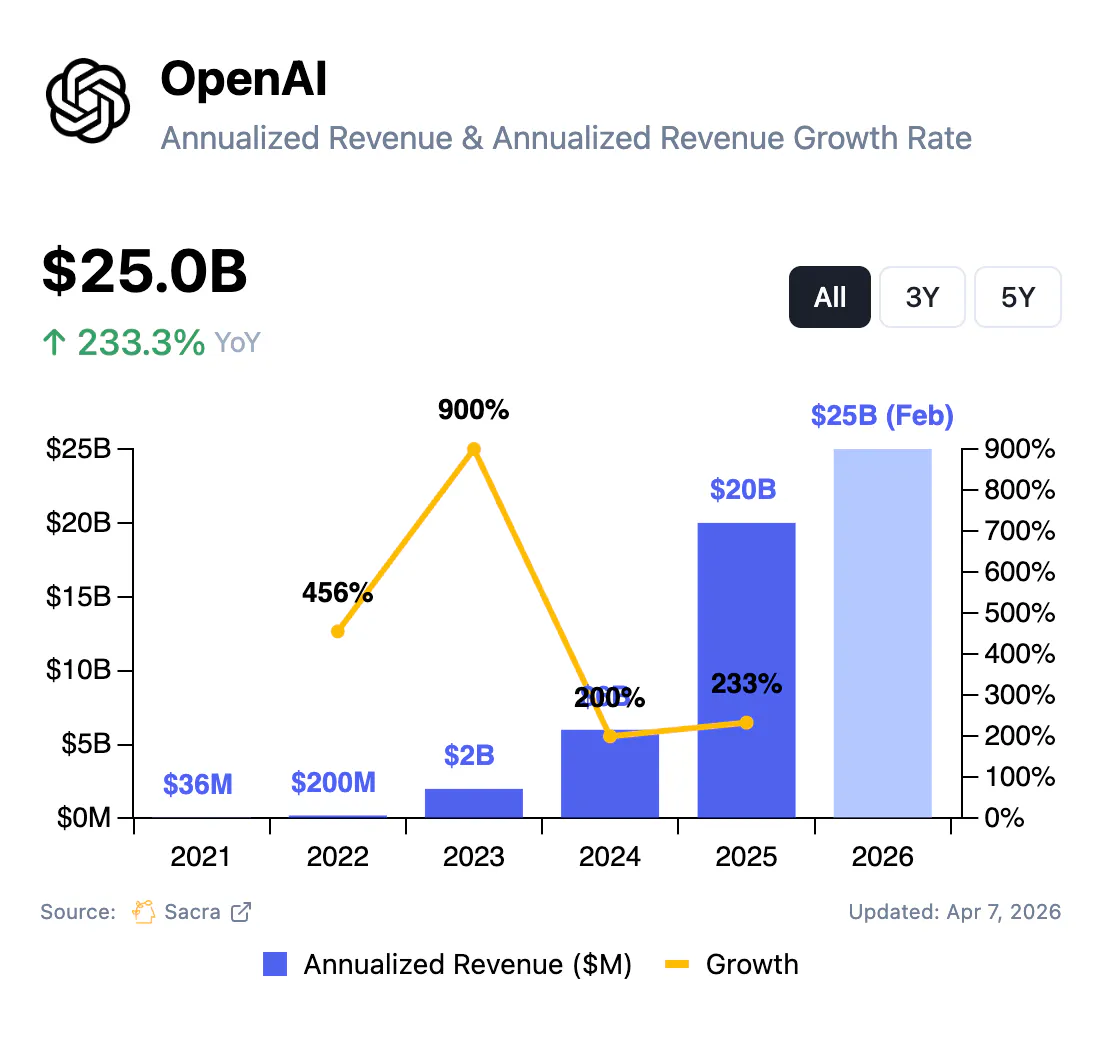
We've covered OpenAI (October 2023, December 2023, October 2024) through its consumer expansion, board crisis, and competitive battle with Anthropic's surging API business, and followed up on the coding wars as OpenAI bid $3B for Windsurf (March 2025) and Claude Code emerged as Anthropic's ChatGPT (July 2025).
Key points from our April 2026 update via Sacra AI:
- Even before OpenAI announced the shutdown of Sora 2 (March 2026), Seeddance (Bytedance), Veo (Google) & Kling (Kuaishou) had taken the lead on video foundation models, each owning a large video property—TikTok, YouTube and Kwai / Snack Video, respectively—with 1,000 terabytes/day of new videos serving as training data both in terms of raw video data volume and engagement metadata, doing in-house what OpenAI was forced to do via deals with Shutterstock and Disney ($1B investment).
- Meanwhile, network effect social platforms Instagram (Meta) with 3B monthly active users (MAUs) and TikTok with 2B (ByteDance) dominated where consumers actually watched AI videos and where they went viral, versus the Sora app (~5M MAUs) which peaked at #1 in the App Store (October 2025) before falling out of the top 100 by January 2026, with monthly downloads dropping from ~3.3M in November to ~1M in February.
- Burning $15M/day on video generation alone ($5.4B annualized) at ~$1.30 and ~40 min of GPU time per every 10-second clip and, with video requiring ~100x the compute of text and $225B+ in projected inference costs through 2030, OpenAI is increasingly redirecting GPUs toward Codex & the strategic battleground of AI coding and the enterprise where they compete with Anthropic, leaving foundation model development in video to long-duration, profitable & cash-generating players Google & ByteDance.
- With its halting of “adult mode” in ChatGPT (March 2026), OpenAI has shuttered its primary vector to driving adoption & monetizing NSFW AI video, an opportunity it has ceded to “free speech” AI model Grok, which launched video generation with Grok Imagine with minimal guardrails, allowing users to chat with NSFW AI anime companions and generate custom video porn.
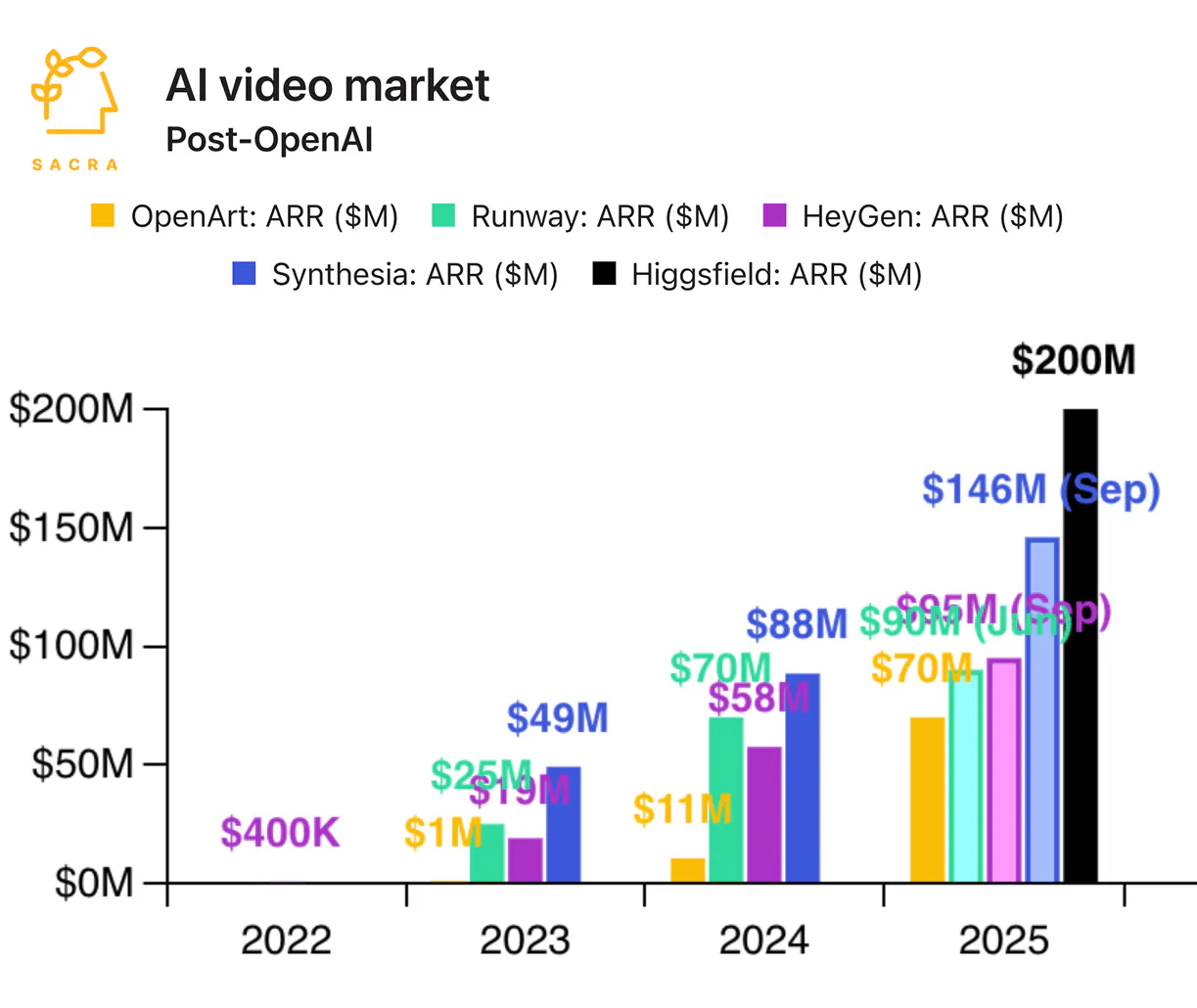
- Although a video model, a social media app & a feature in ChatGPT, Sora lacked a native editing app & experience, relying purely on one-shot text-to-video, missing the workflow orchestration layer that has proved particularly value accretive in making AI video usable for end customers via CapCut (owned by ByteDance), Higgsfield ($300M ARR, up from $200M in 2025) & OpenArt ($70M ARR, up 567% YoY) for creators, Runway ($90M ARR, up 180% YoY) for filmmakers, and Synthesia ($146M ARR, up 80% YoY) & HeyGen ($95M ARR, up 203% YoY) for B2B.