

Revenue
$500.00M
2026
Valuation
$4.50B
2026
Funding
$584.00M
2026
Growth Rate (y/y)
44.3%
2025
Revenue
Sacra estimates that Gong hit $500M ARR in May 2026, up from $298M in 2024.
Gong re-accelerated revenue growth in 2024 after a slowdown in 2022 and 2023 related to sales teams downsizing across the industry, which led to significant headwinds for their per-seat pricing model and declines in net dollar retention.
Valuation & Funding
Gong was valued at $4.5B during a secondary sale conducted through Nasdaq Private Market in November 2025. This was down from $7.25B at its Series E in 2021, following earlier valuations of $2.2B in 2020 and $750M in 2019.
Since its 2015 founding, Gong has raised approximately $584M in total funding, with notable investors including Franklin Templeton, Coatue, Sequoia Capital, Thrive Capital, and Salesforce Ventures. The secondary transaction provided liquidity to employees and existing investors rather than new primary capital for the company.
Product
Gong launched in 2015 as pair programming for sales teams, giving reps instant video replays of their sales calls for peer coaching.
With the dramatic rise in sales video calls post-COVID, Gong expanded from a 1:1 coaching tool to a 1:many data store and system of record for sales activity in a company.
Today, Gong is the place where every customer call at a company gets stored for rewatching. Companies add a Gong extension to their Outlook or Google Calendar settings, and Gong automatically finds upcoming sales calls and demos to record. Then, when a rep gets on one of those Gong-tagged calls, a silent Gong bot joins the meeting to record audio, video, and any chat or screenshares.
After the call, Gong transcribes the calls and stores them in S3—from there, companies can look back at old sales calls for insights, check out Gong's collected analytics and insights pulled from their calls, and review aggregate-level data on sales rep and pipeline performance.
More recently, Gong has reoriented around AI to push beyond its roots as a call recording tool. Its Mission Andromeda initiative centers on an AI sales coaching chatbot and open MCP (Model Context Protocol) integrations, repositioning Gong as an AI-native revenue platform (launched February 2026).
Business Model
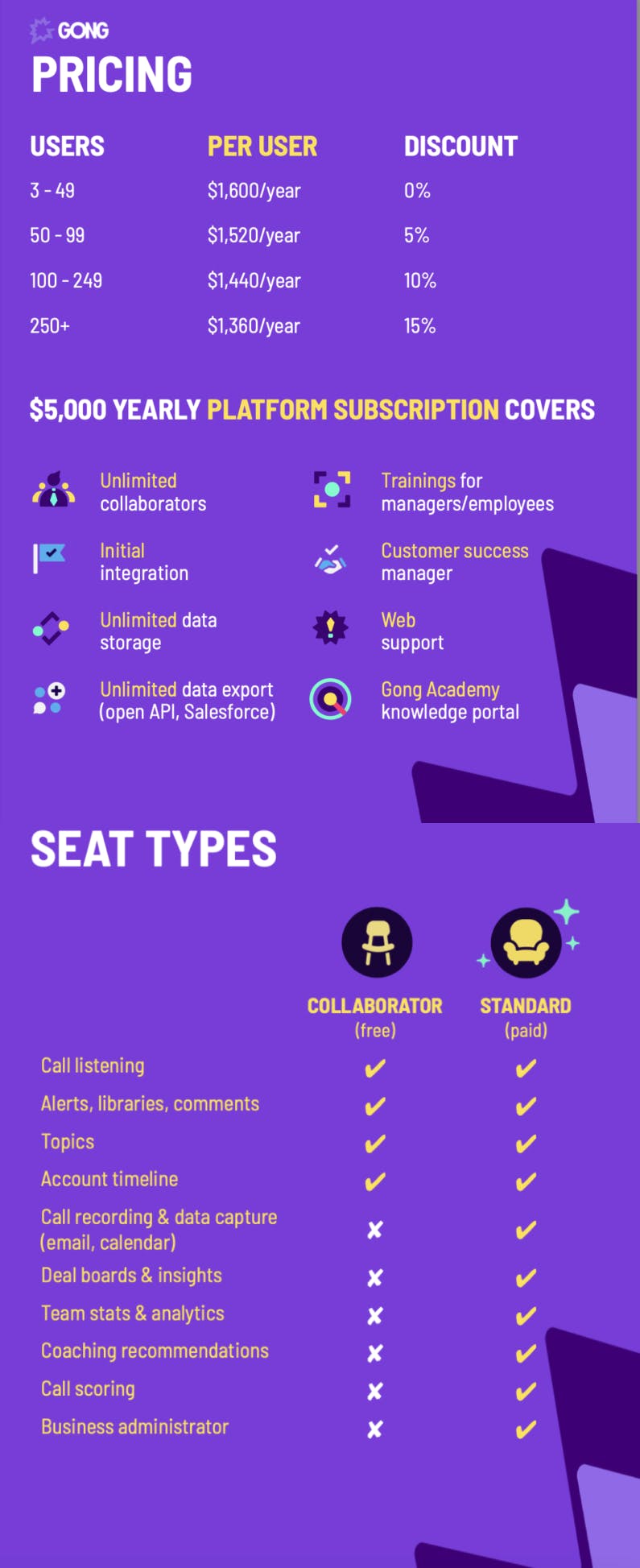
Gong is a subscription SaaS platform company that prices based on the number of seats that a company needs. Pricing ranges from roughly $1,600 per user per year for small teams (3-49 users) to $1,360 per user per year for over 250 users, with discounts from 5% to 15% applied as the number of users increases.
A yearly platform subscription of $5,000 gets companies unlimited Collaborator seats, unlimited storage, trainings, a customer success manager, and unlimited data exports.
Gong’s core offering includes two seat types: Collaborator (free) and Standard (paid). The Collaborator seat provides basic functionalities such as call listening and access to alerts, libraries, and comments, while the Standard seat includes features like deal boards, team statistics, coaching recommendations, and call scoring.
Competition
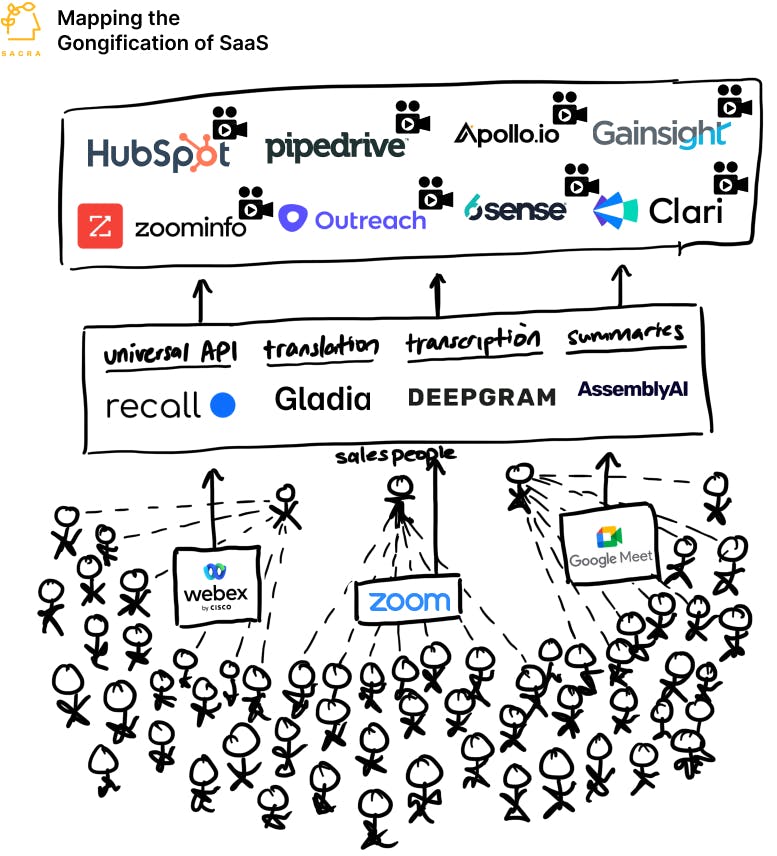
Gongification
Gong's core video recording and analytics feature has become a part of every sales product, from HubSpot (CRM) to Pipedrive (CRM), Apollo (go-to-market), Zoominfo (go-to-market), Clari (forecasting), Outreach (sales automation), 6sense (account-based marketing), and Gainsight (customer success).
Sales platforms monetize call recordings by using it as a usage-based value metric, driving upgrades to higher pricing tiers in their core per-seat subscription SaaS business model.
As this "Gongification" has spread across SaaS, developer middleware has emerged to enable products to easily ingest video and make it useful, from Recall.ai (universal API for meeting bots) to Deepgram (API for transcription), Gladia (API for translation), AssemblyAI (API for text summarization) and Pinecone (vector embeddings for search).
These APIs allow teams to integrate video calls, leveraging existing widespread usage of meeting bots from Zoom, Google Meet and WebEx, rather than building native video experiences as with tools like Mux or Daily.co.
A big trend we're seeing today is that companies are applying the Gong playbook in areas of SaaS that have nothing to do with sales.
Companies are building products that ingest and automatically pull insights out of videos for everything from hiring (Metaview, $7.6M in funding), project management (Spinach.io, $5.2M in funding), and team productivity (Fellow, $30.5M in funding).
What this evolution hinges on is the fact that video data—from the 5+ trillion minutes of video calls per year and counting—is a massive net new source of high-bandwidth insights.
That data is increasingly feeding into every B2B SaaS tool because of how it can power AI-based analytics, discovery and engagement features.
Zoom
Zoom (NASDAQ: ZM) launched Zoom for Sales & Revenue to go after companies like Gong and HubSpot and video-adjacent enterprise workflows around sales, success, and productivity.
But while Zoom dominated the COVID era by being the only company to offer reliable cross-platform video chat at <150ms latency, video chat has been commoditized since then, and Zoom has struggled to transition into a product company and build this productivity suite around their ownership of live video.
Zoom grew 326% year-over-year in 2021 and had 300 million users logging in every day for meetings—as of 2023, growth has nearly flatlined at 4% year-over-year as they compete with vertical SaaS and Microsoft Office (NASDAQ: MSFT) to own with their all-in-one platform product.
DISCLAIMERS
This report is for information purposes only and is not to be used or considered as an offer or the solicitation of an offer to sell or to buy or subscribe for securities or other financial instruments. Nothing in this report constitutes investment, legal, accounting or tax advice or a representation that any investment or strategy is suitable or appropriate to your individual circumstances or otherwise constitutes a personal trade recommendation to you.
This research report has been prepared solely by Sacra and should not be considered a product of any person or entity that makes such report available, if any.
Information and opinions presented in the sections of the report were obtained or derived from sources Sacra believes are reliable, but Sacra makes no representation as to their accuracy or completeness. Past performance should not be taken as an indication or guarantee of future performance, and no representation or warranty, express or implied, is made regarding future performance. Information, opinions and estimates contained in this report reflect a determination at its original date of publication by Sacra and are subject to change without notice.
Sacra accepts no liability for loss arising from the use of the material presented in this report, except that this exclusion of liability does not apply to the extent that liability arises under specific statutes or regulations applicable to Sacra. Sacra may have issued, and may in the future issue, other reports that are inconsistent with, and reach different conclusions from, the information presented in this report. Those reports reflect different assumptions, views and analytical methods of the analysts who prepared them and Sacra is under no obligation to ensure that such other reports are brought to the attention of any recipient of this report.
All rights reserved. All material presented in this report, unless specifically indicated otherwise is under copyright to Sacra. Sacra reserves any and all intellectual property rights in the report. All trademarks, service marks and logos used in this report are trademarks or service marks or registered trademarks or service marks of Sacra. Any modification, copying, displaying, distributing, transmitting, publishing, licensing, creating derivative works from, or selling any report is strictly prohibited. None of the material, nor its content, nor any copy of it, may be altered in any way, transmitted to, copied or distributed to any other party, without the prior express written permission of Sacra. Any unauthorized duplication, redistribution or disclosure of this report will result in prosecution.