Deepgram vs. ElevenLabs
 Jan-Erik Asplund
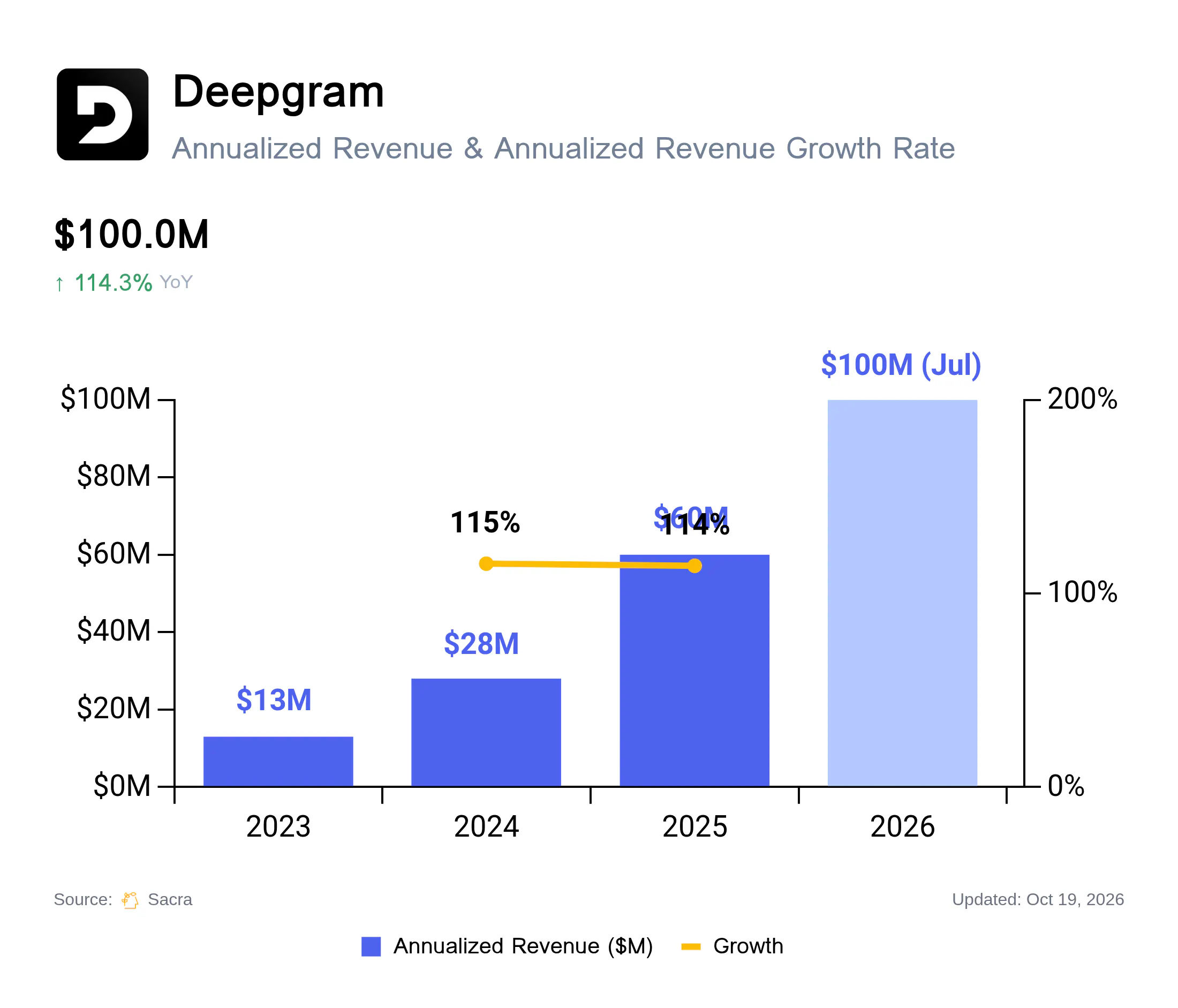
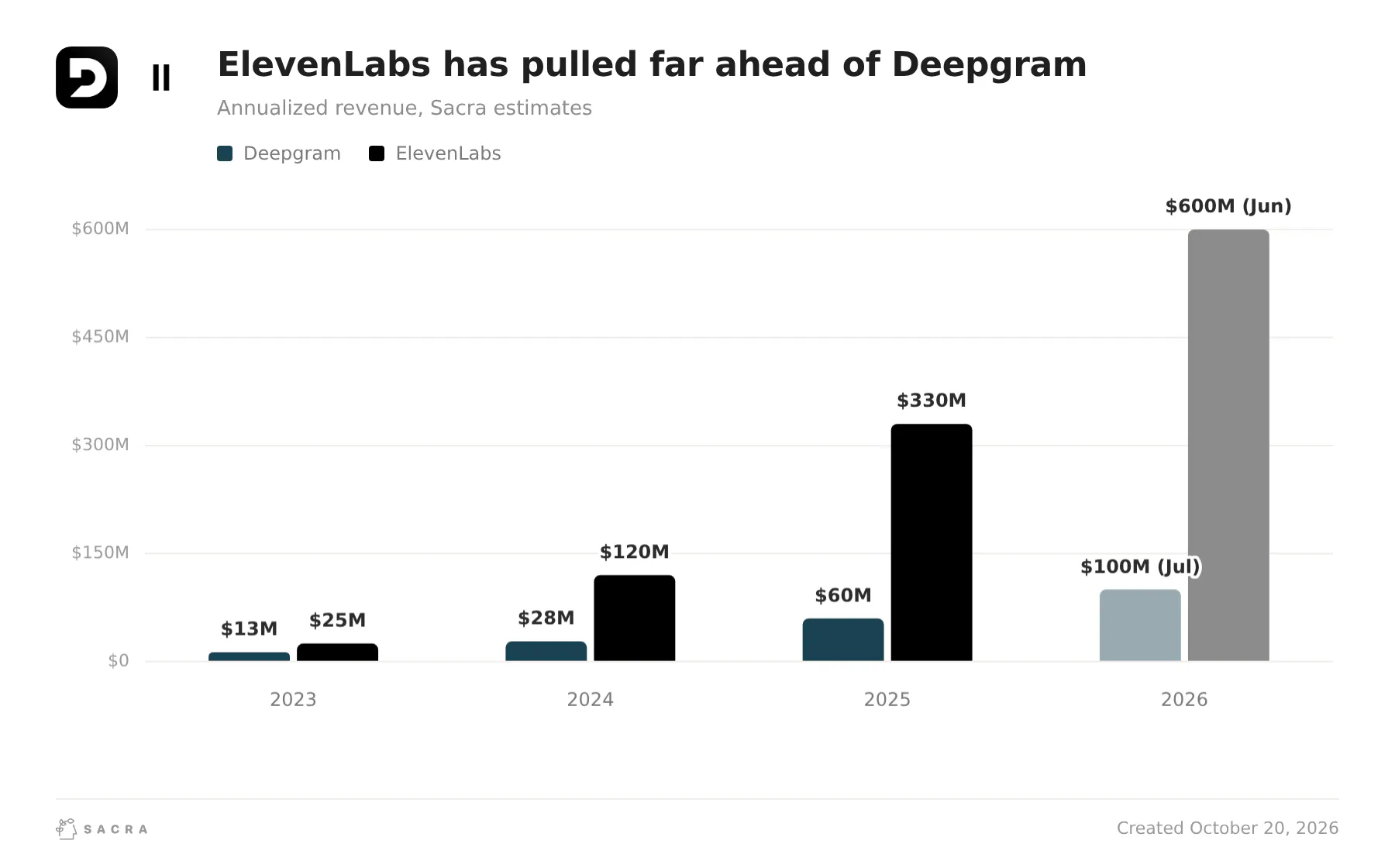
TL;DR: Deepgram spent a decade building speech-to-text infrastructure before becoming a core voice layer underneath AI agents from Retell, Vapi, Sierra & Decagon. Now at a Sacra-estimated $100M annualized revenue in August 2026, Deepgram is expanding into synthetic voices, full AI agents & restaurant ordering applications, competing both with the platforms built on its models and with ElevenLabs ($600M annualized revenue), which has grown from AI voice generation into a full-stack voice AI platform. For more, check out our full report and dataset on Deepgram.
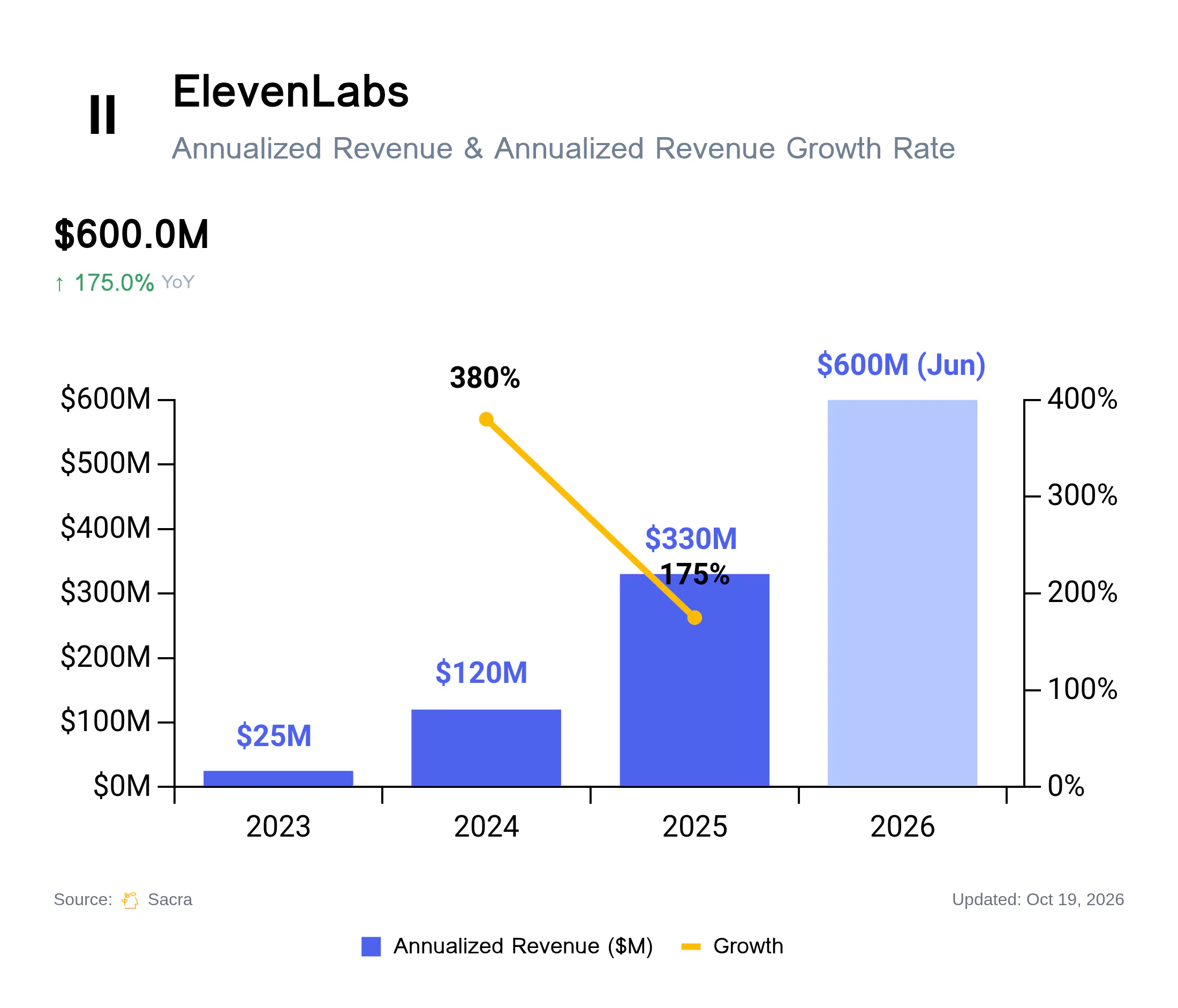
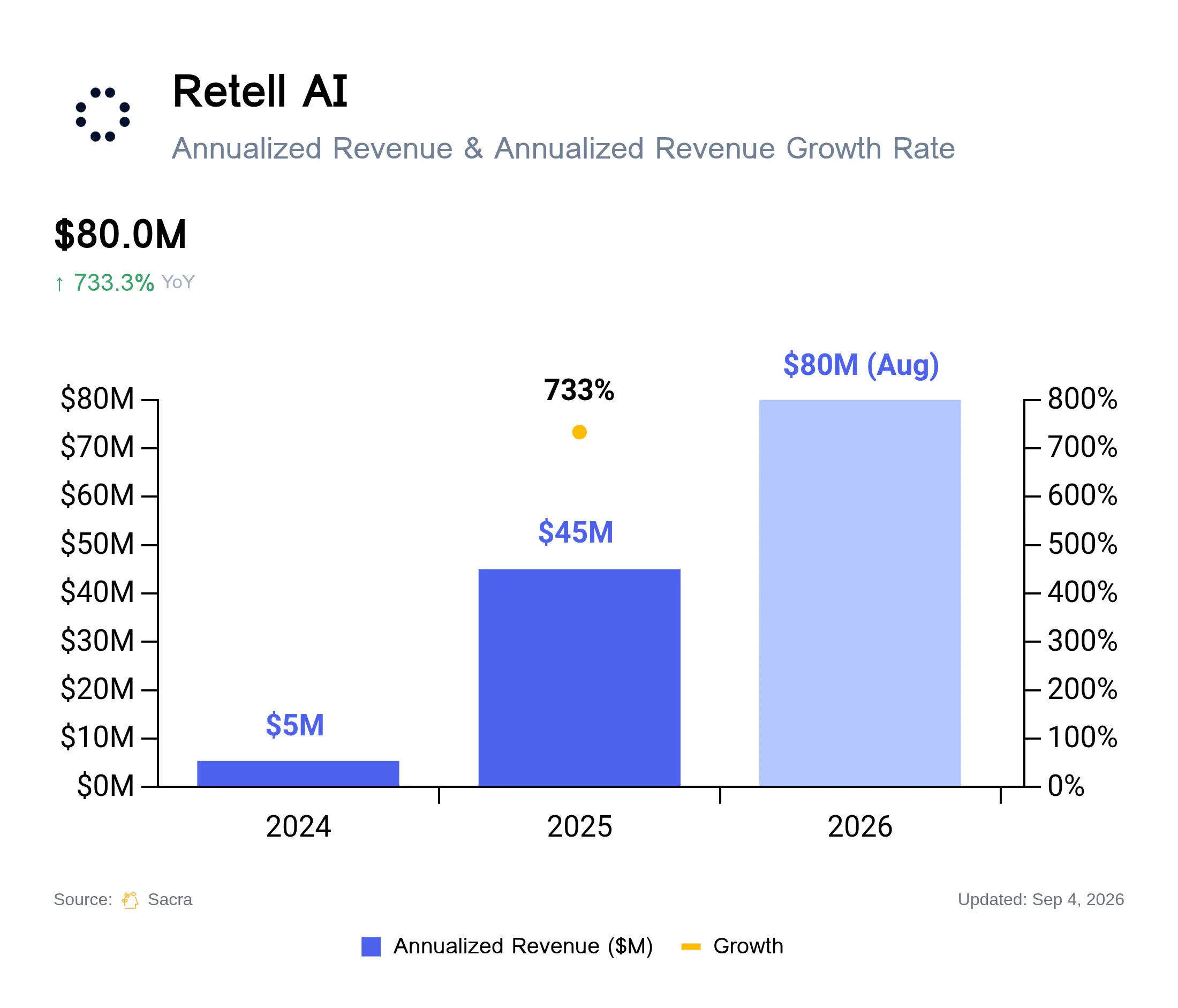
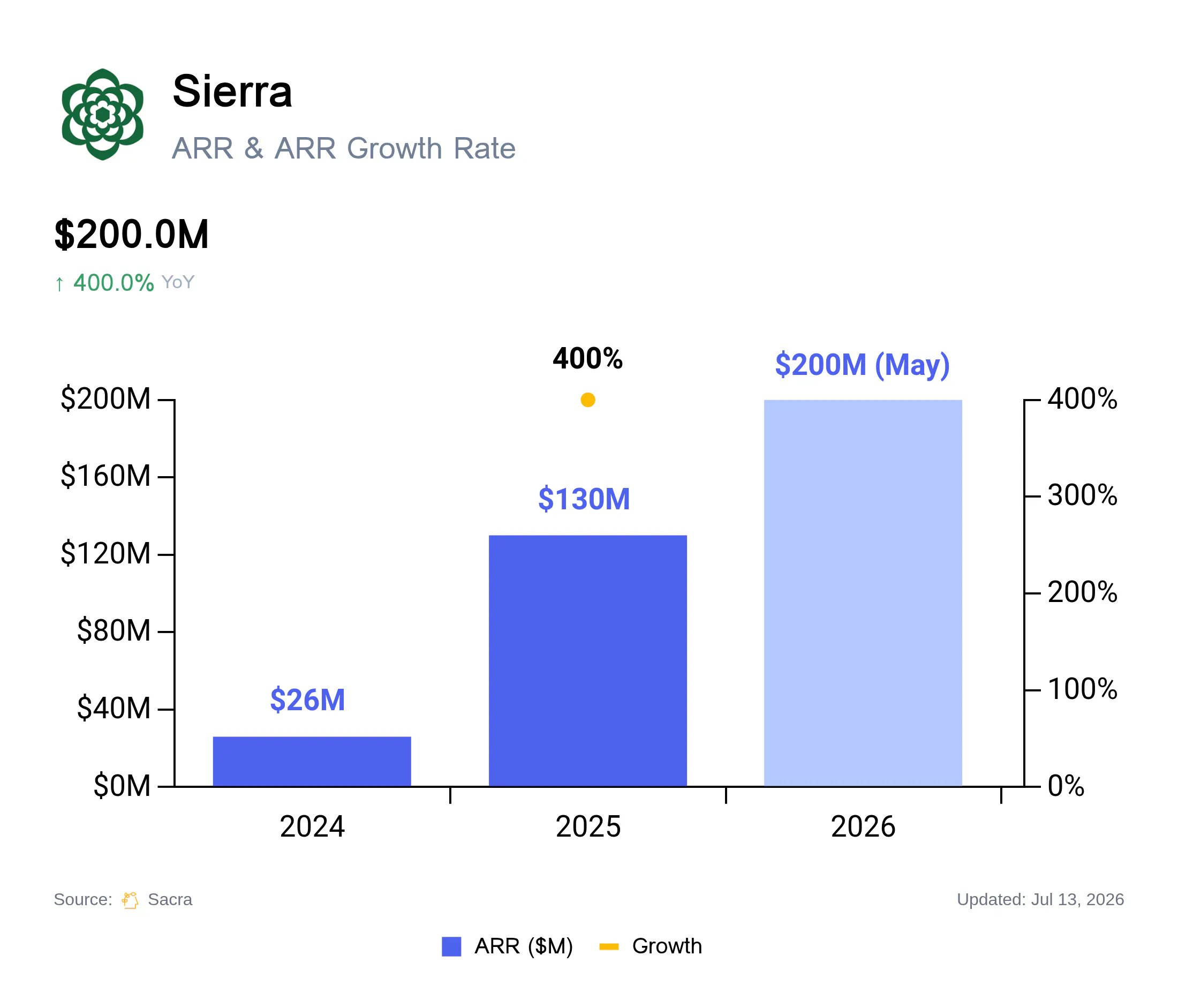
Voice AI has become a top AI application in industries like customer service, healthcare and restaurants driving growth throughout the stack at the application level with companies like Sierra ($200M ARR, +400% YoY in 2025) & Decagon ($100M annualized revenue, +340% YoY in 2025) and at the infrastructure layer with companies like ElevenLabs ($600M annualized revenue, +175% YoY in 2025) and Retell AI ($60M annualized revenue, +733% YoY in 2025).
We decided to research Deepgram, an OG, pre-LLM speech-to-text provider on its milestone of hitting $100M in annualized revenue.
Key points via Sacra AI:
- Where human-based transcription services like Rev ($52M raised, Globespan) charged ~$1 per minute (now $1.99/min) to return transcripts hours or days later, Deepgram (founded 2015) built a speech-to-text API using end-to-end neural networks to automatically transcribe voice audio, trading some of the accuracy of human transcription for near-instant results that today cost ~400x less than Rev's human transcription. Deepgram’s wedge versus Google’s speech-to-text APIs was its focus on noisy business conversations rather than broad consumer voice recognition, monetizing through usage-based API pricing that charged around $0.0125/min ($0.75/hour) for its Base transcription model and $0.0145/min ($0.87/hour) for its higher-accuracy Enhanced model.
- Cheap, near-instant transcription enabled new interaction patterns & software categories—including searching meeting recordings via text (Granola), surfacing insights & coaching opportunities from customer calls (Cresta), and editing video by editing text (Wistia)—making speech recognition core infrastructure for B2B SaaS. Commoditization soon arrived as open source, transformer-based transcription models like OpenAI's Whisper (September 2022) offered 50% fewer transcription errors at rock-bottom costs ($0.006/min), resulting in net new competition (Gladia), adjacent voice companies offering speech-to-text (ElevenLabs) and enterprise customers fine-tuning and using their own in house models (Zoom).
- With the cost of speech-to-text falling by 97% since 2018, Deepgram is increasingly differentiating on the low latency required for AI voice agents rather than maximum transcription accuracy, with its fastest streaming model returning final transcripts in 20ms at 7.4% word error versus ElevenLabs Scribe v2 at 140ms & 3.6%. As AI voice agents emerged in 2023-2024, Deepgram became a speech recognition provider to AI voice agent platforms Retell AI ($60M annualized revenue, +733% YoY in 2025) & Vapi and AI customer service platforms Sierra ($200M ARR, +400% YoY in 2025) & Decagon ($100M annualized revenue, +340% YoY in 2025), with its Flux model (October 2025) adding conversational turn detection so agents can recognize when callers finish speaking without interrupting them.
- Moving up from speech infrastructure into competition with its own customers Vapi & Retell, Deepgram launched its Voice Agent API (October 2025), combining speech recognition, LLMs, synthetic voices & interruption handling into one $0.075/min service, then acquired drive-thru voice startup OfOne (YC W23) in January 2026 to launch Deepgram for Restaurants as its first vertical application. ElevenLabs’s (2022) initial offering around realistic synthetic voices & voice cloning for creators, audiobooks, dubbing & gaming has proven more durable & differentiated than speech-to-text, with its Eleven v4 model commanding a 20x premium over basic Google TTS ($80 vs. $4 per million characters) versus Deepgram's Nova-3 at 1.4x Google STT ($0.26 vs. $0.18 per audio hour), giving it momentum as it expands into speech recognition (Scribe) and a full agent platform (ElevenAgents), now handling 15M+ conversations weekly.
- Growing from $13M annualized revenue at the end of 2023 to $28M at the end of 2024, Deepgram accelerated with the rise of AI voice agents in 2025-2026, with Sacra estimating it reached $60M in annualized revenue at the end of 2025 (+114% YoY) and $100M in August 2026 (+67% YTD), with 85%+ gross margins in 2024 & positive cash flow in 2025, last valued at $1.3B as of its January 2026 $130M Series C (AVP) for a ~20x multiple on estimated January revenue of $64M. Compare to ElevenLabs reaching $600M annualized revenue in June 2026, up from $330M at the end of 2025 (+175% YoY in 2025), valued at $22B as of its September 2026 employee tender (Wellington, T. Rowe Price) for a 27.5x multiple.
For more, check out this other research from our platform: