

Revenue
$52.00M
2025
Valuation
$200.00M
2023
Funding
$1.80M
2016
Growth Rate (y/y)
20.4%
2025
Revenue
Sacra estimates that Kit (formerly ConvertKit) reached $52M annual recurring revenue (ARR) in 2025, up 20% year-over-year from $42M in 2024, not including transactional revenue from its ad network business.
Valuation & Funding
ConvertKit completed a secondary transaction through AngelList with 48 individual angel investors in 2021 that valued the company at $200M. With $29M in revenue for 2021, this implies a 6.9x revenue multiple.
Product
Nathan Barry founded in 2013 as a way for online creators like him to better communicate with their audiences and sell goods like books and courses through email.
Key features of ConvertKit include:
CMS: ConvertKit offers a content management system (CMS) that allows users to write their newsletters directly within the platform as well as host their published emails on the web for easier distribution.
Landing pages & forms: ConvertKit offers customizable landing pages & forms that creators can use to host and sell products to their audience, along with templates for common use cases like waiting lists or 'coming soon' pages.
Visual automations: With visual automations, creators can set up trigger-and-action based flows for their subscribers based on their actions and behaviors, helping automate their email marketing based on events like a new subscriber joining their list, making a purchase, or completing a course.
Business Model
ConvertKit has positioned itself as a powerful email marketing tool for creators, challenging traditional platforms like MailChimp and Constant Contact. Its primary aim is to provide an easy-to-use platform that combines functionality with simplicity, specifically catering to bloggers and e-commerce marketers.
ConvertKit operates on a freemium business model, offering a free tier along with two paid tiers: Creator ($29 per month) and Creator Pro ($59 per month). This pricing structure allows ConvertKit to reach a broad range of customers, from hobbyist bloggers to professional e-commerce marketers.
ConvertKit's primary revenue stream comes from its subscription fees, which grow. based on the number of subscribers on a customer's list. This aligns the company's interests with its users: the more successful a user is at growing their email list and engaging with their audience, the more likely they are to continue using ConvertKit's services and move to a higher pricing tier.
The company has gradually expanded its market through strategic acquisitions. In 2021, ConvertKit acquired FanBridge, a service aimed at helping musicians with marketing services. More recently, it purchased Sparkloop, an email referral tool used to grow email marketing programs. These acquisitions have allowed ConvertKit to expand its suite of services and tap into new markets, such as musicians and newsletter creators.
While ConvertKit's focus has been primarily on email marketing, the company's long-term vision seems to be the development of a comprehensive suite of tools to help creators thrive. By adding more features and services that cater to creators' needs, ConvertKit aims to become a one-stop shop for online creators, helping them grow their audience, engage their subscribers, and ultimately, build successful online businesses.
Competition
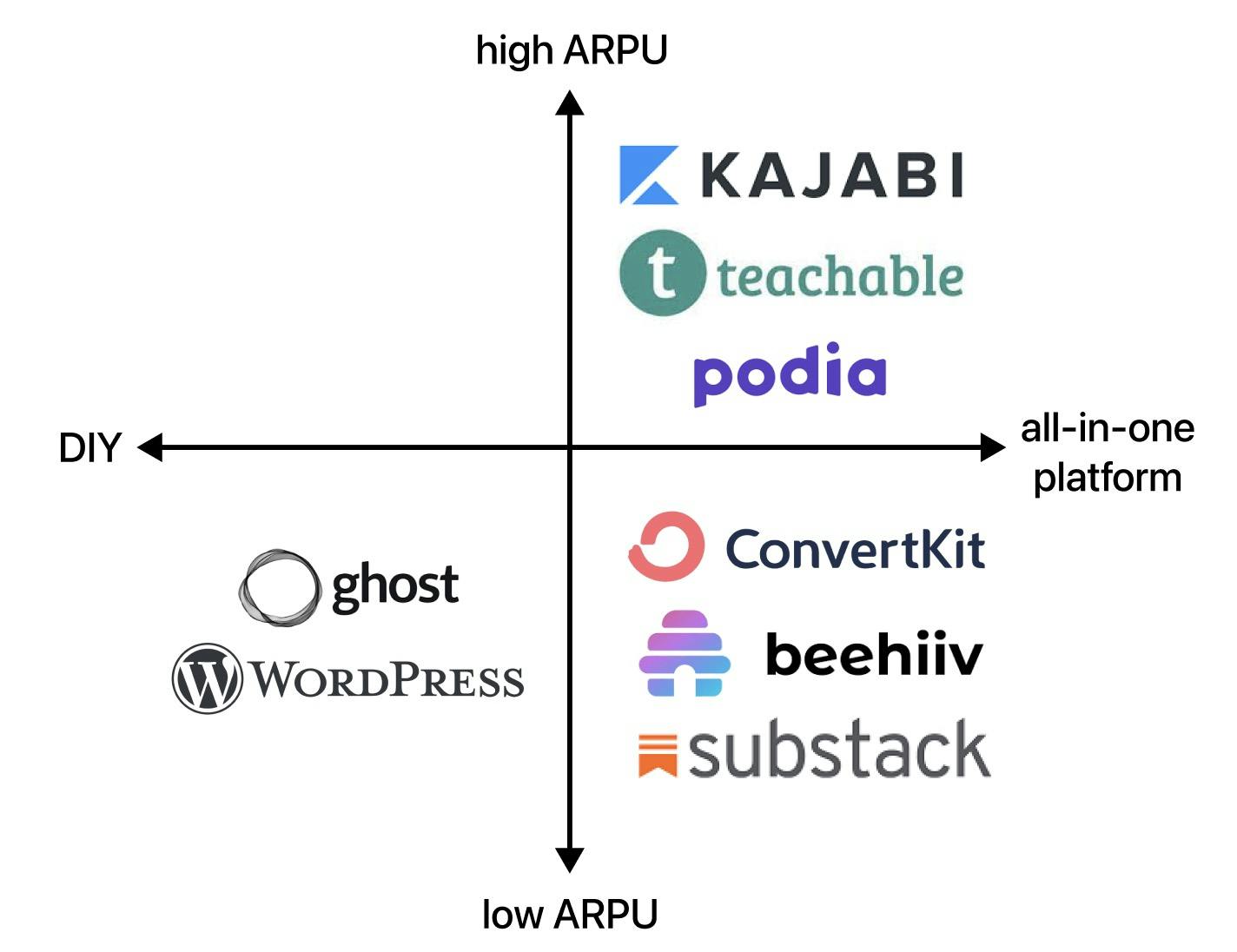
Products like Ghost and Wordpress allow writers to spin up personal sites and email newsletters with means of charging readers for premium access.
Beehiiv offers a similar basic toolset for creating emails, distributing them, building an email list, and monetizing it. Beehiiv similarly charge on a monthly SaaS basis rather than taking a cut of each transaction like Substack.
Companies like Kajabi, Teachable and Podia are in a different category of platforms that allow creators to build courses, communicate with their community, and create and distribute content. Like the other platforms mentioned above, they charge on a monthly SaaS basis instead of taking a cut of all the money that is paid to a creator, and so can offer better economics than a Substack.
Risks
Risks to ConvertKit's business model include:
Creator burnout: On Substack, the typical newsletter churns paid subscriptions at about 50% per year. While the last few years have been big for email newsletters, it's possible that consumers will hit email fatigue and there will be a significant pullback in how much people are willing to sign up for and read email newsletters in the future.
Migration: It's critical for email marketing platforms like ConvertKit to make it easy for consumers to export and own their audience if they want to be able to attract users to their platform. Of course, that opens up the risk that those users will eventually leave—tempted to another platform with more vertical-specific features or lower prices.
DISCLAIMERS
This report is for information purposes only and is not to be used or considered as an offer or the solicitation of an offer to sell or to buy or subscribe for securities or other financial instruments. Nothing in this report constitutes investment, legal, accounting or tax advice or a representation that any investment or strategy is suitable or appropriate to your individual circumstances or otherwise constitutes a personal trade recommendation to you.
This research report has been prepared solely by Sacra and should not be considered a product of any person or entity that makes such report available, if any.
Information and opinions presented in the sections of the report were obtained or derived from sources Sacra believes are reliable, but Sacra makes no representation as to their accuracy or completeness. Past performance should not be taken as an indication or guarantee of future performance, and no representation or warranty, express or implied, is made regarding future performance. Information, opinions and estimates contained in this report reflect a determination at its original date of publication by Sacra and are subject to change without notice.
Sacra accepts no liability for loss arising from the use of the material presented in this report, except that this exclusion of liability does not apply to the extent that liability arises under specific statutes or regulations applicable to Sacra. Sacra may have issued, and may in the future issue, other reports that are inconsistent with, and reach different conclusions from, the information presented in this report. Those reports reflect different assumptions, views and analytical methods of the analysts who prepared them and Sacra is under no obligation to ensure that such other reports are brought to the attention of any recipient of this report.
All rights reserved. All material presented in this report, unless specifically indicated otherwise is under copyright to Sacra. Sacra reserves any and all intellectual property rights in the report. All trademarks, service marks and logos used in this report are trademarks or service marks or registered trademarks or service marks of Sacra. Any modification, copying, displaying, distributing, transmitting, publishing, licensing, creating derivative works from, or selling any report is strictly prohibited. None of the material, nor its content, nor any copy of it, may be altered in any way, transmitted to, copied or distributed to any other party, without the prior express written permission of Sacra. Any unauthorized duplication, redistribution or disclosure of this report will result in prosecution.