
$315M/year Soylent for the UK
 Jan-Erik Asplund
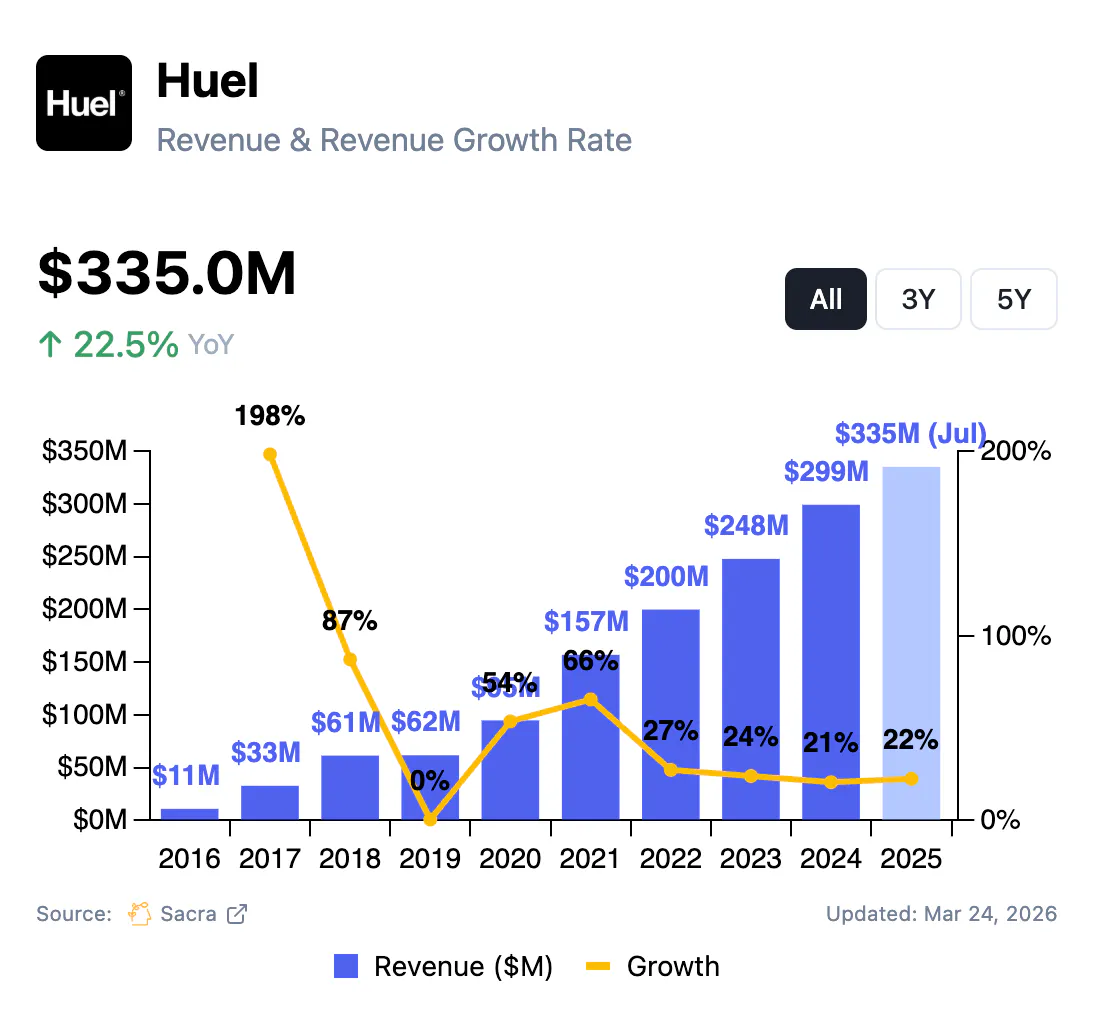
TL;DR: Where Soylent (2013) framed meal replacement as a Silicon Valley efficiency hack for engineers who saw eating as a waste of time, Huel (2015) built a mainstream brand as the "nutritionally complete food" for time-poor professionals in the UK, seizing category leadership before being acquired by Danone for $1.15B this week. Sacra estimates Huel generated $335M in revenue in the trailing twelve months ending July 2025, up 22% YoY. For more, check out our full report and dataset on Huel.
Key points from our research via Sacra AI:
- Where Ensure (Abbott, 1973) and Boost (Nestlé, 1988) were designed as supplementary shakes for the elderly, Huel (2015), launched by affiliate marketer Julian Hearn, built the first mainstream consumer brand in the space by with an oat-flour-and-pea-protein “nutritionally complete food” positioned not as a supplement or weight-loss shake but as a full food replacement for busy, health-conscious professionals in the UK. Soylent (2013), created the modern meal replacement category by framing its milkshake-esque drink as a Silicon Valley efficiency hack, inspiring followers Jimmy Joy (2015 in the Netherlands) and YFood (2017, in Germany), with Huel positioned for a national palate in the UK (51% of revenue as of 2024) already adapted to brown porridge & mushy peas, where desk lunches, Pret grab-and-go, and microwaved ready meals are culturally normalized.
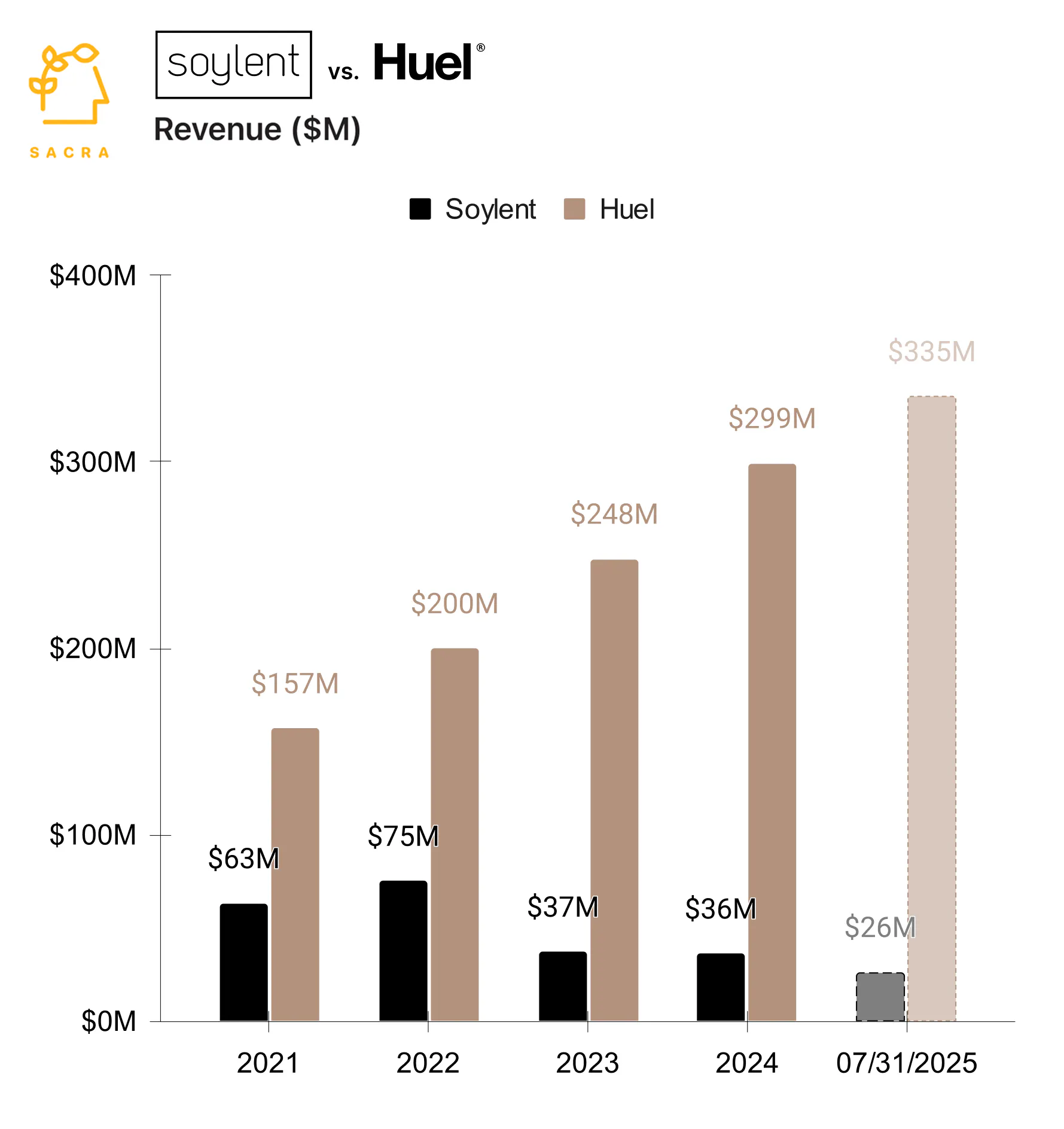
- Expanding from DTC-only into 25,000+ retail locations globally—including Target and GNC, with supermarket sales now making up 33% of its $140M in UK revenue—Sacra estimates Huel generated $335M in revenue in the trailing twelve months ending July 2025, up 22% YoY, with 60% gross & 10% EBITDA margin. Despite launching two years later, Huel now dwarfs Soylent (along with Yfood at $50M/yr acquired in 2023 by Nestlé at €430M and Jimmy Joy at $10M/yr), which peaked at ~$75M in revenue in 2022 before its acquisition by Starco Brands in 2023, and has since declined to ~$26M/year in revenue as its parent company exits lower-margin retail & pulls Soylent out of physical retailers like Walmart.
- French multinational food corporation Danone’s ($30.9B revenue, up 4.5% YoY, $53B market cap) $1.15B purchase of Huel (~3.7x revenue multiple) this week gives it a high-protein, nutrient-dense, muscle-preserving food brand for the 11% of the US & UK taking GLP-1s and spending 33% less on groceries to consume 20% fewer calories, along with a strong DTC brand & customer acquisition engine that brought in 4M+ people largely via paid ads and referrals. Consider Frito-Lay parent company PepsiCo ($94B revenue, up 2% YoY, $206B market cap) down 11% in the last month & General Mills ($19B revenue, down 2% YoY, $20B market cap) with a 8.4% decline in sales across brands like Betty Crocker & Pillsbury in Q1’26 vs. the protein-rich yogurt of Chobani ($3.6B revenue, up 22% YoY) and the engineered, protein-rich snacks of Legendary Foods ($180M revenue, up 63% YoY) & David ($102M revenue, up from $8M in 2024).
For more, check out this other research from our platform:
- Huel (dataset)
- Chobani (dataset)
- $180M/year protein poptart
- Legendary Foods (dataset)
- David (dataset)
- Liquid Death (dataset)
- Weee! vs. Instacart
- Sean Frank, CEO of Ridge, on the state of ecommerce post-COVID
- Pradeep Elankumaran, CEO of Farmstead, on the future of online grocery
- Sebastian Mejia, co-founder of Rappi, on building for multi-verticality in on-demand
- Instacart vs Amazon vs Uber
- Tyler Scriven, CEO of Saltbox, on co-warehousing and D2C ecommerce
- David Lin, CEO of Duffl, on the economics of hyperlocal ultrafast delivery
Read more from
Huel revenue, growth, and valuation
Unlocked Report
Continue Reading
Read more from

$3.6B/year Atkins of yogurt
Free Report
Continue Reading
Chobani revenue, growth, and valuation
Unlocked Report
Continue Reading