

$10M/year clawd-ification of Zapier
 Jan-Erik Asplund
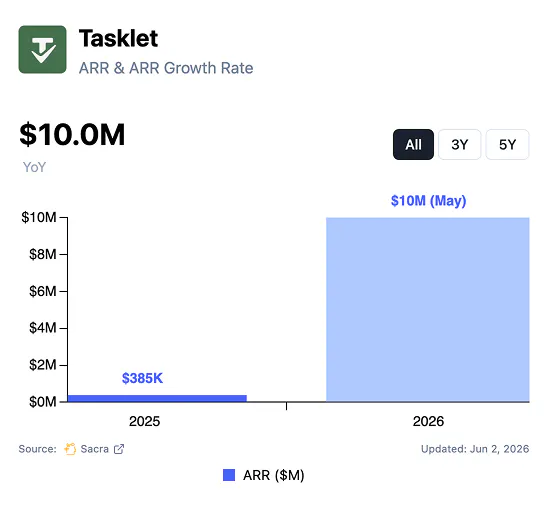
TL;DR: After pivoting away from its email client Shortwave, OpenClaw-inspired cloud agent Tasklet has experienced explosive growth in 2026 with Sacra estimating that it’s grown from sub-$1M ARR to $10M in 5 months. Now, it’s competing to become the agent for all white-collar work against the likes of Claude Cowork and OpenAI Codex. For more, check out our full report and dataset.
We first covered Shortwave pre-pivot to Tasklet in 2022 with our interview of Jacob Wenger, co-founder and Chief Product Officer (now departed and working at Notion as of 2024). We’re following up on Tasklet after their pivot and $20M funding round with Union Square Ventures (April 2026).
Key points via Sacra AI:
- After co-founding Firebase (2011, acquired by Google in 2014), Andrew Lee started the Google Inbox-inspired email client Shortwave (2020) before spinning out its fledgling AI agent feature as Tasklet, an OpenClaw-style personal agent that lives in the cloud, with a chat based frontend that could actually take action in the apps that you use every day. Built for prosumers that want to use OpenClaw but don’t want to self-host it & maintain it, Tasklet offers its cloud service through usage-based subscriptions starting at $25/month (Starter), driving expansion via AI-credit spend as users move from simple if-this-then-that email automations to more complex workflows, with the upside of using the prosumer as a foothold into companies & B2B.
- Producing roughly $0 revenue over its first ~4 years, Shortwave’s growth bumped up to $250K after launching its first agent (Fall 2024) which it then spun out as Tasklet in October 2025, with its growth accelerating dramatically from there and hitting as Sacra-estimated $10M ARR in May 2026, up from $385K at the end of 2025. Compare to AI executive assistant Fyxer AI at $30M annualized revenue in 2025, up 2,900% year-over-year from $1M in 2024, AI-powered agentic workspaces Manus at $127M annualized revenue in 2025 & Genspark at $250M annualized revenue as of March 2026, up from $85M at the end of 2025, AI app builder Replit at $525M in annualized revenue in April 2026, up from $300M at the end of 2025 (+1,775% YoY), and the Grammarly-Superhuman bundle at ~$735M ARR as of June 2025, with Grammarly at $700M ARR and Superhuman’s email client at $35M ARR.
- The market is converging on the idea of an agent for all white-collar work, with foundation model labs building first-party agents like Claude Cowork & OpenAI Codex on top of coding agents, app builders like Replit expanding from text-to-app to more asset types like slides, first-wave agents like Manus & Genspark moving downstream into slides & design from upstream research and no-code productivity stalwarts Zapier & Airtable (via its new product Hyperagent) going agent-first. AI agent upstarts have focused more narrowly on discrete workflows as a wedge, including Fyxer with email triage, Tasklet with app integrations & workflows, and Lindy & Howie with scheduling, where the bet is that habitual use and deepening user context can help them move to adjacent workflows.
For more, check out this other research from our platform:
- Tasklet (dataset)
- Jacob Wenger, CPO at Shortwave, on building a standalone business on email
- Filip Kozera, CEO of Wordware, on the rise of vibe doing
- Ops lead at Scale AI on using Claude Cowork & Codex for QC automation and multi-tool debugging at scale
- Head of Product at SaaS startup on building a personal AI OS with Codex automations and Claude Cowork
- Head of Product Marketing at SaaS startup on automating product marketing with Claude Cowork
- UX lead at real estate firm on running a website redesign with Claude Cowork
- Operations at Whop on using Claude to ship product & automate ops
- Manus (dataset)
- Genspark (dataset)
- Replit (dataset)
- Fyxer AI (dataset)
- Grammarly (dataset)
- Superhuman (dataset)
- Zapier (dataset)
- Airtable (dataset)
- OpenAI (dataset)
- Anthropic (dataset)


