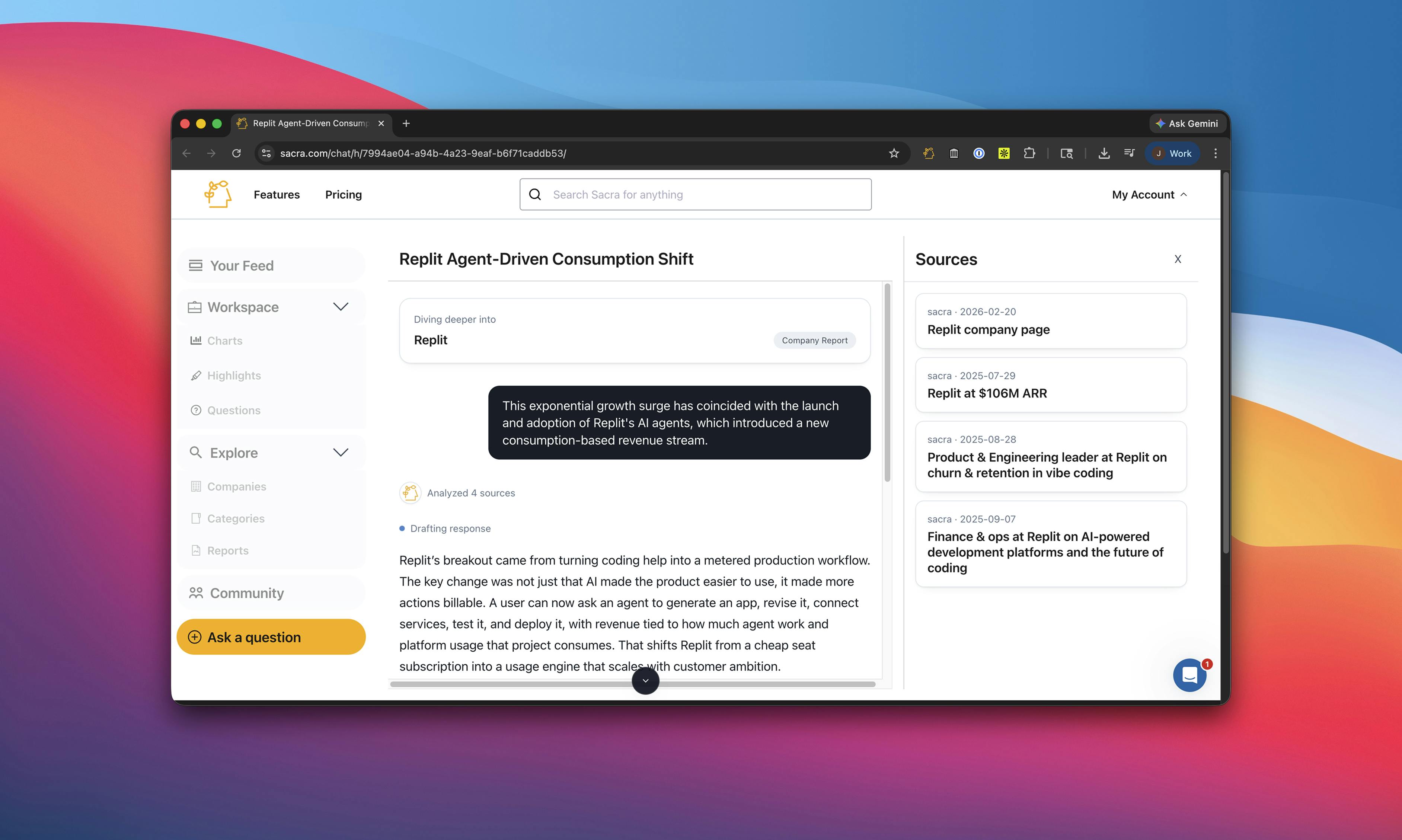
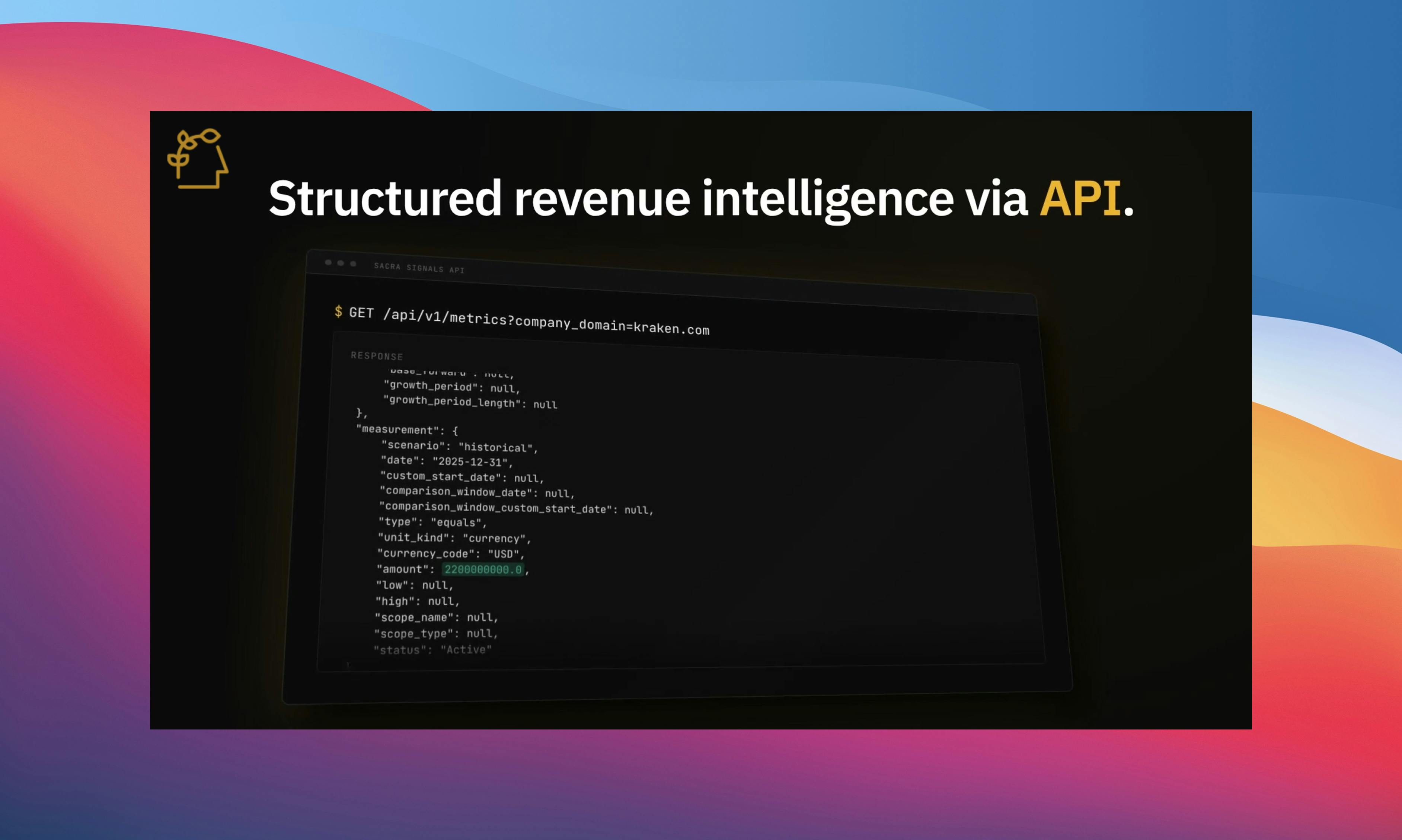
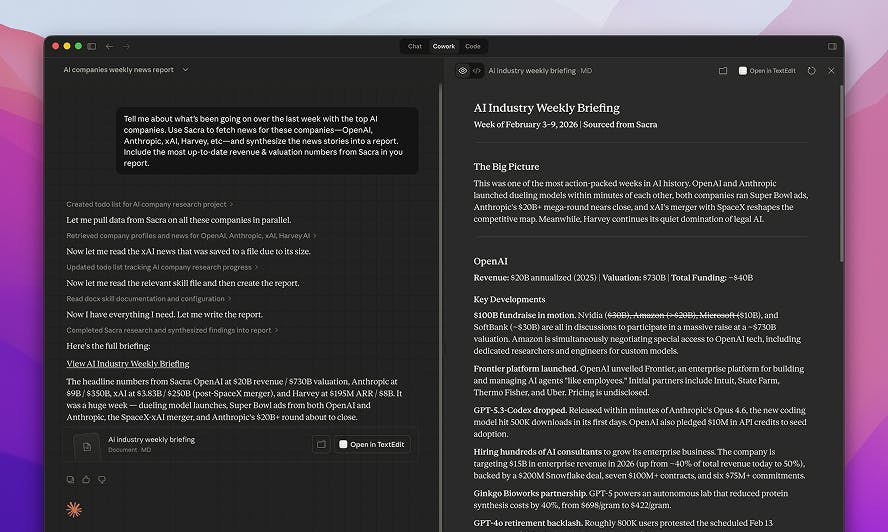
Goodfin (YC W22) is building an AI-native platform for accredited investors to research, evaluate, and invest in private companies. "Think an AI-first UBS for accredited investors, starting with pre-IPO investing as our wedge," says Johnson Yuan, founding software engineer at Goodfin.
Their core product, Goodfin Go, is an agentic AI platform where investors research, evaluate, and invest in private companies through natural conversation.
Behind the scenes, it's a multi-tool agent that pulls from Sacra MCP for company fundamentals, research, and news alongside other data sources to compose grounded answers.
We talked to Johnson about how they built it.
What Goodfin Go does
When a user looks at a deal on Goodfin, they can ask the AI concierge anything about the company. The concierge is an agent that decides which data sources to query based on the question.
"When the user needs information about the company, its funding rounds, recent news, we pull all of that from Sacra," Johnson said.
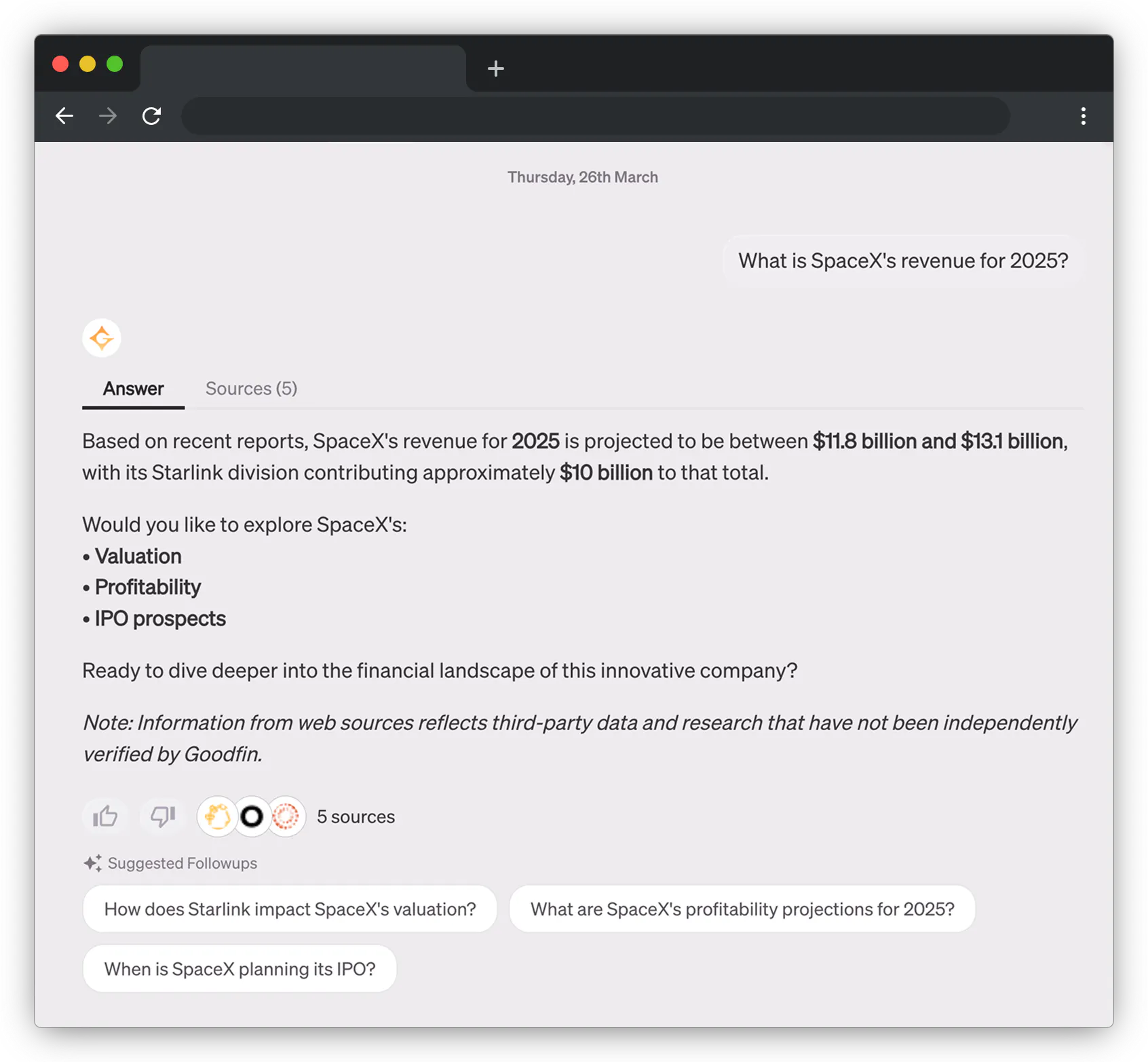
The concierge can pull company profiles covering a company's product, business model, and competitive landscape, funding history broken out round by round, revenue and growth estimates, and recent news, all from a single Sacra MCP connection.
For a pre-IPO investing platform, that covers most of the foundational questions an investor will ask before they go deeper on a deal.
The agent orchestrates across these sources to build a single answer to the user's question. It also incorporates an investor's risk profile and conversation history so responses adapt to each user over time.
On top of the concierge, Goodfin has built two other features that use Sacra MCP:
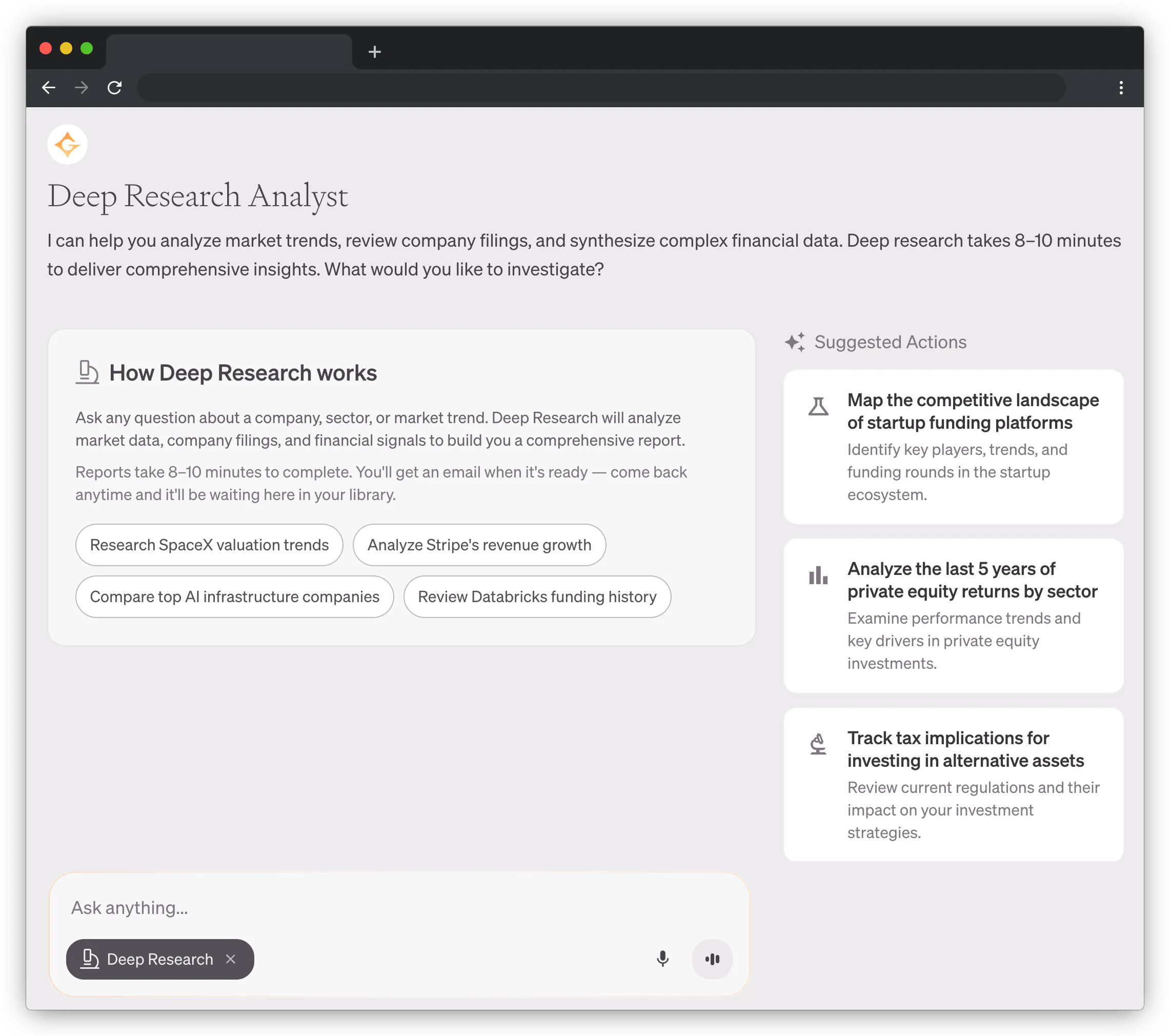
- Deep research. A long-running agent generates multi-section, analyst-style reports. It runs Sacra's search tool in parallel with Caplight and web search, then blends the results into a single research document with a verification step at the end.
- AI news digest. Sacra is one of four news providers feeding into Goodfin's digest system. They batch company news from Sacra alongside those other providers, deduplicate and curate the output, and generate the final text of the newsletter with an LLM.
Why web search breaks for private company data
The core problem Goodfin ran into is the same one that many people building AI agents for research and private markets run into. If you ask an LLM about a private company's funding rounds or revenue, it falls back to web search. And web search for private companies is unreliable.
"A lot of time, the search result doesn't come back very clean. It has a lot of noise, and it isn't always accurate," Johnson says. "The news data, company information, everything might be outdated, not accurate, or the AI might be hallucinating based on the search result."
For a platform where users are making actual investment decisions, that's a higher-stakes version of a problem that plagues most AI research tools. If the agent gives a Goodfin user a wrong number or a hallucinated funding round, it breaks the trust the whole product depends on.
Private company data is also where the information ecosystem is thinnest and where web search is most likely to surface outdated estimates, SEO content with no real data behind it, or nothing at all.
How Sacra MCP fits in
Goodfin defines a set of tools for their Goodfin Go agent, and the agent decides which tools to call based on the user's question. Sacra MCP is one of those tools.
When a user asks about a company, say Anthropic, the agent has a set of queries it can run against that company. The full list of available tools is in the Sacra API documentation, but the core ones Goodfin uses are:
- Get company profile. Returns a full structured breakdown of the company, covering its revenue estimates and breakdown, product and business model, competition, TAM expansion, and risks.
- Get funding rounds. Returns round-by-round funding history with amounts, valuations, dates, and investors.
- Get news. Returns recent news items about the company, sourced from Sacra's deduplicated news pipeline.
- Search. Runs a query across all Sacra documents and returns titles, summaries, and source links for matching research reports, interviews, and datasets.
- Get document contents. Pulls the full text of any Sacra research report, interview, or memo on the company, paragraph by paragraph, so the LLM can reason over the actual content rather than just a summary.
For the live chat concierge, the agent typically calls get-company-profile, get-funding-rounds, and get-news to answer the foundational questions an investor has when they first look at a deal. For the deep research product, it leans more heavily on search to cast a wider net across Sacra's corpus, then uses get-document-contents to pull the full text of the most relevant documents into the report.
"Our deep research system runs Sacra's search tool in parallel with Caplight and web search," Johnson said. "The result we got from Sacra contains the title and the summary of the news source and everything. That helps us compose our research."
On integration, Johnson said the process was straightforward: "We got basically everything we need from the documentation. The integration was actually smooth."
Getting started with Sacra MCP
Sacra MCP is available for all Sacra users. You can connect it to Claude or ChatGPT in a few minutes. If you want to integrate Sacra into your own agent workflows like Goodfin has, the full API and MCP documentation is at docs.sacra.com.
If you're building on top of Sacra data and want to talk about your use case, email us at founders@sacra.com.