

Revenue
$33.00M
2026
Funding
$10.30M
2024
Growth Rate (y/y)
66.1%
2025
Revenue
Sacra estimates Freed hit $33M in annual recurring revenue (ARR) in August 2026, up 22% from $27M at the end of 2025, when it grew 66% year-over-year. Freed’s early growth took it from roughly $1M to $13M ARR in the year ending August 2024.
The company primarily targets the independent practice segment, which represents 47% of US clinicians. Freed built its early business around a $99-per-month subscription and roughly $1K in annual contract value per clinician after discounts. While this "bottom of the market" approach limits revenue per customer, it has enabled faster adoption via its bottom-up, product-led growth (PLG) motion. Freed has been able to undercut enterprise competitors and avoid lengthy enterprise sales cycles.
Free offerings from OpenEvidence and Doximity now put pressure on that positioning, increasing the importance of selling a broader set of clinical and administrative tools. Freed's Front Desk AI receptionist starts at $149 per month per clinic for 250 calls, adding a practice-level subscription that can grow with call volume alongside its per-clinician revenue.
Valuation & Funding
Freed raised a $30M Series A in March 2025 led by Sequoia Capital, with participation from Scale Venture Partners, Daniel Gross, Gokul Rajaram, and Ted Zagat, bringing total funding to approximately $34M.
The financing followed a $4M seed round in November 2023. Early backers included founding investor and board member Yonatan Loewidt and AI Grant, the program founded by Nat Friedman and Daniel Gross, which accepted Freed into its second batch in 2023.
Product
Freed was founded in January 2023 by Erez Druk and Andrey Bannikov, inspired by Druk’s wife Gabi’s experience as a physician spending evenings completing patient notes. Its initial product was an AI medical scribe for independent clinicians and small practices, where documentation often falls directly on the doctor.
For an in-person appointment, the clinician opens Freed’s iPhone or Android app, or uses Freed in a browser or Chrome extension on a computer. They select or enter the patient’s name, start recording, and leave the device nearby to capture both sides of the conversation.
The clinician conducts the visit normally while Freed captures the discussion, with the option to pause and resume if needed.
When the appointment ends, the clinician stops the recording and Freed processes it into a transcript and a structured draft note covering the patient’s symptoms, examination findings, assessment, and treatment plan. Processing can take a few minutes, depending on the visit length and connection.
Notes sync across devices, so a doctor can record on their phone in the exam room and review the draft on their computer afterward, between patients or later in the day.
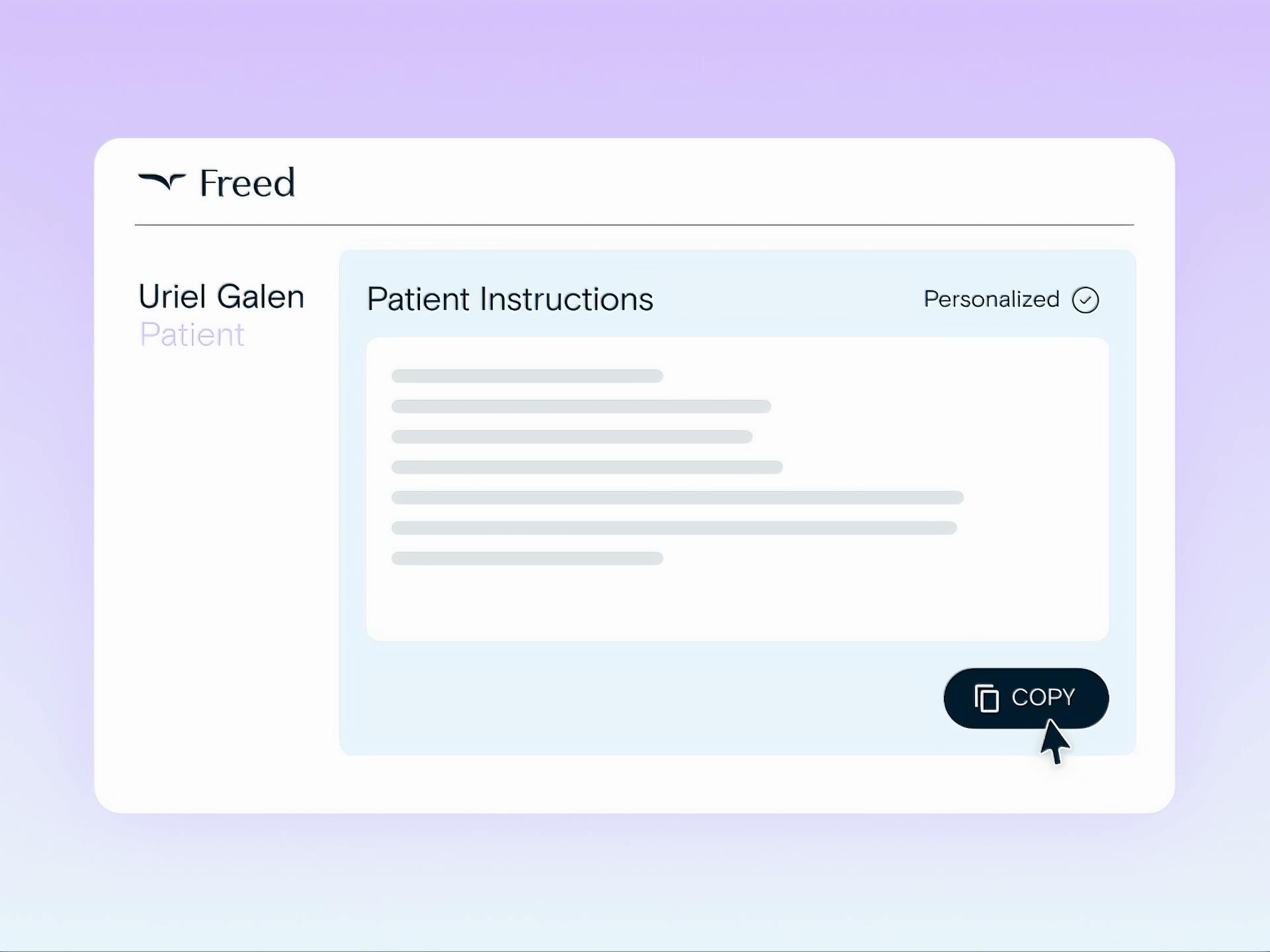
They check its accuracy, edit or add missing details, and then copy the note into the electronic health record (EHR) or use Freed’s Chrome extension to transfer it into a browser-based patient chart. The workflow shifts documentation from writing each note from scratch to reviewing and correcting a prepared draft.
Freed is expanding this documentation workflow into a broader platform for independent clinics. Clinical Evidence lets clinicians ask medical questions within Freed and receive cited answers from more than 50 medical sources.
Coding Assistant helps generate ICD-10 and CPT codes from visit documentation, extending the product from writing notes into preparing the information needed for billing.
Front Desk extends Freed beyond the clinician to the administrative team. Its AI receptionist answers patient calls around the clock, handles routine questions, and routes requests to staff through a shared inbox.
Together, these products broaden Freed’s role from documenting patient visits to supporting clinical research, coding, and patient communication across a small practice.
Business Model
Freed monetizes through tiered per-clinician subscriptions. Starter costs $39 per month for up to 40 notes, Core costs $79 per month for unlimited notes, and Premier costs $119 per month with EHR Push, coding assistance, and additional clinical workflow tools. Premier is also available for $1,248 annually, equivalent to $104 per month.
Group plans add centralized billing, administrative controls, and team features, with pricing generally based on clinician count and custom terms available for larger organizations. Eligible students and trainees can receive 12 months of Core free or up to 50% off monthly Premier subscriptions purchased directly from Freed.
Front Desk adds a practice-level subscription starting at $149 per month for 250 calls. This expands Freed's revenue model beyond clinician seats, with an additional product that can grow with clinic call volume.
Freed's core value proposition is reducing the time clinicians spend documenting visits. It produces a draft note for review after the appointment, with processing that can take a few minutes depending on visit length and connection.
Clinicians can transfer reviewed notes through copy-paste or the Chrome extension's EHR Push feature for supported browser-based EHRs. Group accounts may also have access to deeper direct integrations with selected EHRs.
Their focus on smaller practices and standalone functionality provides a clear differentiation from enterprise-focused competitors like Abridge, which are increasingly tied to major EHR vendors through equity and revenue-sharing agreements.
Freed includes a business associate agreement at signup and offers an organization-wide agreement for groups. Scaling into larger practices still requires meeting broader administrative, integration, and procurement requirements, even when adoption starts with an individual clinician.
Competition
Heidi Health is a direct competitor to Freed, with both using AI documentation to win adoption from individual clinicians. Freed built its early business around a $99-per-month scribe for independent practitioners, where the doctor is often both user and buyer. Heidi uses a free tier with unlimited transcription and standard note generation to encourage adoption, then sells paid clinician, practice, and enterprise plans.
Both are expanding beyond the note. Freed has added Clinical Evidence, Coding Assistant, and Front Desk to serve more of the clinical and administrative work inside small practices. Heidi is building an “AI care partner,” adding Evidence for clinical research and Comms for patient calls and follow-ups, alongside coding and other workflow tools. Their products increasingly overlap, but Heidi combines self-serve adoption with sales to hospitals and health systems, while Freed’s positioning centers on independent clinics.
Enterprise clinical platforms
Abridge, Ambience, and Microsoft’s Dragon Copilot target large health systems with EHR integrations and organization-wide deployments. Their value extends beyond saving doctors time to improving documentation, supporting coding, and fitting into established clinical workflows.
Abridge reached $100M ARR as of May 2025 and a $5.3B valuation in June 2025, while Ambience reached $30M ARR as of May 2025 and a $1B valuation in July 2025. Both are expanding into revenue-cycle workflows, where better documentation can support more complete billing and reduce downstream work. These deployments involve clinical, IT, and finance stakeholders, compared with Freed’s simpler purchase process for smaller practices.
Free & bundled alternatives
OpenEvidence combines medical search with its Visits documentation product, while Doximity offers a free scribe alongside clinical Q&A and patient calling. Both can introduce documentation tools to clinicians already using their platforms, reducing the need to adopt and pay for a separate application.
Epic approaches the same use case from inside the patient record. Its native AI Charting gives health systems an alternative to bringing in another vendor. These offerings put pressure on standalone scribes, particularly those relying on individual clinicians to discover, adopt, and pay for the product themselves.
TAM Expansion
Freed’s expansion opportunity is to turn its foothold with independent clinicians into a broader software business serving small practices. Its move into medical search, coding assistance, and reception creates opportunities to increase spending per customer and reach additional buyers within each clinic.
Clinical workflow automation
Freed is expanding from documenting visits into the work surrounding them. Clinical Evidence supports medical research, while Coding Assistant helps prepare billing information from visit documentation. These additions give Freed more ways to deliver value within the clinician’s existing workflow as standalone note generation faces pricing pressure.
Further expansion could come from connecting visit preparation, documentation, coding, referral letters, and patient follow-up into a more complete workflow. The revenue opportunity depends on how much administrative work Freed can take on and whether the combined product supports higher-value subscriptions.
Specialty-specific solutions
Freed has demonstrated strong product-market fit with independent practitioners, who represent 47% of U.S. clinicians.
This creates an opportunity to develop deeper, specialty-specific solutions. For example, mental health providers have unique documentation requirements and typically operate in small practices - an ideal fit for Freed's lightweight, affordable approach. Similarly, dental practices represent another fragmented market with specialized documentation needs.
By tailoring their AI capabilities to specific verticals, Freed could command higher prices while facing less competition from enterprise-focused players like Nuance/Microsoft.
Building a platform
Freed can expand from selling to individual clinicians into selling to the whole practice. Front Desk introduces a buyer and budget beyond the doctor: the practice owner or manager responsible for staffing and patient communication. Its practice-level subscription can grow with call volume alongside Freed’s per-clinician revenue.
This gives Freed access to administrative spending beyond documentation and another way to acquire customers. A clinic could adopt Front Desk even if its clinicians use another scribe, creating opportunities to cross-sell additional products.
Risks
EHR Integration Bottleneck: Freed supports copy-paste, browser-based EHR Push, and selected direct integrations for group accounts, but maintaining reliable integrations across the long tail of EHRs remains a challenge. Differences in data structures and workflows can complicate larger deployments.
Competitors like Abridge have had to make significant concessions (equity and revenue share) to secure Epic integration. As a lean team targeting independent practices, Freed may struggle to build and maintain integrations across the long tail of EHR vendors their customers use, potentially limiting expansion.
Practice Consolidation Headwinds: Freed's focus on independent practices and small clinics with self-serve pricing and relatively light setup requirements targets a shrinking market. Industry consolidation continues to accelerate - small practices are being absorbed into larger health systems with enterprise-wide technology decisions.
This could squeeze Freed's target market over time and force them to compete more directly with enterprise-focused players like Nuance and Abridge who have deeper relationships with major health systems.
Feature Commoditization Risk: Free scribes from OpenEvidence and Doximity already put pressure on paid standalone documentation, while Epic offers native AI Charting. As note generation becomes more widely available, Freed must give clinicians reasons to keep paying beyond simplicity and affordability.
Freed has expanded into medical search, coding assistance, and reception. The risk is whether these products drive adoption, retention, and incremental revenue sufficient to offset pricing pressure on the scribe, while adding development and support costs.
DISCLAIMERS
This report is for information purposes only and is not to be used or considered as an offer or the solicitation of an offer to sell or to buy or subscribe for securities or other financial instruments. Nothing in this report constitutes investment, legal, accounting or tax advice or a representation that any investment or strategy is suitable or appropriate to your individual circumstances or otherwise constitutes a personal trade recommendation to you.
This research report has been prepared solely by Sacra and should not be considered a product of any person or entity that makes such report available, if any.
Information and opinions presented in the sections of the report were obtained or derived from sources Sacra believes are reliable, but Sacra makes no representation as to their accuracy or completeness. Past performance should not be taken as an indication or guarantee of future performance, and no representation or warranty, express or implied, is made regarding future performance. Information, opinions and estimates contained in this report reflect a determination at its original date of publication by Sacra and are subject to change without notice.
Sacra accepts no liability for loss arising from the use of the material presented in this report, except that this exclusion of liability does not apply to the extent that liability arises under specific statutes or regulations applicable to Sacra. Sacra may have issued, and may in the future issue, other reports that are inconsistent with, and reach different conclusions from, the information presented in this report. Those reports reflect different assumptions, views and analytical methods of the analysts who prepared them and Sacra is under no obligation to ensure that such other reports are brought to the attention of any recipient of this report.
All rights reserved. All material presented in this report, unless specifically indicated otherwise is under copyright to Sacra. Sacra reserves any and all intellectual property rights in the report. All trademarks, service marks and logos used in this report are trademarks or service marks or registered trademarks or service marks of Sacra. Any modification, copying, displaying, distributing, transmitting, publishing, licensing, creating derivative works from, or selling any report is strictly prohibited. None of the material, nor its content, nor any copy of it, may be altered in any way, transmitted to, copied or distributed to any other party, without the prior express written permission of Sacra. Any unauthorized duplication, redistribution or disclosure of this report will result in prosecution.